
Round-the-World Packing List: Backpacking with 8 kg
Round-the-World Packing List: Backpacking with 8 kg
Short answer: for a long trip, a 40-litre backpack and around eight kilograms of luggage are enough. My round-the-world packing list starts with three shirts, two pairs of shorts and one pair of long trousers, a light rain jacket, a warm layer, five pairs of socks, five pairs of underwear, swim shorts, flip-flops and light hiking shoes. Add a small first-aid kit, two credit cards, copies of your documents and only the tech you really use. After 82 countries my most important rule is simple: pack half, then take things out again without mercy.
Packing list for a world trip and backpacking: the ground rules
A good backpacking packing list is not a collection for every conceivable emergency. It is a system you can carry, organise and use again and again on the road. On my six-month trip through South America I travelled with a 40-litre backpack. After more than 15,000 kilometres on buses, many hostels and temperatures between 0 degrees in the Andes and 40 degrees in the Amazon, one thing was clear: less luggage means more freedom of movement.
So my most important advice is this: at first, pack only half of what you think you need. Then check every item again and cut further. On that trip I bought three T-shirts, a pair of sunglasses and a charging cable along the way without any trouble. An overloaded backpack, on the other hand, weighs on you at every transfer, on stairs and on cobblestones.
I also separate a light base for travellers from my extra gear as a content creator. Camera, drone and laptop are work tools and not a must for your world trip packing list. According to my breakdown, my creator setup came to about 8,230 grams. Without the Sony camera and the drone it was around 6,430 grams. So you do not need to buy professional equipment to travel light and sensibly.
- Start with the backpack volume and a weight target, not with a long shopping list.
- Pack clothes that cover several temperature ranges and are quickly ready to wear again.
- Take a backup for important functions, not a spare for every single item.
- Keep essential documents, money and medication separate from comfort items.
- Test the fully packed backpack before you leave, walking and on stairs.
You will find my detailed starting list with the tried and tested 40-litre setup in the South America packing list for backpacking. For a round-the-world trip it serves as a lean base. Climate, planned activities and personal medication are things you then decide to suit your route.
Backpack and packing cubes
For my six months in South America, 40 litres were enough. I used the Osprey Farpoint 40. In my weight breakdown the backpack is listed at 1,500 grams. A backpack was more practical than a hard-shell suitcase on sand, stairs, cobblestones and when boarding buses. That is the experience behind my recommendation, not a general luggage rule for every type of trip.
Packing cubes give every item a fixed place. I keep one section for tops, one for trousers and one for underwear. That way I do not have to empty the whole bag. Compression cubes can also reduce the volume; with my Peak Design Packing Cubes it is 30 percent. I use waterproof bags for camera, drone and batteries. After a downpour in Colombia the electronics inside stayed dry.
This order saves time above all when you move on frequently: take out the cube, grab the item you need and pack it away again. Even so, I do not treat the free space as an invitation to bring more things. Packing cubes compress volume, but not weight. That is why I check the finished setup as a whole and not just by whether the zip still closes.
Valuables do not belong loose in the main compartment. On my South America trip I carried passport, cards and cash in a waterproof bum bag on my body. I had digital copies of my passport, vaccination record, insurance certificate, card numbers and booking confirmations in the cloud, plus a printout in the backpack. This small document routine weighs little and creates a real backup.
Clothing in layers
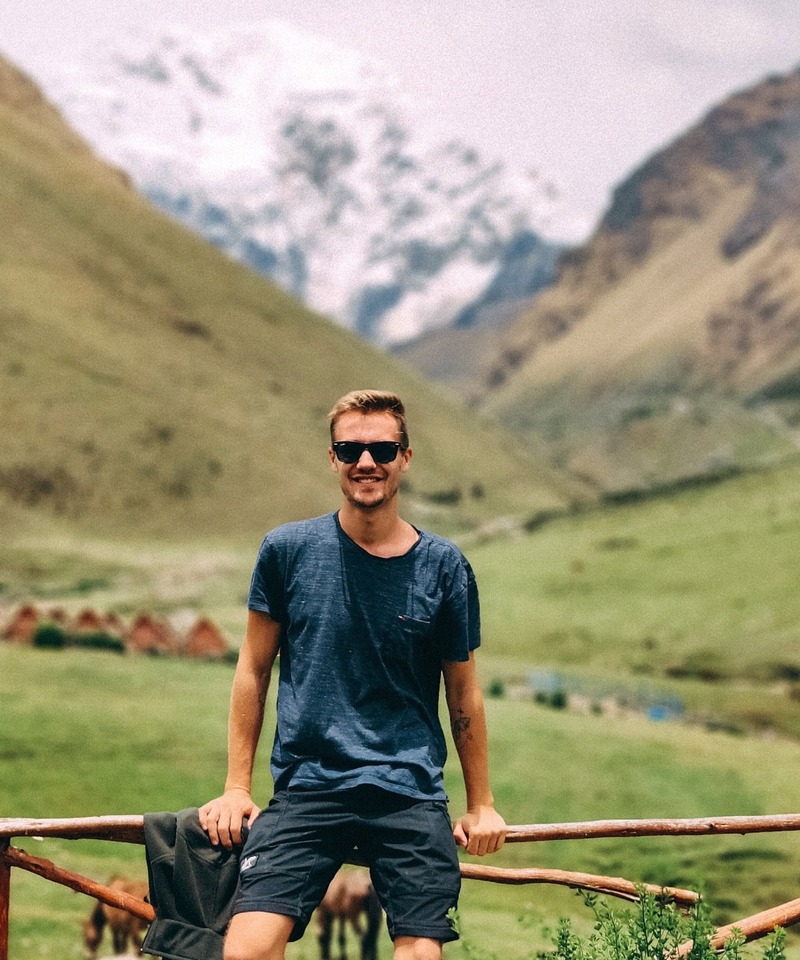
My documented clothing list for six months consisted of three T-shirts, two of them merino wool and one synthetic, two pairs of shorts and one pair of light long trekking trousers that zipped off into three-quarter length. On top of that came a packable rain jacket, a fleece or down jacket, five pairs of socks, five pairs of underwear, swim shorts, flip-flops and a pair of light ankle-high hiking shoes.
The layering principle covered very different conditions. The light rain jacket was the weather protection, fleece or down the warm layer. My Uniqlo Ultralight Down weighed 200 grams, packed down to about the size of a fist and kept me warm down to 0 degrees. The long trekking trousers were just as useful in the Andes as for temple visits or a nicer restaurant. I split the shorts into everyday wear and hiking with zip pockets.
Merino shirts dried quickly for me, picked up little smell even after several days and regulated temperature better than cotton. Five pairs of socks and five pairs of underwear matched my washing rhythm of three to four days. I did not miss having more clothes in six months. This specific selection is tried and tested, but it is no reason to pack clothes for a climate that does not occur on your route at all.
For footwear I stuck to light hiking shoes and flip-flops. The hiking shoes served for trails and city walks, the flip-flops for showers and the beach. Heavy mountain boots and a third pair would have added weight. If your trip includes other activities, review this decision; for the backpacking setup described here, two pairs were enough.
Tech for a round-the-world trip
The smartphone was my most important tool: navigation with offline maps, translation, ride-hailing, hostel bookings, banking and communication all ran through it. Before the trip I download offline maps for the countries. For ordinary travellers the smartphone can also replace the big camera. My professional camera setup is work equipment and should not end up on every world trip packing list without a second thought.
The Anker 737 power bank with 24,000 mAh powered my smartphone, laptop, camera and drone. In the gadget list it is given as 640 grams; the South America table says 630 grams. An Anker Nano II 65W replaced three separate chargers and saved me 200 grams. The UGREEN 4-in-1 USB-C hub combines USB-C, HDMI, SD card reader and USB-A at 50 grams. I take these items because I edit files on the road.
For long journeys I use a Kindle. It weighs 180 grams, whereas in my South America experience a single book weighed about 300 grams. A 30-gram headlamp helped in hostel rooms, on hikes, on night buses and during power cuts. My camera gear always goes in hand luggage; I carry batteries there too.
When it comes to charging I cut down not only on devices but also on duplicate cables and chargers. One powerful charger supplies several parts of my setup. Still, the selection remains personal: if you neither transfer photos nor work on a laptop while travelling, you do not need my hub or my computer. This honest check of what you actually use is what keeps the tech packing list small.
I keep AirTags in my backpack, suitcase, camera bag and drone case. Two memory cards instead of just one give me a backup for photo and video work. I describe more tried and tested helpers, including packing cubes, dry bags and charging accessories, in the best travel gadgets from 82 countries. What matters is this: tech only comes along if it has a clear job on your trip.
Health and travel first-aid kit
My compact first-aid kit for South America weighed 400 grams. It contained ibuprofen 400 mg, Imodium or loperamide, electrolytes, sunscreen with SPF 50+, mosquito repellent with 50 percent DEET, plasters and blister plasters. In my smaller gadget version I added disinfectant spray, sterile wound dressings and tape; that set fitted in a zip bag and weighed 200 grams.
Which medication is right for you is something to clarify with a doctor. I carried a broad-spectrum antibiotic as a backup after consulting my GP and used it once in Peru. That is not a recommendation to self-medicate. Personal medication and advice on destination, health and use belong on your own checklist before departure.
Electrolytes mattered to me for stomach problems, blister plasters for many kilometres on foot. High sun protection was a must because of the strong UV radiation in the Andes, DEET because of mosquitoes in Amazon and coastal regions. Not every destination has the same conditions. So adjust quantities and contents to your route and medical advice instead of blindly copying my South America kit.
Money and paying
I travelled with two credit cards from different banks, one Visa and one Mastercard. If one fails, gets blocked or is swallowed by a machine, the second remains usable. On my South America trip these were DKB Visa and Wise Debit. I also carried 100 to 200 US dollars as an emergency reserve, separate from my normal wallet.
Cash was important in Colombia, Peru and Bolivia for small restaurants, markets and colectivos. My overview of backpacking costs in Brazil also helps to plan spending realistically before a leg of the trip. For the packing list, what counts is not a particular travel budget but the backup principle: two cards, stored separately, a small emergency reserve and secured card details.
Packing list for Southeast Asia and Asia: what changes
The documented Asia element of my packing list comes from five weeks in the Philippines in December 2024. There I travelled via Cebu, Bohol and Palawan. Hand luggage was usually enough for domestic flights; with Cebu Pacific, seven kilograms was the relevant limit. Cash was important for small shops and street stalls, while ATMs were available in larger towns and could be scarce on smaller islands. So I kept cash for two to three days at hand.
In the Philippines I did not drink tap water. Because medical care varies widely by region and transfers between islands may be needed, travel health insurance was part of the plan for me. The mobile network worked reliably in towns but was patchy on islands. My specific stops and practical tips are in the Philippines travel report with route and costs.
General note: “Asia” and “Southeast Asia” cover very different climate zones, traffic rules and entry requirements. Check each country's official requirements shortly before departure and adapt clothing, health protection and luggage limit to your actual route. Beyond the Philippines, I do not derive any blanket special equipment from the sources used here.
What stays at home
Jeans stayed at home in my setup: they are heavy, dry slowly and were impractical in the heat. I did not need a sleeping bag in hostels because bed linen was provided; for organised treks it was included or could be rented. That applies to my documented travel conditions, not automatically to a camping trip.
I also cut an XXL travel towel and travel detergent. A small microfibre towel was enough for beach days, while hostels provided or lent towels. Laundries took care of the washing. The lighter Kindle replaced paper books. I took nothing beyond hiking shoes and flip-flops.
- Jeans, because light trekking trousers dried faster and weighed less.
- Sleeping bag, as long as hostel stays and organised treks were planned.
- XXL towel; a small microfibre towel covered my needs.
- Travel detergent, because I used laundries on the documented route.
- Paper books, because the Kindle offered several titles at less weight.
- A third pair of shoes and heavy mountain boots for my travel profile at the time.
The packing list as a table
The following figures come from my published packing list for six months in South America. They are not a new shopping recommendation; they show how much creator tech changes weight and cost. I give prices and totals exactly as documented there.
| Object | Weight | Cost |
|---|---|---|
| Osprey Farpoint 40 | 1,500 g | 160 € |
| 3 Merino T-shirts | 450 g | 150 € |
| Rain jacket and fleece | 550 g | 120 € |
| Hiking shoes by Columbia | 800 g | 100 € |
| Anker 737 power bank with 24,000 mAh | 630 g | Price not documented |
| DJI Mini 5 Pro as Fly More Combo | 450 g | 1.100 € |
| Sony A7V and Tamron 28–200 mm | 1,350 g | 4.350 € |
| DJI Action 6 Pro and mounts | 300 g | 450 € |
| complete travel pharmacy | 400 g | 50 € |
| remaining clothing | 1,800 g | 100 € |
| Total with creator kit | about 8,230 g | about 6,580 € (excluding the price of the power bank) |
| Total without Sony and drone | about 6,430 g | about 1,130 € (excluding the price of the power bank) |
The table also shows why you should look at work gear separately. Camera and drone are by far the largest cost block. If you do not produce professionally, you can travel with a smartphone and light charging gear. The target of around eight kilograms is then achievable without buying a long list of special products.
Travel insurance
For me, travel health insurance is part of the preparation alongside document copies and means of payment. In Colombia, two nights in hospital because of food poisoning cost 1,800 euros; the refund came within three weeks. For longer trips I pay particular attention to trip duration, sum insured, exclusions for planned activities and the wording on repatriation.
For repatriation, “medically sensible” is broader than “medically necessary”. I also store the insurance certificate, policy number, emergency contact and receipts digitally. I photograph invoices straight away. You will find my experience, criteria and the differences between short-term and long-term plans in the article on the best travel health insurance for long-term travel.
FAQ: frequently asked questions
How big should a backpack be for a round-the-world trip?
For my six-month trip, 40 litres were enough. What matters is not only the volume but the total weight. Without the Sony camera and the drone, my documented gear came to around 6,430 grams. Camping gear or professional equipment change what you need.
How heavy should a backpacking packing list be?
I aim for around eight kilograms and travelled with my full creator kit at about 8,230 grams. My measured backpack weight was 7.8 kilograms without water and tech, and 10.2 kilograms with everything. Less weight made bus changes, stairs and long walks more pleasant.
What clothes do I need for a long trip?
My base was three T-shirts, two pairs of shorts, one pair of light long trekking trousers, a rain jacket, a warm layer, five pairs of socks, five pairs of underwear, swim shorts, flip-flops and light hiking shoes. Adapt this list to the climate and activities on your route.
Do I need a sleeping bag on a round-the-world trip?
Not for my hostel trips. Bed linen was provided there, and on organised treks a sleeping bag was included or could be rented. If you camp on your own, this experience does not carry over; in that case sleeping gear belongs in your own planning.
What belongs in a small travel first-aid kit?
I carried ibuprofen, medication for diarrhoea, electrolytes, sunscreen with SPF 50+, mosquito repellent, plasters and blister plasters. Disinfectant spray, sterile wound dressings and tape completed my small set. Clarify personal medication and how to use it with a doctor beforehand.
What do I change on the packing list for Southeast Asia?
For the Philippines, the key points were seven kilograms of hand luggage on domestic flights, cash for two to three days, no tap water and travel health insurance. For other countries in Southeast Asia, check luggage rules, health information and conditions separately.
Do I need a camera and laptop on a round-the-world trip?
No. For me they are work tools as a content creator. For many travellers the smartphone handles navigation, booking, communication and photos. Only take a laptop, big camera or drone if the specific use justifies the weight.
 German
 English
 French
 Spanish
 Italian
 Japanese
 Chinese
 Dutch
 Portuguese