
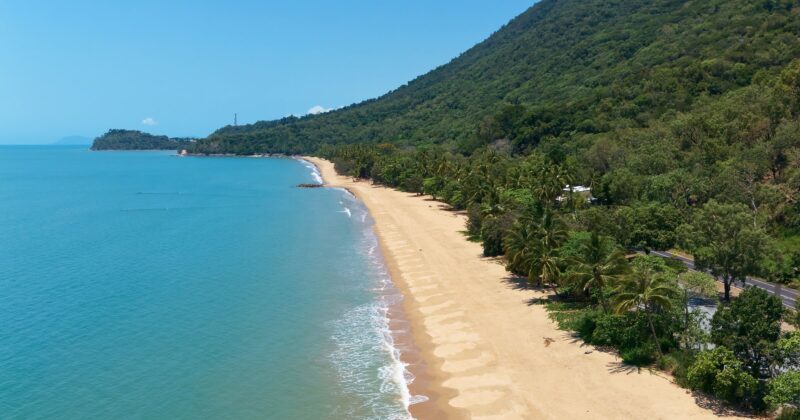
Australia East Coast Route 2026: Cairns to Brisbane Guide
My Australia East Coast Travelogue – from Cairns to Brisbane along one of the world's most iconic coastal routes. In November and December 2025, I spent several weeks traveling the Australian East Coast I traveled to a country that, even after visiting over 82 countries, still manages to leave me speechless. In this guide, I share my route, the absolute Highlights, honest Cost, the best drone spots and practical tips.
The East coast of Australia - from Cairns in the tropical north until Brisbane In the south – this is the classic backpacker route and at the same time one of the most diverse travel experiences imaginable: tropical rainforest meets the Great Barrier Reef, endless sandy beaches alternate with vibrant cities, and the wildlife is more unique than on any other continent.
- Route & Duration: Cairns to Brisbane is about 1,700 km of coastal road — plan at least 2 to 3 weeks so that Great Barrier Reef, Whitsundays, Fraser Island and Noosa don't become a mere transit route.
- Highlights in this order: Snorkeling at the Outer Reef from Cairns, sailing trip to Whitehaven Beach from Airlie Beach, 4WD trip via K'gari (Fraser Island) and surf lesson including Coastal Walk in Noosa National Park.
- Best time to travel: April to October — dry season in the tropical north, less risk of stinger attacks in the ocean and stable visibility at the reef. November to March brings monsoon, cyclones, and often closed beaches.
- Transport: Campervan (from about 40 AUD/day outside of school holidays) is significantly better than Greyhound because you can freely choose stops like Cape Hillsborough or Agnes Water and save on overnight costs.
- Budget framework: €1,200 to €1,800 for backpackers with hostel & bus, €2,800 to €4,000 for campervan couples with reef tour and Whitsundays sailing trip, €6,000+ for comfort with eco-lodges and helicopter flight over the heart of the reef.
Australia East Coast Route – From Cairns to Brisbane
| stage | Highlights | Recommended days |
|---|---|---|
| Cairns & surrounding area | Great Barrier Reef, Daintree Rainforest, Kuranda, Port Douglas | 4-5 |
| Townsville → Airlie Beach | Magnetic Island, Whitsunday Islands, Whitehaven Beach, Hill Inlet | 3-4 |
| Noosa & Sunshine Coast | Noosa National Park, Australia Zoo, Glass House Mountains | 2-3 |
| Brisbane | South Bank, Story Bridge, Lone Pine Koala Sanctuary, North Stradbroke | 2-3 |
Total distance: ~1,700 km | Recommended duration: 2-3 weeks | Transport: Campervan, Greyhound or domestic flights


Cairns & the Great Barrier Reef – Tropical Paradise
Cairns It's the gateway to Australia's tropical north and the perfect starting point for the East Coast route. The city itself is relaxed and manageable – there's a pleasant esplanade with an artificial lagoon (swimming is only possible here during stinger season), but the real highlights lie in the surrounding area. Great Barrier Reef – the world's largest coral reef, visible from space – is only an hour away by boat.
A snorkeling or diving trip to the reef is a must (from AUD 80 for basic day trips, AUD 200+ for premium boats with fewer people). The underwater colors—neon-bright corals, turtles, clownfish, rays—are surreal. My tip: Opt for the Outer Reef. The inner reef zones are more damaged by bleaching and boat traffic; you'll see the difference immediately at the outer edge. Operators like Silverswift or Passions of Paradise go there.
The Daintree Rainforest North of Cairns lies the oldest rainforest in the world (over 180 million years old!), offering hikes through vegetation that has existed since the time of the dinosaurs. Cape Tribulation is the point where rainforest meets reef – one of the few places in the world where two UNESCO World Heritage sites directly meet.
Don't miss: The trip to Kuranda – a small village above Cairns in the rainforest. The journey on the historic Kuranda Scenic Railway through the Barron Gorge National Park And the return journey on the Skyrail cable car over the rainforest canopy is one of Australia's most beautiful day trips. Cost: approximately AUD 135 for the round-trip combination. Plan a full day for it – the views from the Skyrail are priceless.
Those who prefer a quieter atmosphere than Cairns can drive an hour north to Port Douglas. The small coastal town is Cairns' more elegant cousin – offering the same access to the Reef and Daintree, but significantly more relaxed, with a nicer beach (Four Mile Beach) and better restaurants. Many Australian families spend their holidays here. For couples and anyone wanting to avoid the backpacker crowds of Cairns, Port Douglas is a better base.
Townsville, Airlie Beach & the Whitsundays
The Whitehaven Beach on the Whitsunday Islands It's considered one of the most beautiful beaches in the world – and after my visit, I wholeheartedly agree. Seven kilometers of dazzling white quartz sand (98.9% pure silicate – so pure that NASA used sand from here for the Hubble telescope lens), turquoise water, not a single building on the beach. Accessible by boat trip from Airlie Beach, the gateway to the Whitsundays (from 150 AUD day tour incl. snorkeling).
An absolute must-do: The Hill Inlet Lookout Above Whitehaven Beach. From up here, you can see the pattern of white sand and turquoise water that looks like a painting – one of the most photographed scenes in Australia. Day trips usually combine both: Whitehaven Beach in the morning, the lookout in the afternoon. Alternatively, choose Hamilton Island as your base and travel from there by smaller boat.
A stopover in [location] is worthwhile on the way there. TownsvilleThe often overlooked coastal city is the starting point for Magnetic Island – one of the few islands in Australia where you can see wild koalas in their natural habitat. The waters around the island are incredibly clear, and Forts Walk offers spectacular views of the Coral Coast. Plan at least two days to explore the island at your leisure – scooter rentals cost AUD 50/day and are the best way to reach the secluded beaches.
Airlie Beach The town itself is a vibrant backpacker destination with a relaxed beachfront promenade, an artificial lagoon (ideal during stinger season), and a lively nightlife. It's perfect for a relaxing day between boat trips to the Whitsundays. For a quieter experience, head 30 minutes north to Cape Gloucester – from here you can take catamarans to the more remote Whitsunday islands, avoiding the crowds.

Noosa & Sunshine Coast – Pure relaxation
Noosa For me, it's one of the most relaxed spots on the entire East Coast. Noosa National Park It's an absolute highlight: coastal walks with ocean views, koalas in the eucalyptus trees above, and on some days even dolphins right off the coast. The Coastal Walk from Noosa Main Beach to Hell's Gates takes about 2-3 hours and offers different postcard-perfect views at every point. The Main Beach Promenade, with its relaxed cafes and surf shops, is the perfect place to arrive and stay.
Noosa is the perfect place for those wanting to learn to surf: Gentle, long waves at First Point make it one of the best beginner surf spots in Australia. A two-hour beginner lesson costs around AUD 65 and includes a board and wetsuit.
A little further south lies the famous Australia Zoo by Steve Irwin – one of the best zoos in the world and absolutely worth seeing if you want to experience Australia's unique wildlife up close (entrance fee: approx. AUD 65, plan for half a day to a full day). Glass House Mountains Nearby, spectacular hikes and drone spots offer views of the distinctive volcanic cones – my personal favorite for sunrise photography along the entire east coast. The Mount Ngungun Trail is short (1 hour round trip) and delivers one of the best panoramas in Queensland.
Mooloolaba and Caloundra are also worth seeing: less touristy than Noosa, but with wide beaches and a genuine Australian suburban atmosphere. Those traveling with children will find the Sea Life Sunshine Coast Aquarium a welcome change of pace from the beach.
Brisbane – Urban endpoint of the east coast
Brisbane is the perfect end to this East Coast route – a modern metropolis that feels more relaxed and sunnier than many other Australian cities. South Bank With its artificial beach (Streets Beach) right in the city center, it's one of Australia's coolest urban spots – free, clean, and with a direct view of the skyline. Story Bridge It shapes the cityscape and can be climbed for an iconic panorama (from 129 AUD).
Must-do in Brisbane: Lone Pine Koala Sanctuary – the oldest and largest koala sanctuary in the world. Here you can (legally in Queensland) hold a koala and sit next to kangaroos in the meadow. An experience that is no longer possible in many other Australian states. Entrance fee: approx. AUD 49, allow 3-4 hours.
If you still have time: North Stradbroke Island (known locally simply as "Straddie") is worth a day trip – a 30-minute ferry ride from Brisbane, with white beaches, Point Lookout offering whale watching between June and October, and manta rays visible from the shore. A clearly underrated spot that most tourists miss.


The best drone spots along Australia's east coast
As a drone pilot, I was particularly impressed by the East Coast. The combination of tropical rainforest, coral reef, endless beaches, and volcanic landscape provides drone footage that is truly unique. My personal top spots:
- Whitehaven Beach & Hill Inlet: This is an absolute must-see spot. The white sandbanks in the turquoise water create patterns that look surreal from the air. Important: Parts of the Whitsundays are a national park – drones are only allowed to fly outside the park boundaries (usually permitted on the beach itself, but not over hiking trails).
- Glass House Mountains (Sunshine Coast): The iconic volcanic cones bathed in morning light are one of Australia's best sunrise spots. The best vantage point is from the Mount Ngungun Trail.
- Cape Tribulation & Daintree Coast: Where rainforest meets beach – shots you'll only find here. No flying over the national park, but permitted along the beach between the river mouths.
- Kangaroo Point Cliffs (Brisbane): Skyline panorama at sunset. One of the few urban drone spots in Australia with legal access.
- Noosa National Park Coastal Walk: The rocky coastline with the dramatic waves at Hell's Gate is visually unique.
Best time to travel to Australia's East Coast
The best time to travel For Australia's east coast, it largely depends on how far north you want to go. The tropical north (Cairns, Port Douglas) has a rainy season from November to April – during this time it's hot, humid, and some roads are flooded. The south (Brisbane, Noosa) is pleasantly warm year-round, making the route feasible even in the off-season.
Ideal for the entire East Coast:
- September – November (Spring): Perfect temperatures along the entire coast, little rain, and no stinger season in the north. My clear recommendation, and the time I traveled myself. Booking 2-3 months in advance is recommended.
- March – May (Autumn): Also very pleasant: fewer tourists, slightly warmer water. The tail end of the Stinger season can extend into April, but flights are cheaper.
- December – February: High summer and school holidays. In the north, it's stinger season (jellyfish) – swimming is only permitted with a protective suit or stinger nets. Meanwhile, it's peak surfing season in the south. The most expensive time for accommodation.
- June – August: Dry winter season. Pleasantly warm in the north (25°C), but cool at night in the south (10-15°C). Best time for reef diving, as the water is clearest and whale sightings begin between June and October.
Australia Costs – What you really need to budget for
Australia is expensive – that's no surprise. But with the right strategies, it's significantly cheaper than its reputation suggests. International flights cost between €1,000 and €1,600 (round trip Germany to Australia; cheaper options include Asian stopovers with Scoot, AirAsia, or Singapore Airlines). Once there, the price depends primarily on your choice of transport and accommodation.
| Position | budget | comfort |
|---|---|---|
| Accommodation/night | 25-40 AUD (Hostel) | 120-250 AUD (Hotel) |
| Food/day | 20-35 AUD | 50-80 AUD |
| Campervan/day | 60-120 AUD | |
| Greyhound Bus (Cairns→Brisbane) | ~250 AUD (Hop-on/Hop-off pass) | |
| Reef Day Trip | 80-120 AUD | 200-280 AUD |
| Whitsundays day tour | 150-220 AUD | |
| 2-3 weeks total (per person, excluding flight) | ~2,000 AUD (~1,200 €) | ~5,000 AUD (~3,000 €) |
Money-saving tips: Cooking your own meals at the hostel saves 20-30 AUD per day. Supermarkets like Coles and Woolworths have "Reduced to Clear" shelves in the evening. Free campsites (CamperMate app) are often in prime locations and are free. The Greyhound hop-on/hop-off pass is the best deal for backpackers without a van – you can get off and on at any stop for as long as you like.
Practical Australia Tips
Visa: Germans need an eVisitor visa (subclass 651) – free of charge, applied for online in 5 minutes, valid for 3 months. Without this visa, you cannot board the plane.
Transport: A campervan is the classic option (from AUD 40/day with Jucy or Wicked Campers). Greyhound buses are a budget-friendly option with hop-on/hop-off service along the entire coast. Domestic flights (Jetstar, Virgin Australia) are suitable for longer distances – usually unnecessary between Cairns and Brisbane, as the coastline is worth exploring in stages.
SIM card: Telstra has the best network (even in rural areas). Prepaid SIM at the airport: 30 AUD for 35 GB. Optus is cheaper, but weaker in remote regions.
Drone rules: Install the CASA app "OpenSky" and check the zones before each flight. National parks are strictly off-limits, as are the areas around airports and large crowds. Fines start at AUD 1,600.
Power & adapter: Australia uses Type I plugs. Be sure to get an adapter before your trip – it costs three times as much at the airport.
Travel pharmacy: Sunscreen SPF 50+ is essential (the UV radiation is extreme), as are after-sun gel, insect repellent, and possibly motion sickness medication for the boat trips. Pharmacies in Australia are expensive – it's best to bring these from home.
FAQ – Australia East Coast
How long does it take to travel from Cairns to Brisbane on the east coast?
A minimum of two weeks is needed for the highlights. Ideally, two to three weeks offer a relaxed experience including the Great Barrier Reef, Whitsundays, Noosa, and Brisbane. Those with more time can extend their trip north to Cape Tribulation or make extended stops in each location.
Is Australia dangerous (animals)?
The world's most venomous animals live here – but the danger is massively exaggerated. In tourist areas, the risk is minimal. Basic rule: Don't touch anything you don't recognize. During stinger season (November to May) in the north, only enter the water wearing a stinger suit.
Cairns or Brisbane as the starting point?
Cairns to Brisbane (north to south) is the classic and more logical route, as it leads from the tropical heat of Cairns to the milder climate of Queensland. Most backpackers start this way. However, Brisbane to Cairns works just as well – especially if your return flight departs from Brisbane.
Is a campervan worth it?
Absolutely – the best way to experience the East Coast. Being independent, flexible, and waking up at free campsites surrounded by nature is priceless. For 2-3 weeks from Cairns to Brisbane, expect to spend around 900-1,800 AUD for a van.
Do you need an international driving permit?
Recommended, but not always checked. In Queensland and NSW, a German driver's license with an official translation is theoretically sufficient. An international driving permit (15 € at the local registration office) is the safer option.
How much does the Cairns–Brisbane route cost?
Backpacker budget: approximately €1,200 for 2-3 weeks including accommodation, food, and activities (excluding flights). Comfort: €3,000 and up. International flights from Germany to Australia add another €1,000-1,600 to the cost.
Is it possible to see the Great Barrier Reef without a diving certificate?
Yes, very good indeed. Snorkelling tours are the most popular option and showcase the most colorful corals (which live in the top 5 meters). Glass-bottom boats and submarine tours are ideal for non-swimmers. For diving, you either need a certification or can take a course locally (Open Water, approx. 500 AUD).
Which drone is suitable for the East Coast?
The DJI Mini 4 Pro or Mini 5 Pro are ideal: at under 249g, they remain in the lowest CASA weight class, and registration is only required for commercial flying. The image quality is sufficient for all the subjects you want to photograph on the East Coast.
 German
  English