
Chile Round Trip: Atacama, Patagonia & Torres del Paine
- Chile is 4,300 km long — from the Atacama Desert in the north to the glaciers of Patagonia.
- Optimal trip duration: 3–4 weeks for Atacama + Lake District + Patagonia
- Torres del Paine and the Atacama Desert are natural wonders of the world — book early (trekking permits required!)
- Rental cars are recommended from Pucón or Puerto Montt for the Carretera Austral.
- Best time to travel: November to March (Chilean summer)
- Visa for EU citizens: not required, 90 days visa-free
- Cost: approx. €80–120 per day (budget to mid-range)
Chile is one of the world's most fascinating travel destinations—and simultaneously one of the most underrated. This narrow country on the Pacific coast stretches over 4,300 kilometers from north to south and boasts a diversity of landscapes that few other countries on Earth can match: the driest desert in the world, turquoise lakes, active volcanoes, primeval rainforests, and finally Patagonia—that end of the world that never fails to captivate travelers.
I've traveled to Chile several times, always in search of new routes and less-traveled corners. What impresses me every time is how well the country works for independent travelers. The infrastructure is solid, the people are welcoming, and the nature—well, it speaks for itself.
Chile tour at a glance — routes for 2, 3 and 4 weeks
Experiencing Chile in all its diversity takes time. Those with only two weeks must choose: north or south. Those with three or four weeks can travel the classic route from the Atacama Desert to Patagonia—and this is one of the most impressive tours in South America.
2-week route (focus south): Santiago → Puerto Montt / Puerto Varas → Pucón → Torres del Paine → El Calafate (Argentina) → return flight from Punta Arenas
3-week route (classic): Santiago → Atacama (San Pedro de Atacama) → return flight to Santiago → Puerto Varas → Pucón → Carretera Austral (section to Cochrane) → Torres del Paine → Punta Arenas
4-week route (Complete): Santiago → Valle del Elqui → Atacama → Santiago → Valparaíso → Lakes Region (Pucón + Puerto Varas) → Carretera Austral → Torres del Paine → El Chaltén (Argentina) → Punta Arenas
Santiago de Chile — More than just a transit station
Most travelers spend only as long in Santiago as they need to to catch their next flight. That's a shame — because the Chilean capital has much more to offer than its reputation suggests.
I recommend at least two to three days: the Bellavista district with its street art, the markets of La Vega, the view from Cerro San Cristóbal of the skyline against the backdrop of the snow-capped Andes—this is a city that reveals itself slowly, not at first glance. Barrio Italia, in particular, has developed into a vibrant district for food, coffee, and design in recent years.
Atacama Desert — Experience the Roof of the World
The Atacama Desert is considered the driest desert on Earth—in some places, it hasn't rained for hundreds of years. And it is precisely this extreme aridity that makes it one of the best places in the world for stargazing, for lunar landscapes of salt and stone, and for a silence that is rarely found elsewhere.
The base camp for everything is San Pedro de Atacama, a small desert town at an altitude of 2,400 meters. From here you can reach all the important sights: the Valle de la Luna, the Geysire del Tatio (getting up early is worth it — 4 a.m. in sub-zero temperatures, but what a sight!), the Laguna Colorada and the flamingo-pink salt lagoons.
Three to four days in the Atacama Desert is the minimum. Five days are better if you also want to explore the lesser-known areas — such as the Quebrada de Jerez or the Salar de Atacama salt flats at sunset.
For treks in the Atacama Desert, you need good equipment. The most important thing is a reliable backpack that can hold camera equipment and layers for wildly fluctuating temperatures. I always use a compact power bank for such trips.
→ Anker 737 Power Bank (24,000 mAh) — charges my Sony A7 IV and the drone simultaneously, reliably survives even night tours in the Atacama cold.
The Chilean Lake District — Volcanoes, Lakes and Border Crossings
Between Santiago and Patagonia lies a region that is often overlooked in travelogues—unjustly so. The Chilean Lake District around Puerto Varas and Pucón is one of the most beautiful landscapes in South America: emerald-green lakes, perfectly shaped volcanoes, waterfalls, and a very German colonial history (seriously—Puerto Varas looks like a Bavarian village that someone transplanted to Chile).
This is the adventure center of the region. Those who wish can climb the Villarrica volcano (2,847 m, one of the most active volcanoes in the world – the trek to the summit is challenging but doable). The hot springs in the area are the perfect way to relax afterward.
Lago Llanquihue, with its perfect volcanic reflection of Osorno, is an excellent starting point for day trips and the natural starting point for the Carretera Austral.
For the cooler evenings and higher altitudes of the lake region: Merino wool is a must. It regulates temperature better than any synthetic material during sudden weather changes.
→ Icebreaker Merino T-Shirt (Men) — my go-to for all South America trips, dries quickly, doesn't smell after 3 days.
Patagonia — Torres del Paine and El Chaltén
Patagonia. The very word evokes a slight dizziness in travelers who have been there—the knowledge that there are hardly any places on Earth that are so radical, so unpredictable, and so utterly breathtaking.
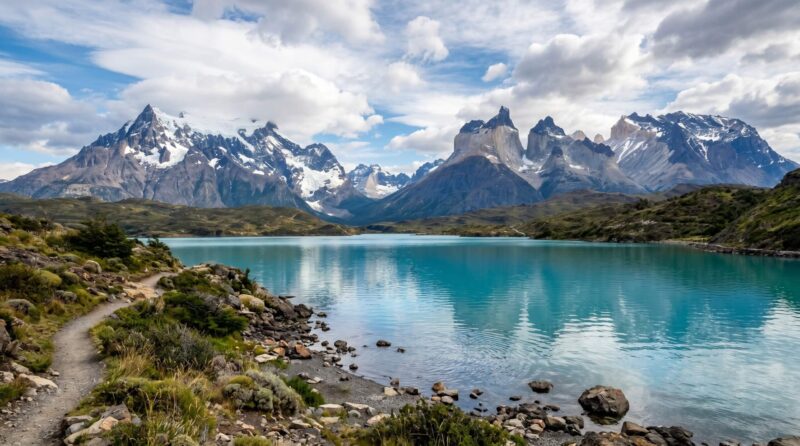
Torres del Paine National Park is the heart of Chilean Patagonia. The three granite towers—Los Torres—appear in completely different colors depending on the light and clouds: orange at sunrise, gray-blue during storms, golden yellow in the evening. The view of the Torres is one of those moments that makes a trip worthwhile.
The W-Trek (5 days, 80 km) is the classic route — it connects the Torres del Paine with the Grey Glacier and the Valle del Francés. Those with more time and fitness can do the O-Trek (9 days, 130 km) and thus circumnavigate the entire massif.
On the Argentinian side lies El Chaltén — the trekking capital of Patagonia with free access to the trails (no permit required!). The view of Fitz Roy at sunrise is one of the most iconic mountain moments in the world.
For Patagonia, you need robust equipment. Especially important: a good rain jacket (Patagonian weather can change completely in 20 minutes) and sturdy hiking boots.
→ Columbia Watertight II Rain Jacket — proven in Patagonian conditions, waterproof, easily foldable.
→ Merrell Moab 3 hiking boots — good value for money, also holds up on Patagonian rocks.
Carretera Austral — The most beautiful road in the world
The Carretera Austral is a 1,240-kilometer-long gravel road that winds through Patagonia's wilderness—from Puerto Montt to Villa O'Higgins, past fjords, hanging glaciers, national parks, and small fishing villages. It is unfinished, inhospitable, and one of the greatest adventures Chile has to offer.
Not every traveler can or needs to complete the entire route. The section between Chaitén (with the impressive Chaitén volcano) and Coyhaique (the only real town along the route) is particularly beautiful. Those with time and a sense of adventure can continue on to Cochrane, from where Patagonia National Park, including the new Cerro Castillo National Park, is accessible.
Chile by rental car — planning a self-drive tour
A rental car is the best way to truly delve into Chile. Especially in the Lake District, along the Carretera Austral, and in the Atacama Desert, the country's true beauty only reveals itself away from the tourist buses.
| route | Travel time (approx.) | Street | Notice |
|---|---|---|---|
| Santiago → San Pedro de Atacama | 24 hours (better flying) | Panamericana + Ruta 23 | I prefer a domestic flight. |
| Puerto Varas → Pucón | 3.5 hours. | Ruta 5 (Panamericana) | Very good condition |
| Puerto Montt → Coyhaique (Carretera) | 2–3 days (including ferries) | Route 7 (gravel!) | 4x4 recommended |
| Puerto Natales → Torres del Paine | 1.5 hours. | asphalt | National Park day ticket |
Important information for car rentals in Chile: An international credit card is mandatory (for the deposit), and many contracts do not allow travel to Argentina—be sure to ask explicitly if you plan to stay in El Chaltén or Bariloche. A 4x4 or at least an SUV is recommended for driving on gravel roads (Carretera Austral).
A compact universal adapter is indispensable for cross-border travel:
→ Skross World Adapter Pro+ universal travel adapter Chile uses type C/L sockets, while some Argentinian hotels use different formats. A universal adapter is recommended.
Chile Costs — What does a tour cost?
Chile is relatively expensive by South American standards—cheaper than Europe, but significantly more expensive than Bolivia, Peru, or Colombia. With careful planning, you can achieve manageable costs.
| category | budget | middle class | comfort |
|---|---|---|---|
| Accommodation (per night) | 15–30 € | 50–90 € | €120–200 |
| Food (per day) | 15–25 € | 30–50 € | 60–100 € |
| Transport (domestic flights) | €40–120 each way (LATAM, book early) | ||
| National park entrance fees | Torres del Paine: ~€25 (up to €40 in high season) | ||
| Total budget per day | 60–70 € | 80–120 € | €150–250 |
For 4 weeks in Chile (including domestic flights, but excluding round-trip flights): Budget travelers can get by with €1,800–€2,200, while middle-class travelers should budget €2,800–€3,800.
Best time to travel to Chile
Chile spans so many latitudes that the "best time to travel" depends heavily on the region.
Accessible year-round. Most pleasant climate is March–May and September–November (shoulder and shoulder seasons). Tours are overcrowded during the Chilean summer (December–February).
Patagonia (Torres del Paine): November to March is high season — longest days, best trekking weather. April-May is low season with beautiful autumn colors and fewer tourists, but shorter days. October is possible but often still very windy.
Lakes region (Pucón, Puerto Varas): October to April, high season December–February.
Chile Visa and Entry Requirements for Germans
For German, Austrian, and Swiss citizens, Chile is easy to enter: no visa required, entry with a valid passport, maximum stay 90 days. The customs declaration form (Formulario de Declaración de Aduana) must be filled out at the airport—be sure to declare food, fruit, and meat honestly, as checks are strict.
Important: Chile is very strict about the import of fresh food — everything must be declared, violations can result in heavy fines.
For travel onward to Argentina or Bolivia: German citizens also travel there without a visa. Border crossings on the Carretera Austral or between Torres del Paine and El Calafate are well signposted and operate smoothly.
FAQ — Frequently Asked Questions about the Chile Tour
How long should a tour of Chile last?
At least 3 weeks, preferably 4 weeks. In 2 weeks you can explore either the north (Atacama) or the south (Patagonia) well, but not both regions — Chile is simply too big for that.
How much does a tour of Chile cost?
For a 4-week trip, expect to spend approximately €2,800–€3,800 on-site (excluding round-trip flights), assuming a mid-range budget. This is in addition to domestic flights (2–3 routes recommended, approximately €40–€120 each way) and the transatlantic flight (approximately €700–€1,200 from Europe).
Do I need a visa for Chile?
No. German, Austrian, and Swiss citizens can enter Chile visa-free and stay for up to 90 days. Entry with a valid passport is sufficient; no visa is required.
When is the best time to travel to Torres del Paine?
November to March is the peak season with the best trekking weather. Late November/early December is particularly recommended: long days, fewer tourists than in January/February, and trekking permits are often still available.
Do I need a permit for Torres del Paine?
Yes, you need to book in advance for the W Trek and the O Trek, as well as for overnight stays in the national park. The booking system is run through CONAF / bnmchile.com. Places fill up quickly during the peak summer season (December–February)—book early.
Can I explore the Atacama Desert independently or do I need tours?
Both are possible. Some attractions (like Valle de la Luna) can be reached with a rental car or by bicycle. However, the Geysire del Tatio and the more remote lagoons are only accessible with tours or a private 4x4 vehicle. For most travelers, a combination of tours and independent exploration makes the most sense.
Is the Atacama Desert accessible year-round?
Yes. The Atacama Desert has a stable desert climate with very little rainfall. Temperatures fluctuate greatly between day (up to 25°C) and night (down to -5°C). During the Chilean winter (June–August), the nights are significantly colder, but the desert is less crowded. Flooding (altiplano floods) can block some roads in January/February.
What equipment do I need for Patagonia?
Windproof, waterproof jacket (essential), sturdy hiking boots, layering (onion principle), sunscreen (UV index extremely high due to the ozone hole), hat and gloves even in summer, trekking poles for longer hikes. Patagonian weather is extremely unpredictable—four seasons in one day is not a cliché.
Can I pay with euros or a credit card in Chile?
Chilean pesos (CLP) are mandatory. Euros are rarely accepted. Credit cards (Visa, Mastercard) work well in cities, but often not on the Carretera Austral and in remote parks. Withdraw cash from ATMs in Puerto Natales or Coyhaique, near the national park. Be aware of daily withdrawal limits (often 100,000–200,000 CLP per withdrawal).
How do I get from Torres del Paine to El Chaltén (Argentina)?
The transfer is via Puerto Natales and the Cerro Castillo border crossing. Shuttle buses connect Puerto Natales with El Calafate, from where buses run to El Chaltén. Total travel time is approximately 5–7 hours. There are also direct shuttles from Puerto Natales to El Calafate (approximately 5 hours), daily during peak season.
Is the Carretera Austral suitable for regular rental cars?
Parts yes, parts no. The northern section (Chaitén to La Junta) is mostly gravel but passable with a regular car. Further south (from Cochrane onwards), some sections are rougher—a 4x4 or high SUV is recommended. Check rental agreements: many standard cars are not insured for gravel roads.
Are there safety risks for travelers in Chile?
Chile is considered one of the safest countries in South America. In Santiago, there is increased pickpocketing activity in some neighborhoods (especially in the metro and markets) – standard precautions are sufficient. In the wilderness (Patagonia, Atacama), there are no significant dangers other than the weather itself. Regularly check the travel advisories issued by your government's foreign office.
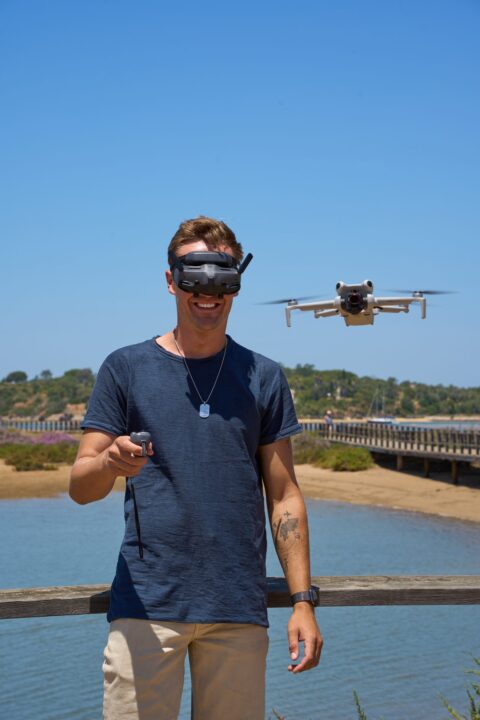
Max Haase
Travel Content Creator · Drone Photographer · Visual Storyteller
A professional travel creator for over 10 years with over 4 million followers. Specializing in high-end tourism board collaborations and visual travel storytelling.


 German
 English