
Machu Picchu, Cusco & Rainbow Mountain Peru — complete itinerary & tips
- Vinicunca (Rainbow Mountain) lies at 5,200 m — one of the most colorful mountain landscapes in the world.
- The best base is Cusco — from there you can reach Rainbow Mountain, Machu Picchu and the Sacred Valley
- Altitude sickness (soroche) is the biggest risk — plan at least 2 acclimatization days in Cusco.
- Total cost of a Peru trip (3 weeks, backpacker): approx. €1,800–2,500 including flight.
- Best time to visit: May–October (dry season, clear view of Rainbow Mountain)
- No visa required for Germans, Austrians and Swiss citizens — up to 183 days visa-free
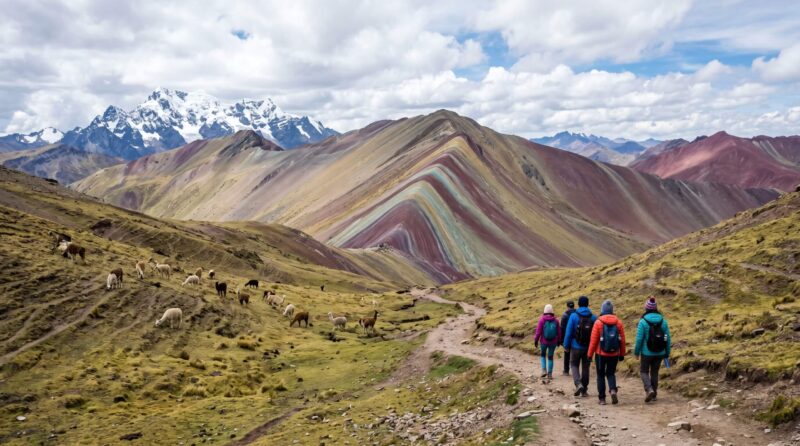
Rainbow Mountain in Peru—officially Vinicunca, or "Winikunka" in Quechua—is one of the most spectacular natural phenomena in the Andes. Mineral deposits over millions of years have colored the mountain in vibrant bands of red, yellow, green, and purple. What was hidden under ice and snow until 2015 has been revealed by climate change—a surreal natural spectacle at an altitude of over 5,000 meters.
In this travel report you will find everything you need to know for a trip to Peru including Rainbow Mountain, Cusco and Machu Picchu: the best route, the most honest tips on altitude sickness, costs, the best travel gear and an FAQ on the most important questions — all from personal experience.
Peru Overview: The Route at a Glance
Peru is vast — and most travelers underestimate the distances. Those with three weeks can experience it in great depth. Those with two weeks need to prioritize. My recommendation for a classic Peru itinerary focusing on Cusco, Rainbow Mountain, and Machu Picchu:
| day | station | Height | Highlight |
|---|---|---|---|
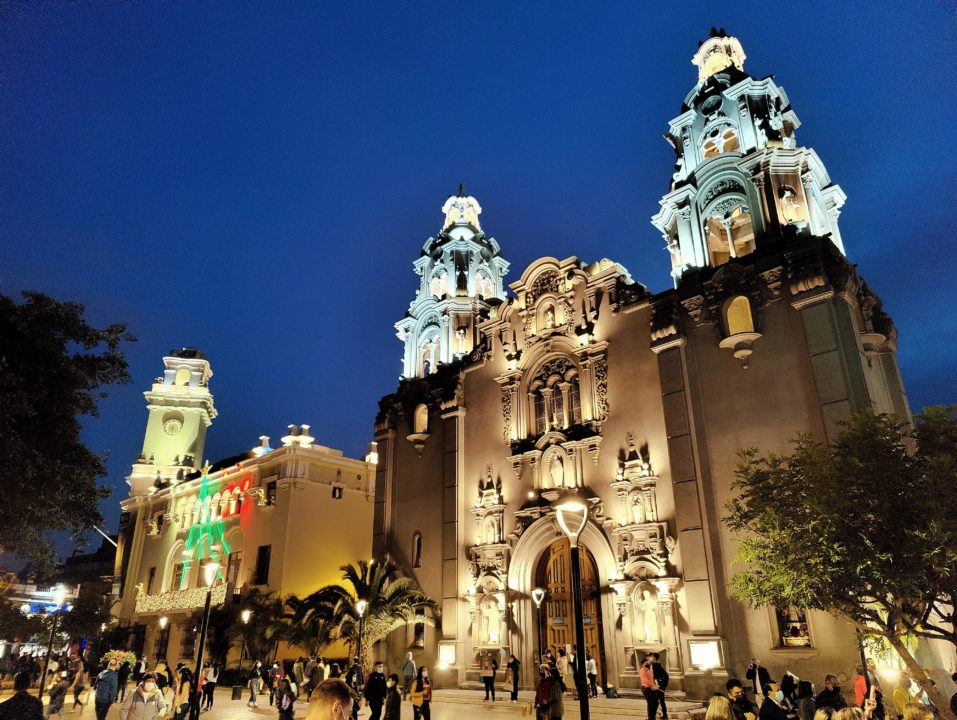
| 1–2 | Lima | 154 m | Arrival, exploring Miraflores, ceviche |
| 3–5 | Cusco | 3,400 m | Acclimatization, cityscape, Sacsayhuamán |
| 6 | Sacred Valley | 2,900 m | Pisac, Ollantaytambo, markets |
| 7–8 | Machu Picchu | 2,430 m | Inca Citadel, Machu Picchu Mountain |
| 9 | Rainbow Mountain | 5,200 m | Vinicunca day trip from Cusco |
| 10–12 | Lake Titicaca (opt.) | 3,812 m | Uros Islands, Taquile |
| 13–15 | Lima / Return journey | 154 m | Barranco, Culinary Departure |
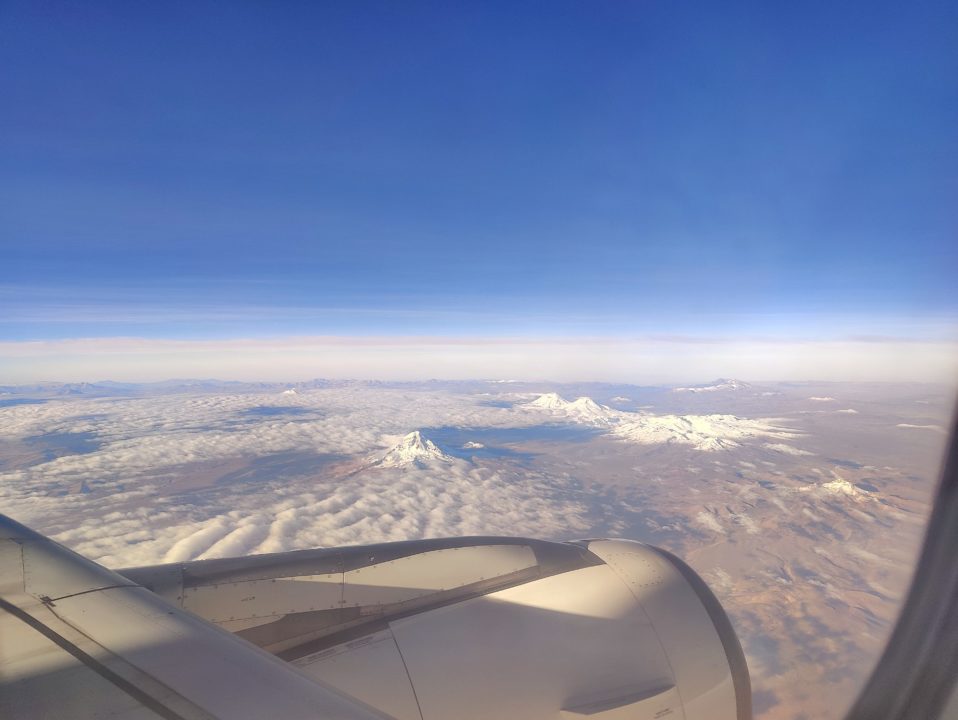


Cusco: Acclimatization is mandatory
Cusco lies at an altitude of 3,400 meters — and anyone who starts exercising immediately after arrival or rushes to see the sights will regret it. My tip: Take it easy for the first two days. Drink plenty of water, drink little alcohol, and avoid rapid ascents.
The city itself is impressive: Inca stonework forms the foundation of colonial churches, lively markets in San Pedro, and an old town that is a UNESCO World Heritage Site. A visit to Sacsayhuamán—the massive Inca fortress overlooking the city—is a must, despite its name.
Sights in Cusco:
- Sacsayhuamán — gigantic Inca fortress with panoramic views of Cusco (20 min walk or taxi)
- Qorikancha — the Golden Temple of the Inca, now beneath a Dominican church
- San Pedro Market — an authentic food market without tourist prices
- Plaza de Armas — heart of the old town, surrounded by colonial buildings and the cathedral
- Barrio de San Blas — a craft quarter with narrow streets and workshops


The Sacred Valley of the Incas
The Valle Sagrado—the Sacred Valley of the Urubamba River—lies between Cusco and Machu Picchu and is worth a full day trip in itself. The high plateau is fertile, the ruins breathtaking, and the markets authentic.
Most people visit the valley as a day trip from Cusco — either organized or by collectivo (shared taxi, 2–5 soles per leg). Key stops:
- — Inca site above the village, plus one of the most beautiful markets in the valley (Tuesday, Thursday, Sunday)
- Ollantaytambo — a vibrant Inca city with vast terraced gardens, departure point for trains to Aguas Calientes
- Chinchero — a traditional village with textile weaving cooperatives and Inca terraces
- — circular terraced amphitheater, possibly Inca experimental fields for agriculture
- Salineras de Maras — salt pans that have been actively cultivated since Inca times.

Machu Picchu: How to get there and what you need to know
Machu Picchu needs no introduction. The Inca citadel at 2,430 meters, shrouded in clouds and surrounded by steep mountain peaks, is one of the most impressive structures in human history—even if you've seen it in 100 photos.
The most convenient way is via Ollantaytambo by train to Aguas Calientes (1.5 hours, from about €25 one way with PeruRail or Inca Rail). From Aguas Calientes, a bus goes up to the citadel (US$12 round trip) or you can walk up (1.5 hours, free). From the train, you can then take another bus or the usual route.
Time slots and routes: The ticket is tied to a specific entry time slot (e.g., 6:00, 7:00, 8:00, etc.). Those wishing to experience the sunrise should take the first train from Aguas Calientes (approx. 5:30). Entry opens at 6:00.
What else is worth considering?
- Machu Picchu Mountain — additional ticket required, ascent 1.5 hours, panoramic view of the entire citadel from the top
- Huayna Picchu — steep, highly sought-after climb (book very early, max. 400 people/day)
- Sun Gate Inti Punku — part of the classic Inca Trail route, no extra ticket required


Rainbow Mountain Peru: Vinicunca at an altitude of 5,200 meters
Rainbow Mountain (Vinicunca) is the visual highlight of any trip to Peru. At an altitude of 5,200 meters, mineral rock strata are exposed in bands of iron oxide (red), chlorite (green), limonite (yellow), and lavasonite (purple). The result is a mountain that looks as if it has been painted.
Until 2015, Vinicunca was unknown—glaciers covered its colors. Climate change has retreated the snow, revealing one of South America's most photographed natural attractions. Today, hundreds of visitors come every day.
Getting to Rainbow Mountain
Almost all visitors make a day trip to Vinicunca from Cusco. The journey takes approximately 3 hours by bus (one way). There are two main options:
- Guided tour: From Cusco approx. USD 25–35 including transport, guide, sometimes lunch. Departure usually at 4:00 am.
- Independent travel: Collectivos from Cusco to Cusipata, then on to Chillca (starting point). Cheaper but more complicated to coordinate.
The ascent: 4,900 m to 5,200 m
From the park entrance at approximately 4,900 m to the viewpoint at 5,200 m, the ascent is about 3 km with an elevation gain of approximately 300 meters. That may not sound like much, but at this altitude it's a real challenge. Well-acclimated hikers can complete it in 1–1.5 hours. Horses are also available for hire for those who prefer not to hike (bookable on-site, approximately USD 15).
Tips for visiting Rainbow Mountain
- Start very early: Be at the starting point by 7:00 AM. Clouds roll in around midday, often obscuring the mountain. It's also more crowded then.
- Warm clothing: Even in the dry season, it is bitterly cold at 5,200 m. Windbreakers, hats, and gloves are essential.
- Acclimatize first: Never go directly to Rainbow Mountain after arriving in Cusco. Spend at least 2-3 days in Cusco.
- Entrance to Palccoyo: Those who want fewer crowds choose Palccoyo (Rainbow Mountain Alternative) at 4,900 m — less well-known, also colorful, more easily accessible.


Altitude sickness in Peru: What you really need to know
Altitude sickness (soroche) is the number one concern on any trip to Peru—and yet it is surprisingly underestimated by many. Cusco lies at 3,400 m, Rainbow Mountain at 5,200 m. The human body needs time to adapt to the lack of oxygen.
At altitudes of 2,400 meters and above, Peru poses a high risk of acute altitude sickness, and treatment in Cusco or at Machu Picchu is privately billed. In addition, there is the risk of gastrointestinal illnesses from tap water, which can cost several hundred dollars to treat without insurance.
Recognizing symptoms
Mild AMS (Acute Mountain Sickness): headache, fatigue, dizziness, nausea, sleep problems. Severe AMS: persistent headache despite ibuprofen, vomiting, coordination problems. High-altitude pulmonary edema or high-altitude cerebral edema are medical emergencies—immediate descent and medical attention.
Prevention and acclimatization
- Arrive and rest: First day in Cusco just arrive, rest, drink plenty of fluids
- Ascend slowly: No excursions to higher points in the first 48 hours.
- Coca tea: A local remedy that relieves symptoms, legal in Peru
- No alcohol for the first few days: It significantly worsens dehydration and symptoms.
- Ibuprofen: Effective against altitude headaches (400–600 mg)
- Diamox (acetazolamide): Prescription only, to be taken preventively, consult a doctor.
Costs: What Peru really costs
Peru is a moderately expensive travel destination in Latin America—cheaper than Chile or Brazil, more expensive than Bolivia or Ecuador. Those traveling on a backpacker budget will find it quite manageable. Those seeking comfort will have to pay accordingly.
| category | Budget (€) | Comfort (€) |
|---|---|---|
| Accommodation/night | 8–15 (Hostel) | 40–80 (Hotel) |
| Food/day | 8–15 (Menu del Día) | 25–50 (Restaurant) |
| Machu Picchu Ticket | ~36 € (fixed price for foreigners) | |
| Ollantaytambo–Aguas Calientes train | €25 one way | 60–100 € (Vistadome) |
| Rainbow Mountain Tour | 25–35 € (guided tour) | |
| Domestic flight Lima–Cusco | €30–80 (depending on the booking time) | |
| Total budget 3 weeks including flight | €1,800–2,200 | €3,500–€5,000 |
Peru packing list: What you really need
Peru demands adaptability: coast, highlands, and jungle have completely different requirements. The highlands around Cusco and Rainbow Mountain require special preparation.
Cusco in Peru has local trekking shops, but the quality is often only mediocre and the selection of shoes is limited. For multi-day treks like the Salkantay or the Inca Trail, you should bring your own tried-and-tested gear.
Essential for the highlands and Rainbow Mountain
- Layering system (Merino base): Temperature changes are extreme — -5°C in the morning at Rainbow Mountain, 20°C at midday in Cusco
- Waterproof jacket: Thunderstorms develop quickly in the highlands.
- Power bank: Trips are long, power outlets on Rainbow Mountain are non-existent
- Water filter: Tap water in Peru is not drinkable — saves on plastic bottles and costs
- Trekking shoes: Absolutely essential for Rainbow Mountain and Machu Picchu
- Sunscreen SPF 50+: UV radiation is massively increased at 5,000 m
Recommended gear with Amazon links
I have personally used these products on highland trips:
- Anker 737 PowerBank (24,000 mAh) — sufficient for 2–3 smartphone charges per day, robust and reliable on excursions: → Anker 737 Power Bank on Amazon
- LifeStraw Water Filter — Filters drinking water from streams and springs, ideal for trekking tours in the Andes: → LifeStraw Water Filter on Amazon
- Petzl Tikkina headlamp — for early starts to Rainbow Mountain (4:00–5:00 AM departure in the dark): → Petzl Tikkina on Amazon
- Merino basic set (Icebreaker/Smartwool) — indispensable for temperature fluctuations in the Andean highlands, dries quickly, odor-neutral: → Merino Baselayer on Amazon
- Osprey Farpoint 40 Backpack — the carry-on backpack for South America: fits in hand luggage, comfortable to carry even on long hikes: → Osprey Farpoint 40 on Amazon
- Diamox / Soroche tablets — for the prevention and relief of altitude sickness (consult a doctor!): → Altitude sickness tablets on Amazon
- Nobite DEET mosquito repellent — for the lowlands of Peru (Amazon region, Puerto Maldonado): → Nobite DEET on Amazon
Entry requirements and visa: The most important information for travelers to Germany, Austria, and Switzerland (DACH region).
Germans, Austrians, and Swiss citizens can enter Peru visa-free for stays of up to 183 days. The visa is stamped upon arrival at the airport or border crossing—simply present your passport and state the length of your stay.
- Visa: No visa required for citizens of Germany, Austria, and Switzerland (DACH region) for stays of up to 183 days.
- Passport: Must be valid for at least 6 months beyond the date of departure.
- Vaccinations: No mandatory vaccinations; Hepatitis A/B, Typhoid and Yellow Fever (for the Amazon) are recommended.
- Currency: Peruvian Sol (PEN); ATMs readily available in Lima and Cusco
- Sockets: Type A and B (US standard), voltage 220V — EU adapter required
FAQ — Rainbow Mountain Peru & Cusco
What is the height of Rainbow Mountain (Vinicunca) in Peru?
Rainbow Mountain Vinicunca lies at 5,200 meters above sea level. The viewpoint on the ridge is at approximately 5,036 meters. The starting point of the ascent is already at almost 4,900 meters.
What are the typical symptoms of altitude sickness in Peru?
Common symptoms of altitude sickness (soroche) in Peru include headache, fatigue, dizziness, nausea, and sleep problems. Symptoms usually appear within the first 12–24 hours after arrival. Drinking plenty of fluids, resting, and drinking coca tea can help with mild cases.
How dangerous is altitude sickness in Peru?
Mild altitude sickness is common and usually harmless. Severe high-altitude pulmonary edema (HAPE) or high-altitude cerebral edema (HACE) are dangerous—both rare medical emergencies requiring immediate descent. Those who acclimatize and listen to their bodies face little to no serious risk.
When is the best time to travel to Rainbow Mountain in Peru?
The best time to visit Vinicunca and Cusco is during the dry season from May to October. At this time, the skies are usually clear and the colors of Rainbow Mountain are clearly visible. The rainy season (November–April) often brings fog and poorer visibility, but fewer tourists.
How do you get to Rainbow Mountain?
Rainbow Mountain is about a 3-hour bus ride from Cusco. Most visitors book a guided day tour from Cusco (US$25–35 including transportation). Departure is usually between 3:30 and 4:30 a.m. to arrive at the mountain early, before the clouds roll in.
Do I need a visa for Peru?
Germans, Austrians, and Swiss citizens do not need a visa for Peru. Stays of up to 183 days are visa-free. The passport must be valid for at least six months beyond the date of departure.
How much does a 3-week trip to Peru cost?
A 3-week trip to Peru on a backpacker budget, including flights, costs approximately €1,800–€2,200. For a more comfortable trip, expect to pay €3,500–€5,000. The biggest single expenses besides accommodation are the Machu Picchu ticket (approx. €36), trains, and domestic flights.
Can I visit Rainbow Mountain on my own?
Yes, Rainbow Mountain can be reached independently — via collectivos from Cusco to Chillca and then on foot. It's cheaper than a guided tour (saving approximately $5–10 USD), but significantly more complicated to coordinate and less predictable in terms of timing.
How long is the climb to Rainbow Mountain?
The ascent from the park entrance (approx. 4,900 m) to the viewpoint (approx. 5,200 m) takes 45–90 minutes with good acclimatization. The route is approximately 3 km long with an elevation gain of 300 meters. At this altitude, the pace is considerably slower than usual.
What is Palccoyo and is it better than Vinicunca?
Palccoyo is a lesser-known alternative to Rainbow Mountain, also in the Cusco region. It's situated at a slightly lower altitude (around 4,900 m), has similar color layers, and is significantly less crowded. A good choice for people with altitude sickness or those who prefer to avoid crowds.
What clothing do I need for Rainbow Mountain?
You should bring warm clothing to Rainbow Mountain: a hat, gloves, windbreaker, and merino baselayer are necessary at 5,200 m, even in summer. Mornings can be as cold as -5°C. Trekking boots or sturdy footwear for the trail are mandatory.
Rainbow Mountain Peru height — how does that differ from the Inca Trail?
The Inca Trail reaches its highest point at Dead Woman's Pass at 4,215 m. Vinicunca (Rainbow Mountain) is significantly higher at 5,200 m. The Rainbow Mountain ascent is shorter (3 km) but more strenuous due to the higher starting point. A 4-day permit is required for the classic Inca Trail.
Max Haase
Travel Content Creator · Drone Photographer · Visual Storyteller
A professional travel creator for over 10 years with over 4 million followers. Specializing in high-end tourism board collaborations and visual travel storytelling.
 German
 English