
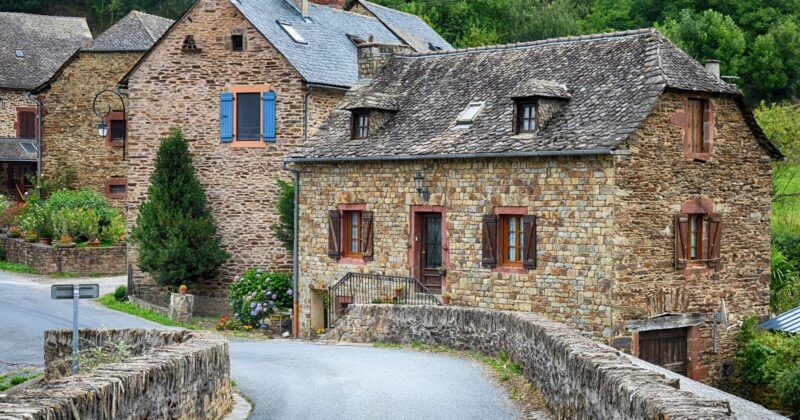
Southern France Road Trip 2026: Route, Map & Provence
A road trip through the South of France is one of the quintessential European routes – and rightly so. The Côte d'Azur with its luxury yachts, Provence with its lavender fields and vineyards, the Camargue with its wild horses and flamingos, plus Mediterranean villages that look like they've been lifted straight from an Impressionist painting. I've driven this route three times in a campervan – once in July during the lavender season, once in autumn for the grape harvest, and once in spring when the mimosa trees are in bloom. Each season has its own unique magic. In this guide, you'll find a complete map of all the regions of the South of France, the best routes for 1 week, 10 days, 2 weeks, or 14 days, all the costs, overnight stops along the way, the best campsites, and my personal insider tips that you won't find in any guidebook. Whether you're traveling by motorhome, campervan, or rental car: this route works.
- Complete route: From Aix-en-Provence via Marseille, Cassis, Saint-Tropez, Cannes and Nice to Menton – 400 km in 7, 10 or 14 days, plus Camargue and lavender fields as a side trip.
- Map of Southern France Regions: Provence (lavender, wine, villages), Côte d'Azur (luxury coast from Saint-Tropez to Menton), Camargue (flamingos, horses, rice), Luberon (mountain villages and handicrafts).
- Best route to the South of France: From Germany via Strasbourg-Lyon-Marseille (1,200 km, 12 h), overnight stays in Beaune (Burgundy) or Montélimar (gateway to Provence).
- Lavender fields Valensole (July), Calanques of Cassis, port of Saint-Tropez, old town of Nice, villages of Gordes & Roussillon, Camargue safari on horseback.
- Costs of a road trip in the South of France: €70–100/day for 2 people (frugal) to €130–180/day (Côte d'Azur restaurants). Campsites €25–55/night, tolls €150–180 total.
Southern France map and regions: The complete overview
The map of Southern France encompasses four main regions, each distinct in character, landscape, and culture. When people think of a Southern France road trip, they usually think of the Côte d'Azur – but that's only part of the story. For a meaningful tour of Southern France by car or campervan, you should be familiar with all four regions:
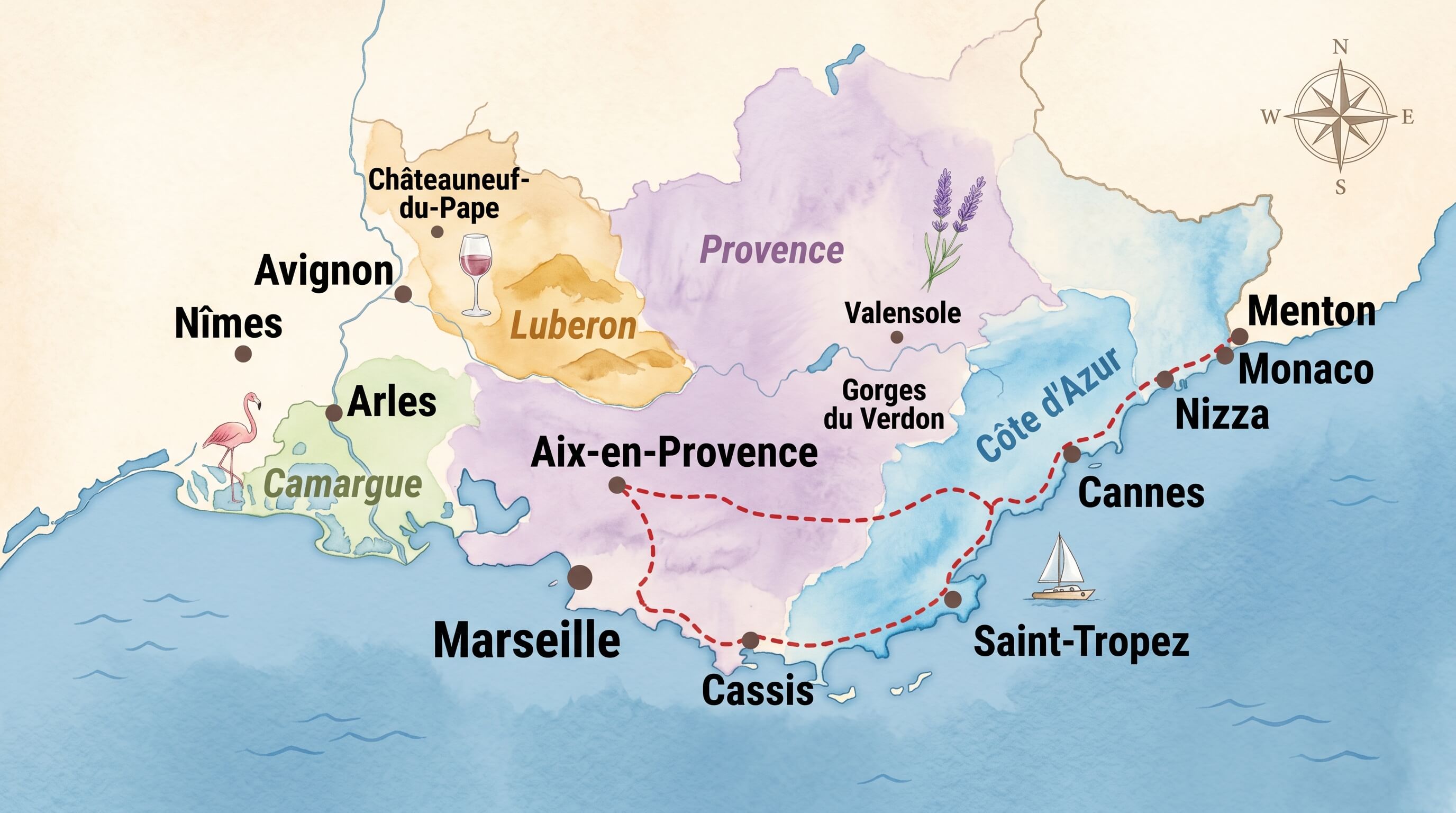
Provence stretches from Avignon in the west to Nice in the east, inland to the Luberon mountains. The classic image: lavender fields, olive groves, medieval hilltop villages, Roman ruins, rosé wine. Best time to visit: June/July (lavender) or September (grape harvest).
2. Côte d'Azur (Luxury Coast): The Mediterranean coast between Cassis and the Italian border near Menton. This is where glamorous resorts like Saint-Tropez, Cannes, Nice, and Monaco are located. Turquoise waters, spectacular rock formations (Calanques), luxury hotels, and yacht harbors. More expensive than Provence, but unique.
3. Camargue (Nature Park in the Rhône Delta): The third largest region is often overlooked, but a must for nature lovers. Flat landscapes dotted with white Camargue horses, pink flamingos, rice paddies, and salt pans. The cities of Arles (home to Van Gogh!) and Aigues-Mortes (a fortified town) are essential stops. You'll find the Camargue on a map of southern France south of Nîmes and Arles, between the two branches of the Rhône River.
4. Luberon (mountain villages in the hinterland): Northeast of Aix-en-Provence lies the Luberon Natural Park with some of France's most famous villages: Gordes, Roussillon, Lourmarin, and Ménerbes. This region is the "real" south of France – peaceful, rich in crafts, and gastronomically excellent.
The ideal route combines all four regions: starting in Aix-en-Provence (the central base of Provence), a northern loop through the Luberon and lavender fields, a southern route to the Camargue and Arles, and an eastern drive along the Côte d'Azur to Menton. This route is approximately 450 km long and ideal for 10–14 days. Those with less time will need to omit some regions – 7 days are sufficient for Provence and the Côte d'Azur, excluding the Camargue/Luberon.


Best route to the South of France: Getting there, overnight stays and tolls
The best route to the South of France from Germany is the classic A7 / Autoroute du Soleil. From Frankfurt it's 1,000 km to Lyon, and from there another 300 km to Marseille. Total driving time: approximately 12 hours. For a relaxed road trip, an overnight stop on the way to the South of France is always a good idea.
The three classic routes from Germany:
- Route 1 – Classic via Strasbourg/Lyon: Karlsruhe → Strasbourg → Mulhouse → Lyon → Marseille. 1,150 km from Munich, 1,200 km from Frankfurt. Best motorway connection, toll roads throughout.
- Route 2 – Relaxed via Switzerland/Burgundy: Munich → Basel → Beaune (Burgundy) → Avignon. 1,250 km, somewhat slower, but significantly more scenic and with the opportunity for wine tasting in Beaune.
- Route 3 – Toll-free via Auvergne: Saarbrücken → Metz → Clermont-Ferrand → Nîmes. 1,300 km, but completely without motorway tolls in France. However, this means driving at country road speeds and a longer journey time.
Best places to stay overnight on the way to the South of France:
- Beaune (Burgundy): 650 km from Frankfurt. Wine capital of Burgundy, perfect for wine lovers. Camping Les Cent Vignes right on the edge of town (€32/night).
- Lyon: 800 km from Frankfurt. Capital of French gastronomy – anyone staying overnight should definitely eat at a bouchon lyonnais (traditional Lyonnais restaurant). Camping International de Lyon on the outskirts of the city, €36/night.
- Montélimar (Gateway to Provence): 1,000 km from Frankfurt. A small town in the Rhône Valley, where you can already feel the southern atmosphere. Camping La Farigoulette is €26 per night. Ideal for those driving the route in two days.
- 1,100 km from Frankfurt. UNESCO World Heritage Site with the largest Roman theater north of the Alps. At the gateway to Provence, ideal for a night before the final sprint.
Toll fees in France: For a motorhome under 3.5 t (Class 2), you'll pay around €85–95 one way from the German border to Marseille. For campervans over 3.5 t (Class 3), it's €150–180. For the route via the A7 (Lyon → Marseille) alone: €38 toll, Class 2. Payment at the toll booths can be made by credit card, cash, or the Liber-t electronic toll collection box.
Is the A7 in France dangerous? My assessment: The A7 between Lyon and Marseille is considered one of the most dangerous motorways in France – primarily due to the high volume of truck traffic and narrow lanes in the Rhône Valley. Particularly problematic are the bridges and tunnels south of Lyon. Rain makes the road slippery, and in summer there are extreme traffic jams (up to 6 hours of standstill at the toll booths in July and August). My recommendation: drive the A7 early in the morning (5-7 am) or at night to avoid the traffic. Alternatively, take the parallel N7 national road, the famous "Route du Soleil" from the 1960s.
French Riviera: Saint-Tropez, Nice and the most beautiful bays of the Mediterranean coast
The Côte d'Azur is the most glamorous stretch of any road trip through the South of France. The approximately 120 km of coastline between Cassis and Menton boasts more luxury hotels, yacht harbors, and Michelin-starred restaurants than any other region in Europe – but also some of the most spectacular natural landscapes. The combination of sophisticated elegance and rugged coastline is unique.
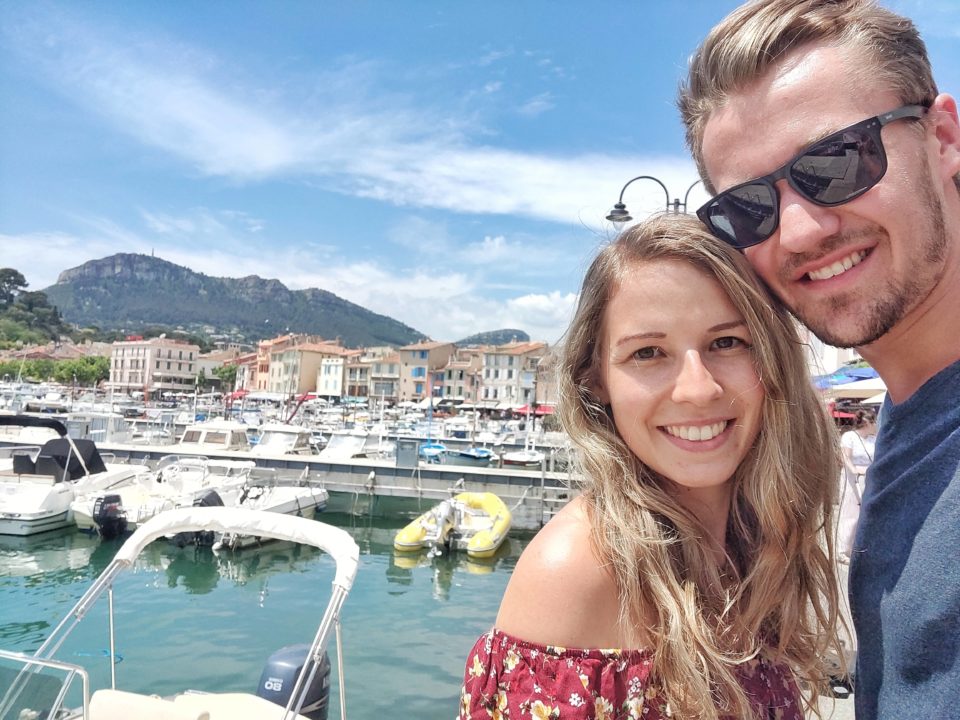
Cassis and the Calanques: Just past Marseille lies the picturesque port town of Cassis. The famous Calanques – fjord-like rock inlets with turquoise water – are the absolute highlight of the coast. They can be reached by hiking (Calanque de Port-Miou in 20 minutes, Calanque d'En-Vau in 2 hours) or by boat (€24 per person for the 90-minute tour). Campervan pitches: Camping Les Cigales directly in Cassis, €42/night.
Saint-Tropez: Arguably the most famous small town in the world. Its marina is filled with luxury boats larger than most houses. The old town, with its ochre-colored facades, is charming even without a budget for €1,000 cocktails. The historic Place des Lices (market every Tuesday and Saturday) is the heart of local life. Beaches: Pampelonne Beach (a 12 km long dream beach with legendary beach clubs), Tahiti Beach (the original nudist beach legend of the 1960s).
The "Venice of the Côte d'Azur" – an artificial lagoon city from the 1960s, built on the principle that every house has direct water access. Architecturally fascinating, perfect for a coffee break.
Cannes: Famous for its film festival in May. The Croisette (seafront promenade) is glamorous, and the Rue d'Antibes is the best shopping street. From the Îles de Lérins, with the Saint-Honorat Abbey (winegrowing, visits possible), you have the best view of the coast.
Nice and the Arrière-Pays: The Promenade des Anglais is the most beautiful waterfront promenade in the world. The Vieille Ville (Old Town) with its daily Cours Saleya market, and the Colline du Château viewpoint overlooking the Baie des Anges. Plus: the hinterland (Arrière-Pays) with hilltop villages like Èze (a hexagonal village perched on a 429-meter rock), Gourdon, and Saint-Paul-de-Vence (an arts village).
Menton and the Italian border: The easternmost end of the Côte d'Azur. Known for lemons, Italian flair (right on the border), and the only botanical garden in southern France that specializes entirely in tropical plants.
Monaco (as a day trip): Only 15 km from Nice, but a separate state. Monte Carlo with the casino, the Prince's Palace, and the Oceanographic Museum. By campervan: Parking only in designated areas (Parking des Pêcheurs, €6/hour).


Provence self-drive tour: Lavender, wine and the most beautiful villages
A self-drive tour of Provence is the highlight of a road trip in the South of France for many. Here you'll find classic postcard views: lavender fields stretching to the horizon, medieval hilltop villages perched on rocky outcrops, vineyards producing rosé, olive groves dotted with olive oil producers, and cuisine that ranks among the best in France. A one-week road trip through Provence is ideal.
Valensole and the lavender fields: The Valensole Plateau northwest of Manosque is the most famous lavender region in Europe. The main flowering period is from late June to mid-July, when the lavender is harvested and distilled. The best photo spots: the solitary tree in the field near D6 south of Valensole (marked as "Lavandes arbre solitaire" on Google Maps), and the Musée de la Lavande in Coustellet (an interactive museum with a distillation demonstration, €8). My tip: Arrive at 6:30 a.m.; the light is magical and you'll have the place to yourself.
Gordes and Roussillon – the iconic villages: Two of France's most beautiful villages are only 15 km apart. Gordes is a village built entirely of light limestone on a rocky outcrop – the view from the Pointe de Vue at the village entrance is considered one of the most photographed spots in France. Roussillon, in contrast, is built entirely of ochre-red clay, a red village against a backdrop of green forests. Both villages are narrow and steep – not accessible by campervan; parking is available on the outskirts.
Aix-en-Provence: The historic capital of Provence, shaped by Paul Cézanne (his studio is open to visitors, €7). The Cours Mirabeau is the city's most elegant boulevard, lined with fountains and plane trees. A large market takes place on the Place Richelme on Wednesdays, Thursdays, and Saturdays. Aix is the perfect base for a tour of Provence – you can park your campervan here and take day trips in all directions.
Wine regions of Provence:
- Côtes de Provence: The largest growing region, especially Rosé. Top châteaux: Château Miraval (since 2012 Brad Pitt), Château Sainte-Roseline.
- Châteauneuf-du-Pape: One of the world's most famous red wines. A small village with the ruins of a papal palace on the Rhône plateau. Tasting €10–20.
- Bandol: A smaller appellation near Toulon, specializing in rosé. Top Domaines: Domaine Tempier, Château Pibarnon.
Top day trips in Provence: The Gorges du Verdon (canyon with turquoise river, 30 km long „Grand Canyon“ of Europe), Les Baux-de-Provence (rock village with light show in old quarries), Isle-sur-la-Sorgue (on Sundays the largest antiques market in southern France).



Camargue on the map of southern France: Flamingos, horses and wild nature
The Camargue is easy to find on a map of southern France: the Rhône delta between Nîmes in the north, Arles in the northeast, and Montpellier in the west. This approximately 900 km² wetland is a UNESCO Biosphere Reserve and the most important natural area in southern France. For many travelers, it's the emotional surprise of their road trip – quieter, wilder, and more pristine than anything on the Côte d'Azur.
Arles – Gateway to the Camargue: This ancient Roman city was later home to Vincent van Gogh, who painted some of his most famous works here (Café Terrasse in the evening, Les Alyscamps). The Roman amphitheater (UNESCO World Heritage Site, €9 entrance fee) is still used for bullfights. The Fondation Vincent van Gogh presents rotating exhibitions (€12). A large market takes place on the Boulevard des Lices on Thursdays and Saturdays.
Pont de Gau Ornithological Park: The most important bird sanctuary in the Camargue – home to over 300 bird species, including the pink flamingos for which the region is world-famous. Admission: €7.50, plan for a 2–3 hour visit. Best time to see flamingos: March to June (breeding season). Magnificent boardwalks through the marshland.
Saintes-Maries-de-la-Mer: The heart of the Camargue – a pilgrimage town on the Mediterranean with a medieval fortified church. Legend has it that Mary Magdalene and Mary Salome landed here after the crucifixion. Every year on May 24th/25th, the Gitan pilgrimage takes place – thousands of Roma and Sinti make the journey here. A fascinating experience if you're there at the right time.
White Camargue horses and black bulls: The wild Camargue horses have been bred here for 4,500 years and are one of the oldest horse breeds in the world. Organized horse safaris through the marshland start at €35 per person (1 hour) and go up to €85 (full day with picnic). The manadiers (Camargue cowboys) ride these horses to herd the black fighting bulls.
Aigues-Mortes: This perfectly preserved 13th-century fortified town boasts a complete city wall. King Louis IX once assembled his crusading troops here before their departure. A visit to the tower (Tour de Constance) is a must (€9). Surrounding the town are the famous salt marshes with their pink salt – the salt pans turn pink at the end of summer due to the seaweed that washes in from the sea.
Campervan pitches in the Camargue: The entire region is a nature reserve; wild camping is strictly prohibited. Top spots: Camping Le Clos du Rhône (€38/night, directly on the river), Camping La Petite Camargue (€32/night, pool), Aire de Camping-Car Saintes-Maries-de-la-Mer (€12/night, basic, but fantastic location).


Camping in the South of France: pitches, costs and rules for motorhomes
Southern France is one of the best-equipped countries in Europe for camping and motorhome travel. The infrastructure is excellent – over 8,000 campsites, around 3,000 motorhome pitches, and a camper-friendly culture. Prices are higher than in Spain or Portugal, but the quality is generally premium.
Parking space categories in France:
- 5-star premium camping: €50–90 per night in high season, with pool, entertainment, restaurants, and water park. Examples: Yelloh! Village, Castel Camping. Suitable for families, overkill for couples.
- 3-4 star camping: €28-45/night, solid infrastructure without luxury. Best category for value for money. The majority of all campsites fall into this category.
- Municipal campsites: €12–22 per night, basic but adequate (water, electricity, sanitary facilities). Often located in small towns directly on the river.
- Campervan parking area: €8–15/night, special pitches for motorhomes with water/waste disposal and electricity, but usually without sanitary facilities or showers. Perfect for overnight stays.
- A network of farmers and wineries offering free camping pitches (in exchange for purchasing farm products). €30/year membership, 10,000+ pitches. A hidden gem for wine lovers.
Wild camping in southern France: Officially prohibited with fines of €35–150. In practice, enforcement varies greatly from region to region. Strictly controlled: Côte d'Azur (Saint-Tropez, Nice, Cannes – where campers are actively cleared), Calanques National Park (camping prohibited), coastal areas. More relaxed: Camargue hinterland, Luberon mountains, wine regions. Rules: Do not park directly by the sea, do not set up awnings/tables/chairs (this is considered camping), do not make noise, and do not leave any trash.
My top 5 campsites in the South of France:
- Camping Les Cigales (Cassis): €42/night, directly in Cassis, within walking distance of the port and the Calanques.
- Camping Les Prés (L'Isle-sur-la-Sorgue): €32/night, quiet location by the river, perfect for a Provence tour.
- Camping Le Clos du Rhône (Saintes-Maries-de-la-Mer): €38/night, Camargue base.
- Camping de la Rive (Nice hinterland): €36/night, quieter than directly on the coast, bus to the city.
- Camping Les Romarins (Gordes): €34/night, in the heart of the Luberon, pool overlooking the village.
Cost of a road trip in the South of France: 1 week, 10 days, 2 weeks compared
Southern France is in the upper third of European road trip destinations in terms of price. Significantly more expensive than Spain, Portugal, or Eastern Europe, but still cheaper than Switzerland, Norway, or the British Isles. Here's the complete budget with all the details:
- Campsites in the South of France: €28–55/night in high season (July/August), €20–38/night in low season. Average: €35/night.
- Campervan parking areas: €8–15/night. Not everywhere, but ideal for 1-night stops.
- Tolls in France (Class 2): Total route border → Marseille round trip: €150–180. Within southern France (e.g. Marseille → Nice): €18.
- €1.70–1.85/L. Total fuel costs for the entire South of France route (approximately 1,000 km within France): €200–240.
- Restaurants: Set lunch menu €16–25, à la carte dinner €35–60 per person, Michelin-starred restaurant €95–280 per person. The Côte d'Azur is significantly more expensive than Provence.
- Supermarket (Carrefour/Intermarché/Leclerc): Weekly shopping for 2 people: €90–130. Significantly more expensive than in Spain, but very good quality.
- Bakery: Baguette €1.20–1.80, Croissant €1.40–2.50, Pain au Chocolat €1.60–2.80. Fresh pastries are a must every morning.
Total budget for different trip durations (2 people):
- Southern France Road Trip 1 Week (7 Days): Budget €650–950 | Comfortable €1,200–1,700 | Luxurious €2,500+
- Southern France Road Trip (10 days): Budget €900–1,400 | Comfortable €1,700–2,400 | Luxurious €3,500+
- Southern France Road Trip 2 Weeks (14 Days): Budget €1,300–1,900 | Comfortable €2,400–3,400 | Luxurious €5,000+
Plus €300–400 for fuel and tolls for travel to and from Germany. Côte d'Azur beach clubs (beach clubs with sun loungers) cost an extra €40–120 per day – a significant expense if you want the classic Riviera beach experience.
Money-saving tips for the South of France: The Formule Midi (lunch menu) is one of the best dining deals in France, offering 2-3 courses for €16-22. In the evening, enjoy baguette, cheese, and rosé on the beach for €10 per person. Wines are inexpensive in Provence: Rosé Côtes de Provence directly from the winery starts at €6 per bottle, and in supermarkets, it's around €4 per bottle.
Hidden gems of southern France: villages and towns without tourist crowds
Besides the classic tourist attractions, southern France has numerous hidden gems that even the French themselves hardly know about. Here are my personal favorites from three road trips through the region:
France has the EU EHIC, but mountain rescue is not included in the standard package for hiking accidents in the Alps or Pyrenees. Private international health insurance also covers your return flight if you are unable to travel.
1. Moustiers-Sainte-Marie (Verdon): A tiny village clinging to the rocks, with a golden star stretched across the gorge on an iron chain (legend: a knight promised the star upon his return from the Crusades). Entrance to the Grand Canyon du Verdon.
2. Bormes-les-Mimosas (Var): A medieval village with a sea of mimosa flowers that bloom completely yellow in February. One of the 100 most beautiful villages in France (Plus Beaux Villages de France). My favorite village on the entire Côte d'Azur.
3. Èze Village (between Nice and Monaco): A hexagonal village perched atop a 429-meter-high rock, 30 km east of Nice. The Jardin Exotique at the summit offers one of the most beautiful views on the entire French Riviera. Go early in the morning (before 9 a.m.), otherwise the crowds are unbearable.
4. Les Baux-de-Provence: A hilltop village with the Château des Baux, a medieval ruin. Right next to it are the Carrières de Lumières – old limestone quarries repurposed as immersive light shows (14 € entrance fee, changing themes such as Van Gogh, Monet).
The "antiques capital" of France. Every Sunday (April to September), the town transforms into the second largest antiques market in Europe – right on the banks of the Sorgue River with its waterwheels. A must-see for furniture lovers.
6. Gorges du Verdon: The "Grand Canyon of Europe," 700 m deep, with turquoise water. The Route des Crêtes (D952) offers the most spectacular views – a 23 km circular route with 14 viewpoints. Kayaking and climbing are possible at the bottom of the canyon.
7. Marseille Le Panier: The oldest quarter of Marseille, a small Mediterranean village within the city. Colorful streets, street art, small bistros. Mostly ignored by tourists who only visit Notre-Dame-de-la-Garde. Le Panier is the real Marseille.
8. Cassis Calanque d'En-Vau: The most spectacular of the Calanques. Not accessible by car – a 2-hour hike from the Presqu'île car park, with some scrambling sections at the end. Once you reach the beach, you'll see why: 100-meter-high white cliffs, turquoise water, and 30 meters of sand. A natural wonder.


Best time to travel to the South of France and A7 safety: Practical tips
The best time to travel to the South of France for a road trip depends heavily on your preferences. The region has a Mediterranean climate with hot, dry summers and mild, wet winters. Here are the months in detail:
- April to May: 18–24 °C, green Provence, mimosa blossoms (April), not yet crowded. Ideal for hiking and village tours.
- 22–28 °C, lavender starts to bloom (from mid-June), gradually warming up, peak season begins. My favorite.
- 28–35 °C (sometimes 40+), peak lavender month (July), but overcrowded. Campsites are 40% more expensive, towns are packed. Only recommended for people who absolutely want to see lavender fields.
- September: 22–28 °C, grape harvest underway, summer visitors gone, perfect weather. My #2 favorite.
- October: 18–23 °C, mild autumn, stable weather conditions, favorable prices.
- November to March: 8–16 °C, lots of rain in November (the wettest month), Mistral wind (up to 100 km/h!), but calm. Only for hardcore campers.
A cold north-northwesterly wind blowing from the Rhône Valley towards the Mediterranean. It can reach speeds of up to 100 km/h. Typical for spring and autumn, with wind speeds lasting 3–10 days at a time. During a Mistral: park your campervan in a sheltered spot (not directly on the coast), fold up your awning, and avoid the beach. However, the Mistral brings clear skies and excellent visibility.
A7 Safety – What You Really Need to Know: The question "is the A7 in France dangerous?" is frequently Googled, usually for good reason. The A7 (Autoroute du Soleil) is considered one of the most dangerous motorways in Europe – not because of poor road conditions, but because of extreme traffic volume in the summer. In July and August, over 200,000 vehicles travel the Lyon–Marseille section alone each day. Traffic jams can stretch up to 200 km, with delays of up to 6 hours at the toll booths. In addition, the lanes are narrow, there is a lot of truck traffic, and there are no alternative routes in tunnels or on bridges.
My recommendation for the A7: Drive at night between 11 pm and 5 am, and in July/August even from 3 am to 7 am. Alternatively: travel completely outside of the summer holidays (i.e., June or September). A third option: the parallel N7 (Nationale 7) is quieter, toll-free, but significantly slower – however, you'll pass through historic towns like Valence, Orange, and Avignon. For relaxed travelers, it's a much better choice.
Drone regulations in France: Drone registration with the DGAC online (free of charge), insurance is mandatory for drones over 250g. Restricted zones: National parks (Calanques, Cévennes, Mercantour), cities, military zones. The Gorges du Verdon is partially a drone-free zone. The Geoportail app shows the current drone zones.
My personal highlight from three trips to the South of France: Sunrise on the Plateau de Valensole in mid-July, when the lavender fields glow purple in the first light and it's just you and a drone around. Followed by a coffee in a small village and a whole day without a plan along the Route des Crêtes above the Calanques.
FAQ: Southern France Road Trip – Frequently Asked Questions
How long does a road trip in the South of France take?
One week for the highlights (Provence villages or the Côte d'Azur – one of the two). Ten days for the complete tour including the Camargue and Luberon – the sweet spot. Fourteen days if you want to travel at a relaxed pace and explore all regions. Travel from Germany takes 1–2 days each way with an overnight stop. So, plan for a total vacation of 12–16 days for 10 days on location.
How much does a road trip to the South of France cost for two people?
€650–950 for 1 week on a budget, €1,200–1,700 for a comfortable stay. €900–1,400 for 10 days on a budget, €1,700–2,400 for a comfortable stay. €1,300–1,900 for 2 weeks on a budget, up to €3,400 for a comfortable stay. Plus €300–400 for fuel and tolls for travel to and from Germany. The Côte d'Azur is significantly more expensive than inland Provence – those who save money can stay longer in Provence.
Which map of southern France shows all regions?
Google Maps is sufficient for basic orientation. For detailed planning of the regions: the Michelin map 527 (Provence-Côte d'Azur) on paper (€9). For offline use on the go: Maps.me or Organic Maps. The Southern France regional map shows four main regions: Provence, Côte d'Azur, Camargue, and Luberon – all within a maximum 2-hour drive of each other.
What is the best route to the South of France from Germany?
Via Strasbourg–Lyon–Marseille on the A5/A7 (1,150 km from Munich, 1,200 km from Frankfurt). Tolls around €85 one way. Overnight stay recommended: Beaune (Burgundy) or Montélimar (gateway to Provence). Alternatively, toll-free via Auvergne (Saarbrücken–Clermont-Ferrand–Nîmes), but 2 hours longer. For motorhomes over 3.5 t, the toll-free route is often cheaper.
Is the A7 motorway in France dangerous?
The A7 (Autoroute du Soleil) is well-built, but extremely congested in the summer. In July and August, over 200,000 vehicles travel daily between Lyon and Marseille, resulting in traffic jams of up to 200 km and standstills of up to 6 hours. The lanes are narrow, and there is a lot of truck traffic. Recommendation: travel at night (11 pm–5 am) or early in the morning (3 am–7 am), or take the N7 (Nationale) entirely.
When does lavender bloom in southern France?
Late June to mid-July. Peak bloom usually between July 5th and 15th. The Valensole Plateau is the most famous region, but the Sault Plateau (at a higher altitude, blooms 1-2 weeks later) and the Luberon Valley are also worth visiting. Harvesting takes place in mid-July, after which the fields turn yellow-brown. Best time for photography: 6:30-8:30 a.m. or 7:00-8:30 p.m. for the soft light.
Which sights are a must-see in Provence?
Top 10: Valensole lavender fields (July), Gordes & Roussillon villages, Gorges du Verdon, Aix-en-Provence old town, Châteauneuf-du-Pape wine tasting, Les Baux-de-Provence light show, Isle-sur-la-Sorgue antique market (Sundays), Avignon Papal Palace, Orange amphitheater, Camargue safari.
Is it possible to camp freely with a motorhome in the South of France?
Officially prohibited with a €35–150 fine. Actively monitored and cleared on the Côte d'Azur. Largely tolerated inland (Provence, Luberon, hinterland). Strictly prohibited in the Camargue (nature reserve). Rules: no parking on the coast, no furniture, respectful behavior. Apps: Park4Night, CamperContact, especially France Passion (10,000+ free farm pitches with a €30/year membership).
Which are the most beautiful places to stop overnight on the way to the South of France?
Beaune (Burgundy, wine town, 650 km from Frankfurt), Lyon (the gastronomic capital of France, 800 km), Montélimar (gateway to Provence, 1,000 km), Orange (UNESCO World Heritage Site, 1,100 km). My tip: Beaune on the way there (wine tasting), Lyon on the way back (bouchon lyonnais dinner). Alternatively: beautiful places along the way like Chamonix or Annecy to the east.
Can I do a road trip in the South of France by car instead of a campervan?
Absolutely. The infrastructure is excellent: boutique hotels from €95/night, Airbnb cottages from €120/night, small hostels from €50/night. Rental cars from Munich/Frankfurt to Marseille start at €35/day, with a one-way toll of €300 (Class 1). A road trip through southern France with your own car works the same way – just replace campsites with hotels. The costs are similar.

Max Haase
Travel Content Creator · Drone Photographer · Visual Storyteller
A professional travel creator for over 10 years with over 4 million followers. Specializing in high-end tourism board collaborations and visual travel storytelling.

 German
 English