
Which Canary Island is right for you? Map & comparison
The Canary Islands — seven islands, each with its own unique character. I've traveled to all seven main islands and I'll tell you honestly: the question isn't WHETHER you should go to the Canaries, but WHICH island is right for you. Gran Canaria is so different from Lanzarote, and Tenerife has hardly anything in common with La Palma.
- Islands in direct comparison: All seven main islands plus Madeira – from Gran Canaria as a miniature continent to El Hierro as the wildest outpost with its own profile.
- Tenerife for hikers: Mount Teide (3,718 m) is Spain's highest mountain; plus Anaga laurel forest and whale watching off Costa Adeje – budget around €60–110 per day.
- Lanzarote as Mars on Earth: Timanfaya National Park with lava fields, César Manrique architecture and wine cultivation in the craters of La Geria – drone favorite of the Canary Islands.
- Fuerteventura & La Palma: Fuerteventura offers endless beaches and kitesurfing winds; La Palma scores as the greenest hiking island with one of the best starry skies in Europe.
- Decision-making aid: Families and all-rounders: Gran Canaria. Peace and nature: La Gomera or El Hierro. Surfers: Fuerteventura. Culture and photography: Lanzarote.
In this guide, I compare all seven islands in terms of landscape, weather, activities, costs and vibe — so you know immediately which Canary Island will be your next travel destination.
Canary Islands on the map — Location & Geography
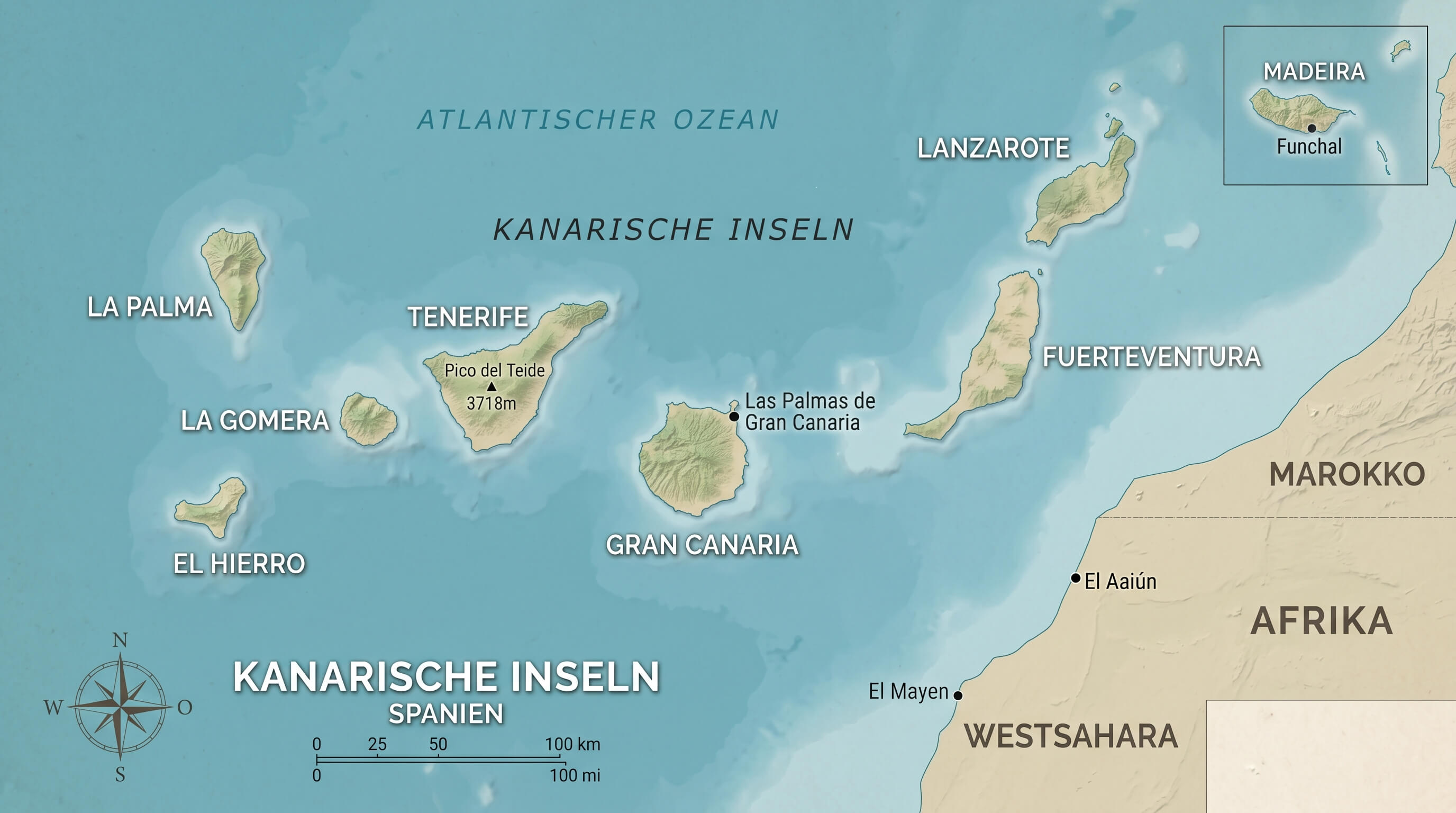
The map above shows the situation at a glance: The islands belong politically to Spain and are organized as an autonomous region—geographically, however, they are significantly closer to Africa than to the Spanish mainland. The easternmost point of the islands (Lanzarote) is only 125 km from the Moroccan coast, while Madrid is 1,800 km away. This location at subtropical latitude (27–29° North) is also the reason for the year-round spring-like weather for which the Canary Islands are so well known.
The archipelago consists of seven main islands and several smaller ones. From west to east: El Hierro, La Palma, La Gomera, Tenerife, Gran Canaria, Fuerteventura, and Lanzarote. All are of volcanic origin—hence the dramatic landscape with craters, lava fields, and black sand beaches.
A comparison of the 7 Canary Islands
| Island | character | Perfect for | Budget/day |
|---|---|---|---|
| Gran Canaria | All-rounder, miniature continent | Families, beach + mountains, nightlife | 60–100 € |
| Tenerife | Volcanic giant, diverse | Hikers, Teide, whale watching | 60–110 € |
| Fuerteventura | Desert & Endless Beaches | Kitesurfers, beachgoers, peace and quiet | 50–90 € |
| Lanzarote | Volcano art, Martian landscape | Culture, drone, wine lover | 55–95 € |
| La Palma | Green hiking island, starry sky | Hikers, nature, astrophotography | 50–85 € |
| La Gomera | Primeval forest, mystical, Garajonay | Hikers, those seeking peace and quiet | 45–80 € |
| El Hierro | Smallest, wildest, quietest | Divers, dropouts, adventurers | 40–70 € |
Gran Canaria — The miniature continent
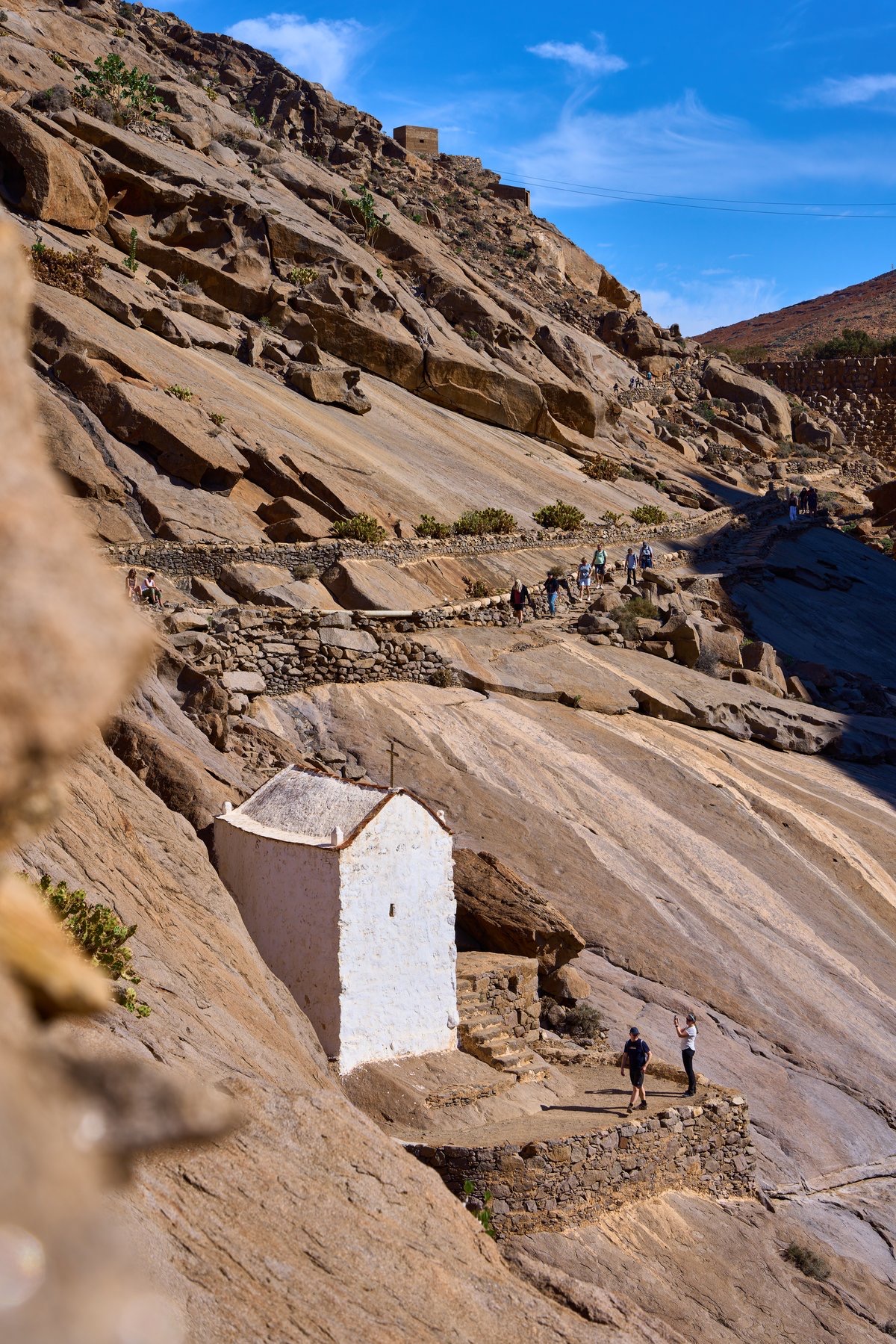
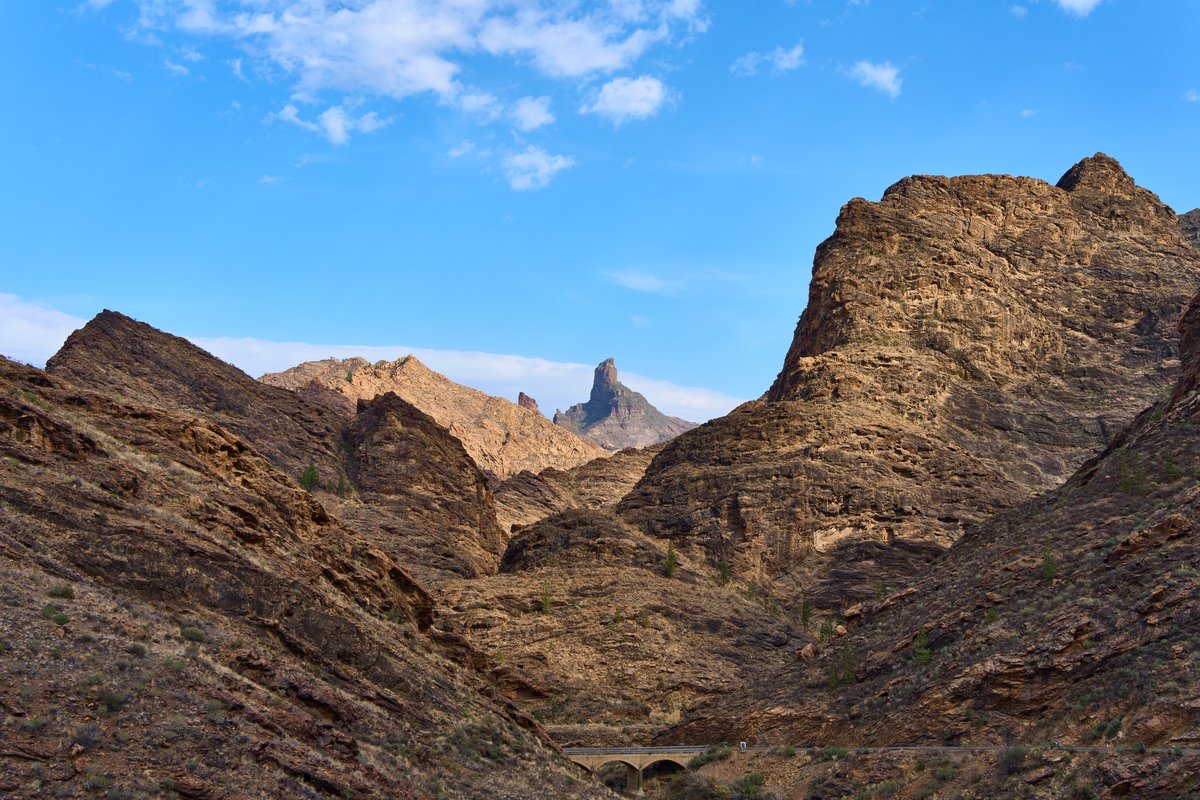
Gran Canaria packs everything onto one island: Saharan dunes (Maspalomas), green mountain valleys (Barranco de Guayadeque), cosmopolitan cities (Las Palmas), and secluded mountain villages. I call it the "miniature continent" because you can lie on the beach in the morning and hike at an altitude of 1,900 meters in the afternoon.
Maspalomas dunes (especially at sunset), Roque Nublo (landmark of the island), Las Palmas old town Vegueta, Puerto de Mogán (the „Venice of the Canary Islands“).
Read my detailed review Gran Canaria travel report including all drone footage.

Lanzarote — Where volcanoes meet art
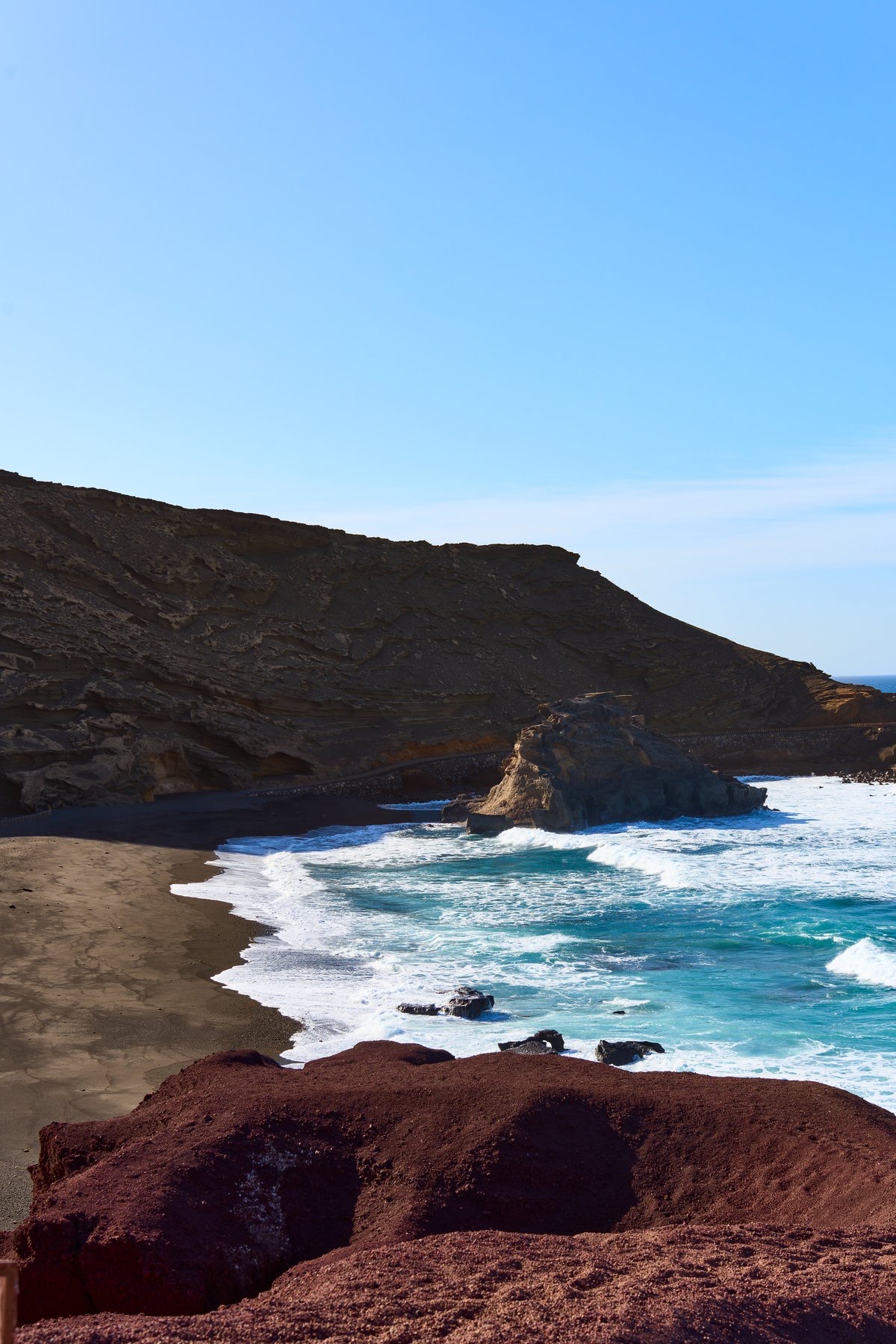
Lanzarote is the most cinematic of the Canary Islands. The volcanic landscape of Timanfaya National Park looks like Mars—red, black, and ochre lava fields as far as the eye can see. Add to that the wine-growing regions of La Geria, where vines grow in volcanic craters.
The artist César Manrique shaped the island like no other. His works — Jameos del Agua, Mirador del Río, Fundación César Manrique — are artworks that blend seamlessly into the volcanic landscape.
From the air, Lanzarote is absolutely breathtaking. The color contrasts between black lava, red sand, and turquoise sea are surreal. My Lanzarote travelogue shows the best spots.
Fuerteventura — wind, waves and wide open spaces
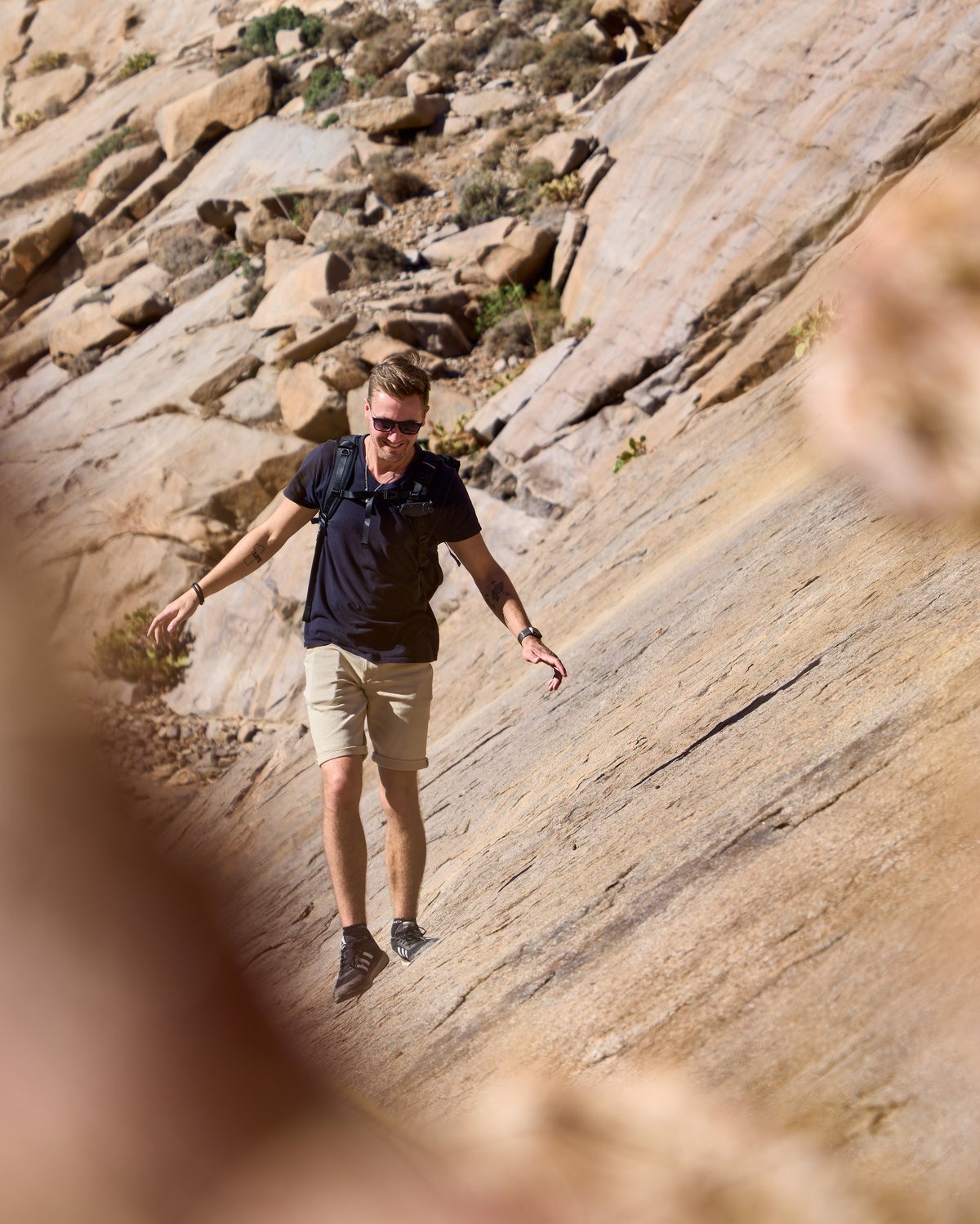
Fuerteventura is the island for kitesurfers, surfers, and anyone looking for endless beaches without crowds. The island is flat, dry, and windy—perfect conditions for water sports.
The beaches are the most beautiful in the Canary Islands: Playa de Cofete (wild and secluded), Playa de Sotavento (kitesurfing paradise), El Cotillo (surfer village). The desert landscape inland is photogenic, but less spectacular than Lanzarote's volcanoes.
All the details are in my Fuerteventura travel report.
Tenerife — Mount Teide and more
Tenerife is dominated by Spain's highest mountain — Mount Teide (3,718m). The caldera surrounding the volcano is a lunar landscape that is particularly magical at sunrise. The cable car takes you to 3,555m (summit only with a permit).
In the north, Tenerife is green and lush (Anaga Mountains, laurel forests), while in the south it is dry and touristy (Playa de las Américas). Puerto de la Cruz in the north is the most charming town on the island.
La Palma — The green hiking island
La Palma is the greenest and least touristy of the main Canary Islands. While Lanzarote is portrayed as a Martian landscape and Fuerteventura as a desert, La Palma offers a quiet contrast: subtropical laurel forests, deep volcanic gorges, and one of the darkest starry skies in Europe. The island is officially a UNESCO Biosphere Reserve and a Starlight Reserve.
For whom: Hikers, nature lovers, astro-photographers, those seeking peace and quiet.
Must-see:
- Caldera de Taburiente — the world's largest erosion crater, spectacular hikes
- Ruta de los Volcanes — 24 km long-distance hiking trail across a volcanic chain
- Roque de los Muchachos (2,426 m) — Observatory and one of the best starry skies in Europe
- Los Tilos — mystical laurel forest with waterfalls
€55–85 per day (cheaper than the major islands, little package tourism).
Following the 2021 volcanic eruption, some regions in the south are still in the reconstruction phase. The main tourist areas (Santa Cruz, El Paso, Los Llanos) are not affected.
La Gomera - The wild mountain paradise
La Gomera is one of the smallest of the Canary Islands (370 km²) and can only be reached by ferry from Tenerife. This is precisely what makes it a hidden gem: no direct flights, hardly any package tourists, instead endless mountain trails, hidden coves and the unique UNESCO World Heritage Site of Garajonay National Park — one of the last laurel forests in Europe.
For whom: Hikers, backpackers, culture enthusiasts, off-the-beaten-path travelers.
Must-see:
- Garajonay National Park — UNESCO World Heritage Site, cloud forest with trees up to 1,000 years old
- Valle Gran Rey — the hippie bay of the Canary Islands, black sand beach and sunsets
- Los Órganos — spectacular basalt columns visible only from a boat
- Silbo Gomero — the famous whistling language (UNESCO cultural heritage), is still spoken today.
€60–90 per day (accommodation is cheap, restaurants are expensive due to the island location).
Ferry from Los Cristianos (Tenerife), 50 minutes. Flights are only available from Tenerife North.
El Hierro — The wildest outpost
El Hierro is the smallest and westernmost of the Canary Islands—until 1492, it was considered the end of the known world. Today, it is one of the few European destinations that can be powered entirely by renewable resources. The island has no traditional beaches, but instead boasts dramatic cliffs, volcanic craters, and some of the best diving spots in Europe.
For whom: Divers, geology enthusiasts, off-grid travelers, minimalists.
Must-see:
- Mar de las Calmas — a protected marine reserve with dolphins, turtles, whales and crystal-clear water
- El Sabinar — wind-shaped juniper trees, one of the most surreal motifs in the Canary Islands
- Mirador de la Peña — a viewpoint designed by César Manrique overlooking the entire island
- Faro de Orchilla — the westernmost point of Spain and former Prime Meridian (before Greenwich)
Budget: €50–80 per day (budget island, limited luxury amenities).
Getting there: Direct flights only from Tenerife or Gran Canaria, or by ferry.
Madeira — The Flower Island (Bonus Recommendation)
Technically not a Canary Island (but belonging to Portugal), but often combined in the same trip. Madeira is the hiker's paradise of the Atlantic — the famous Levada walks lead along historic irrigation channels through laurel forests and spectacular gorges.
More on this in my Madeira travel report.
Which island is right for you? — Decision-making aid
- First Canary Islands trip: Gran Canaria or Tenerife — the most diverse
- Beach + Kitesurfing: Fuerteventura
- Photography + drone: Lanzarote (volcanoes) or La Palma (starry sky)
- Hiking: La Palma, La Gomera or Madeira
- Rest + get out: El Hierro or La Gomera
- Nightlife: Gran Canaria (Las Palmas, Playa del Inglés)
- Family: Gran Canaria (best infrastructure) or Tenerife
Best time to travel & which island is the warmest?
The Canary Islands are rightly marketed as the "Islands of Eternal Spring" — the average temperature remains between 18 and 25 °C all year round. But there are significant differences between the islands and between the north and south sides of each island.
Which Canary Island is the warmest?
The warmest of the Canary Islands is Fuerteventura, closely followed by Gran Canaria (south) and Lanzarote. The reason: their location in the east, closer to the African mainland, plus their flat topography without high mountains to block clouds. Fuerteventura's average annual temperature is 22.4 °C. In winter (December–February), the daytime temperature remains consistently between 20–22 °C, and in summer between 26–28 °C.
Temperature comparison of the main islands (annual average)
- Fuerteventura: 22.4 °C — warmest island, very stable temperatures
- Gran Canaria (South): 22.2 °C — warm, dry south, green north
- Lanzarote: 21.9 °C — warmer but windier than Gran Canaria
- Tenerife (South): 21.5 °C — warm in the south, significantly cooler in the north
- La Palma: 20.1 °C — cooler due to altitude and northeasterly exposure
- La Gomera: 20.3 °C — mild, often trade wind clouds in the north
- El Hierro: 20.0 °C — windy and cool, warmest coasts in the south
Best time to travel for each type of trip
- Beach holidays: Possible all year round, ideal October–April
- Hiking: March–May and September–November (pleasant temperatures, little rain)
- Kitesurfing/Surfing: November–March (trade winds strongest)
- Starry skies (La Palma): August–October (clear nights, few trade wind clouds)
- Diving (El Hierro): August–October (best visibility)
FAQ — Frequently Asked Questions about the Canary Islands
Are the Canary Islands 7 or 8 islands?
The Canary Islands consist of seven inhabited main islands and several smaller islands. Since 2018, La Graciosa (northwest of Lanzarote) has also been officially recognized as an eighth island—but it has only around 700 inhabitants and no airport. In a travel context, the seven main islands are usually mentioned: El Hierro, La Palma, La Gomera, Tenerife, Gran Canaria, Fuerteventura, and Lanzarote.
Do the Canary Islands belong to Africa or Europe?
The Canary Islands belong politically to Spain and therefore to the European Union. Geographically, however, they lie on the African continental plate, only about 100 km off the coast of Morocco and Western Sahara. For travelers, this means: EU entry with a national identity card, the euro as currency, German-speaking doctors in tourist areas—but the subtropical climate of Africa.
Which Canary Island is the warmest?
With an average annual temperature of 22.4 °C, it is the warmest of the Canary Islands. The south of Gran Canaria (Maspalomas) is only slightly behind at 22.2 °C. In winter (December–February), these two islands are the most reliable choice for consistently warm temperatures of 20–24 °C.
Which Canary Island is the cheapest?
For package holidaymakers, Gran Canaria is often the cheapest option due to the wide selection of flights and hotels (from €400 per week in the off-season). For independent travelers, La Palma is the most affordable island, with prices ranging from €55 to €85 per day and budget-friendly accommodations. Lanzarote and Fuerteventura fall in between in terms of price, while Tenerife is the most expensive, particularly in its tourist hotspots.
Which island is suitable for families?
Gran Canaria is the most family-friendly island: extensive package holiday infrastructure, child-friendly beaches in Maspalomas and Playa del Inglés, theme parks (Palmitos Park, Sioux City), and good medical care. An alternative is Fuerteventura for a beach holiday with a more relaxed atmosphere.
Which island is best for hikers?
La Palma is by far the most popular destination—the Caldera de Taburiente and the Ruta de los Volcanes are among the most spectacular hiking trails in Europe. La Gomera and Tenerife (Teide National Park, Anaga Mountains) follow. Those who prefer less mountainous terrain will find a variety of highland hikes on Gran Canaria.
Do I need a rental car?
Yes, on every island except Gran Canaria and Tenerife South. While the Canary Islands have bus connections between larger towns, the most beautiful spots (Caldera de Taburiente, the Anaga Mountains, El Cotillo on Fuerteventura) are only accessible by car. Rental car prices start at €20 per day in the off-season. Note: the mountain roads on El Hierro and La Gomera are winding—not recommended for those prone to motion sickness.
When is the best time to travel to the Canary Islands?
The Canary Islands are a year-round destination with a pleasant climate throughout the year. For beach holidays, the warmest time is June to October (25–29°C water temperature). For hiking and city breaks, March to May and October to November are ideal (pleasant 20–24°C, little rain). Peak season is Christmas/New Year and February to March (Carnival) – during these periods, flights and hotels are significantly more expensive.
A professional travel creator for over 10 years with over 4 million followers on Instagram. Specializing in high-end tourism board collaborations, luxury hotel campaigns, and drone photography from 82+ countries.


 German
 English