
Albania Sights: 12 Highlights & Route
Albania Sights: 12 Highlights & Route
The sights of Albania pack mountains, Ottoman old towns, springs and a long Mediterranean coast into surprisingly short distances. When I spent just under two weeks travelling the country by rental car and drone in April 2025, I had hardly any expectations. That is exactly why the contrasts impressed me so much: cobblestones and historic houses in the morning, a mountain road later on and a view over clear water in the evening. This overview helps you choose the most important places sensibly instead of just collecting individual photo spots on a map.
My selection is based on that trip and sorts the places by what makes them special and how they can be linked into a route. I tell the story of the drive in more detail in my Albania travel report with route and practical tips. Here the focus is deliberately on the sights: from Tirana and Kruja via Berat to the Riviera and the Blue Eye.
Albania sights at a glance
Anyone travelling to Albania for the first time can easily underestimate its variety. In the north lie the Albanian Alps with deep valleys and mountain villages. Around Tirana, capital city life, history and the Bovilla Reservoir come together. Further south come Berat and Gjirokastra, before the landscape turns more Mediterranean towards the Riviera and Saranda. That means city, culture, hiking and coast can all be combined in one round trip.
For my trip a rental car was the right choice. The main roads were straightforward, while access roads away from them could be bumpy. At the Bovilla Reservoir in particular, the gravel road was part of the experience. So I would not only compare distances but also leave time for slow sections, breaks and spontaneous viewpoints.
- Tirana works well as a starting point and for urban sights.
- Kruja combines a castle, a bazaar and the history of Skanderbeg.
- Bovilla stands for landscape, views and a more adventurous approach.
- Berat and Gjirokastra show historic townscapes in the interior.
- The Riviera, Saranda and Butrint add beaches and ancient history.
- Theth and Valbona are the places for mountain scenery and longer hikes.
Albania sights around Tirana
Tirana: colour and everyday life
Tirana was a surprise for me. The capital feels colourful and lively without being reducible to a single landmark. A good starting point is the car-free Skanderbeg Square in the centre. From there you can explore the city on foot. The brightly painted facades of many formerly grey buildings shape the streets and also tell the story of how Tirana has changed.
Cafés and restaurants cluster in the Blloku district, while the New Bazaar brings market life and modern design together. What I liked most about Tirana was that ordinary city life always remains visible between the well-known spots. So plan time for a coffee break and a walk with no fixed destination as well.
Kruja: castle and Old Bazaar
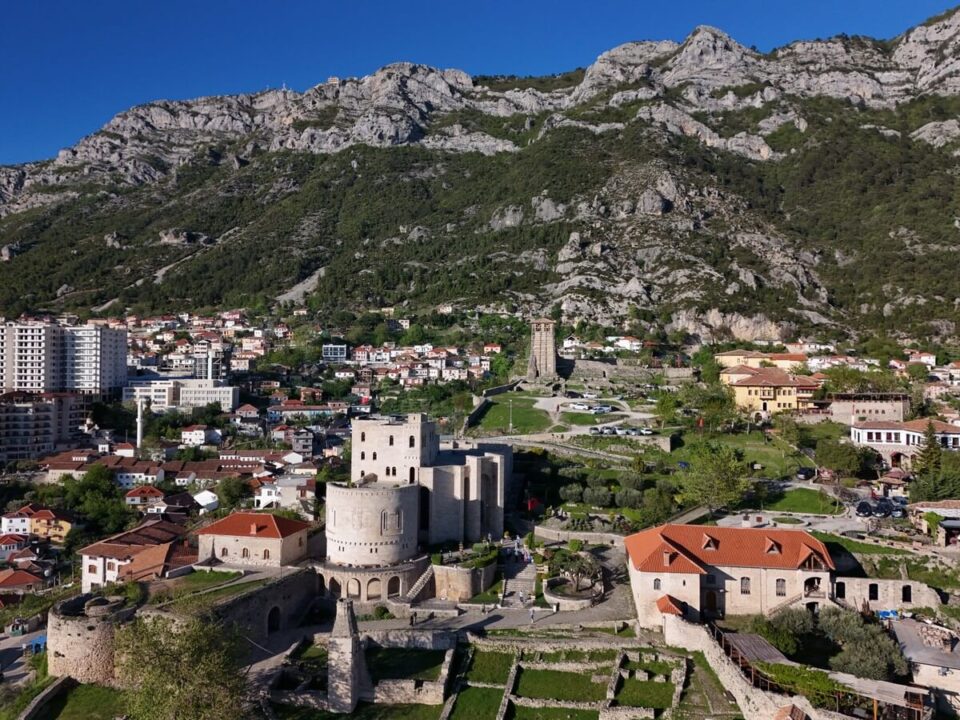
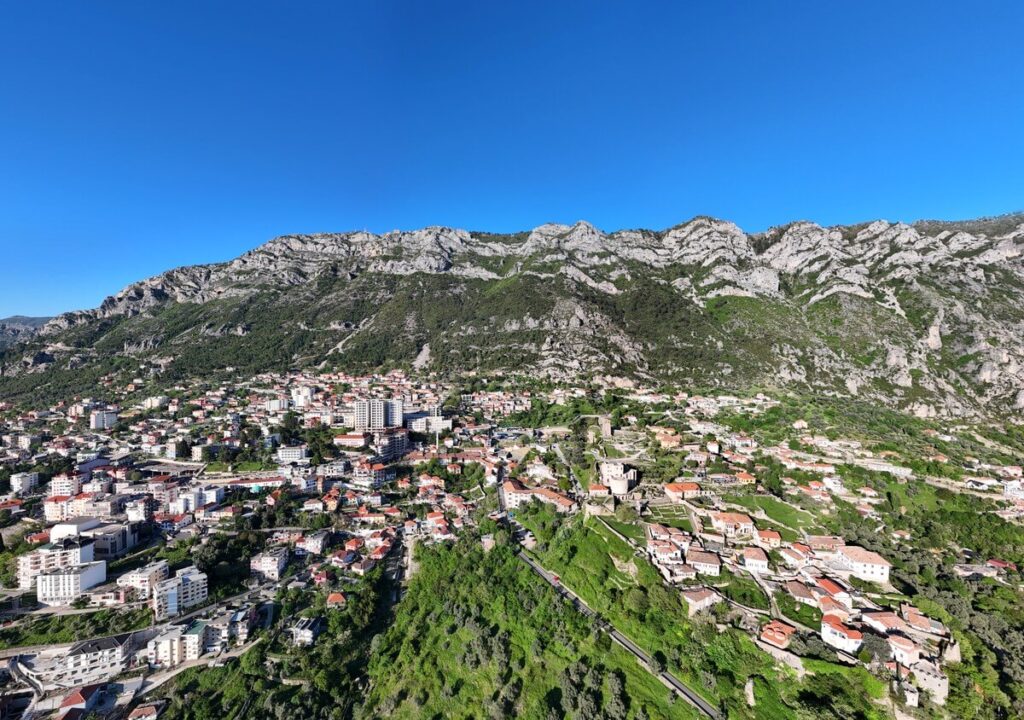
Kruja lies north of Tirana and is tied to George Kastrioti, known as Skanderbeg. His struggles against the Ottomans in the 15th century made him a national hero. The castle above the town, the mountains behind it and the Old Bazaar climbing the slope form one of the most striking historic ensembles on my route.
In the bazaar, cobbled lanes lead past carpets, metalwork and small shops. Even so, Kruja did not feel like a stage set to me. I sat in a small café there for two hours, drank Turkish coffee and watched what was going on. The bazaar is quieter early in the morning; it is also worth looking beyond photos and noticing the details and the craftsmanship.
Bovilla: the turquoise reservoir
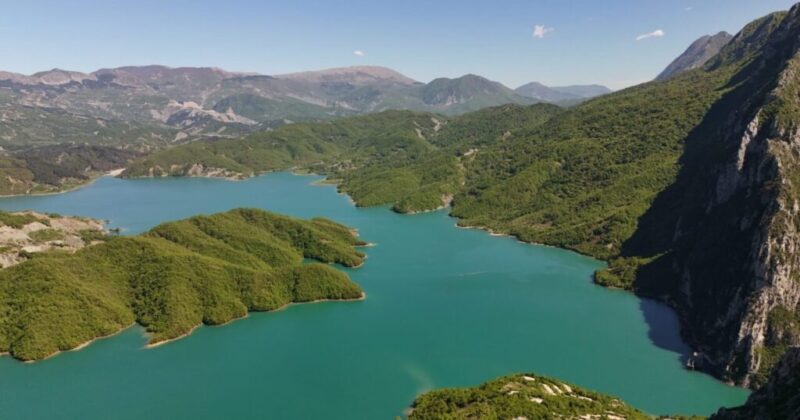
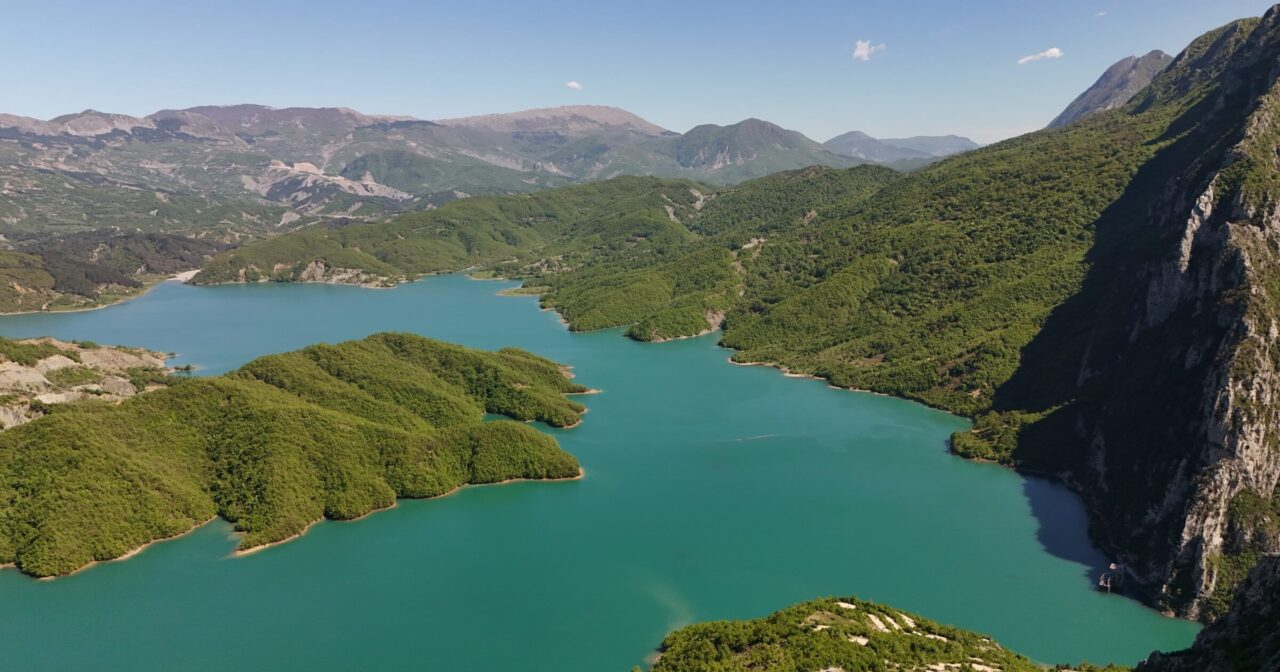
The Bovilla Reservoir north of Tirana was the strongest landscape of my trip. The water glows an intense turquoise between green mountains. I sent my drone up several times because the colour looked almost unreal on the camera screen. On site it was just as impressive. The panorama does not depend on a building but on the interplay of water, rock and open space.
The approach ran along a winding gravel road full of potholes. If you drive up, leave enough time and do not assume that a short distance is automatically covered quickly. It was quiet at the top during my visit. That calm is exactly what made Bovilla more than a photo stop. Respect for the landscape and for water protection should go without saying on a visit.
Historic Albania sights in the interior
Berat: a thousand windows
Berat is known as the “city of a thousand windows”. From the opposite bank of the river in particular it becomes clear why: the whitewashed Ottoman houses stand close together on the slope and their many windows define the view. The historic quarters of Mangalem and Gorica lie on different sides of the river and are connected by a stone bridge.
Above Mangalem sits the sprawling castle. What is remarkable is that people still live within its walls. Between the houses there are small churches, mosques and restaurants. As a result the site does not feel like a closed open-air museum. For me, this transition from monument to lived-in neighbourhood was exactly what made it interesting. On the steep paths, comfortable shoes help more than a tightly timed plan.
Gjirokastra: an old town of stone
Gjirokastra makes a good southern addition to Berat without simply repeating the same experience. The historic town is shaped by steep lanes, traditional houses and its fortress. On my route it lay between Berat and the Blue Eye. That made it easy to combine a cultural stop with the onward drive towards the coast.
Berat works through its hillside facades and the river, Gjirokastra through stone, steep gradients and the dominant fortress. If you visit both, give each of them time instead of treating them as interchangeable old-town stops. The atmosphere reveals itself when you walk slowly.
Butrint: antiquity near Saranda
Butrint lies in the south near Saranda and adds another historical layer to the trip. The ancient ruins form a clear contrast to the Ottoman old towns of Berat and Gjirokastra. This lets you add culture to a stay on the coast without driving far back inland for a whole day.
On my twelve-day route, Saranda and Butrint together made up the second-to-last day. This combination is practical if the drive back to Tirana follows afterwards. I would not treat the site as a quick box to tick: ruins make more sense when you look at paths, setting and landscape as one connected complex.
Albania sights on the Riviera
Gjipe Beach: a bay between cliffs
Gjipe Beach is a small pebble bay framed by high rock walls. It can be reached on foot or by boat. I took the hiking trail, which led downhill for about 30 minutes. The way back is correspondingly uphill, so water and enough time are part of the plan. This access is exactly what sets Gjipe apart from a beach where you park right next to your towel.
In the bay, clear water, rocks and the opening to the sea come together. Large hotel blocks did not shape my impression there. Still, seclusion does not mean a place can take unlimited pressure. If you bring food, take everything back with you and stay on the paths.
Dhermi, Jale and Porto Palermo
The Riviera between Vlora and Saranda cannot be reduced to a single bay. Dhermi, Jale and Gjipe were stops on my coastal leg; Porto Palermo added another point along the route. Clear water, rocky stretches and pine trees are typical. Even the drive along the coast keeps delivering new perspectives on mountains and sea.
Instead of ticking off as many beaches as possible in one day, I would deliberately choose a few stops. Dhermi and Jale are easier to fit into a coastal route, while Gjipe needs more time because of the walk. Season and heat also matter for planning. In high summer the coast gets very hot and crowded; May, June and September are considered more pleasant alternatives.
Syri i Kaltër: the Blue Eye
Syri i Kaltër, the Blue Eye in the south, is a karst spring in a wooded area. The intensely blue centre explains the name immediately. The water rises from great depth and shifts between dark blue and turquoise depending on the angle. On my trip I combined the visit with Gjirokastra and the onward drive towards the Riviera.
One distinction matters: there is also a place near Theth that is called the Blue Eye. If you just type “Blue Eye Albania” into your navigation, check which one is meant. Syri i Kaltër lies in the south near Saranda; the other one belongs to the mountain region around Theth.
Albania sights in the Albanian Alps
Theth and Valbona
Theth and Valbona stand for a completely different side of the country than the Riviera. The mountain villages lie in impressive valleys of the Albanian Alps. The well-known Valbona to Theth trail runs between them over a mountain pass. The tour is a longer hike and should be planned as a stage of its own, not as a spontaneous detour on the way south.
In Theth, the Grunas Waterfall and the local Blue Eye are among the well-known natural sights. Several days make sense for the region so that the journey there, the hike and a weather buffer do not work against each other. The mountain season is shorter than the travel season on the coast; for hiking, the summer months from June to September are considered the most suitable period.
My actual trip took me from Tirana via Kruja, Bovilla, Berat and Gjirokastra to the Riviera and Saranda. That is why I mention the Alps as a separate extension and not as a stage I completed myself. This keeps the planning honest: if you want to combine north and south, you need more time than for my compact route.
Planning Albania sights as a road trip
Albania sights on a twelve-day route
My sequence began with two days in Tirana. Kruja and Bovilla followed, each as a stage of its own. I planned two days for Berat, then the route led via Gjirokastra and Syri i Kaltër to the coast. Dhermi, Jale and Gjipe filled the Riviera days before Saranda and Butrint formed the southern finale. On day twelve I drove back to Tirana.
- Days one and two: Tirana with the centre, Blloku and the New Bazaar.
- Day three: Kruja with the castle and Old Bazaar.
- Day four: Bovilla Reservoir and viewpoints.
- Days five and six: Berat with Mangalem, Gorica and the castle.
- Days seven and eight: Gjirokastra and Syri i Kaltër.
- Days nine and ten: the Riviera with Dhermi, Jale and Gjipe.
- Day eleven: Saranda and Butrint.
- Day twelve: drive back to Tirana.
This order avoids constant back and forth and links similar regions together. Even so, it should not be a rigid programme. Gravel roads, longer stops and weather can cost time. If you also want to see Theth and Valbona, it is better to extend the trip than to keep cutting the southern stops shorter.
Preparing for Albania sights in practice
Outside the cities, having your own vehicle makes remote places much easier to reach. I picked up my rental car at Tirana airport. I made good progress on main roads, while side roads called for careful driving. Offline maps are useful because there can be dead spots in mountain regions. Albania is not part of the EU, so mobile roaming should also be checked before the trip.
For realistic budget planning I have summarised my observations separately in Albania costs for a road trip and travel budget . If you mainly want to know why the country stands out for me as a European destination, you will find more context in Albania as a hidden gem in Europe. That keeps this article focused on choosing and combining the sights.
Tourism boards that want to present landscape, culture and local experiences in a distinctive visual story will find information about my content production and possible projects on the page Collaboration.
Experiencing Albania sights responsibly
Many of the strongest places live from their surroundings: Bovilla from the calm by the water, Gjipe from its hard-to-reach bay and the Alps from trails through sensitive mountain landscape. Precisely because Albania is becoming more visible to tourists, each person's behaviour counts. Taking your rubbish with you, respecting barriers and using local paths are small but decisive contributions.
Restraint pays off when taking photos too. A drone opens up special perspectives, but local rules, protected areas, privacy and safe distances come first. Check current regulations before you fly.
Albania did not win me over with a single attraction but with the quick succession of very different landscapes and towns. If you choose fewer places and stay longer, you notice more: conversations in a café, the light on Berat's facades or the silence above Bovilla. That, for me, is where the value of these sights lies.
FAQ
Which sights are a must-see in Albania?
For a first round trip I would combine Tirana, Kruja, Bovilla, Berat, Gjirokastra, Syri i Kaltër and at least one stretch of the Riviera. Butrint adds ancient history to the route. If you have more time and hiking experience, you can add Theth and Valbona as a separate northern stage.
How many days do I need for the sights of Albania?
Twelve days were enough for me for a route from Tirana through the interior to the Riviera and back. Berat and the coast each got more room. I would plan extra days for the Albanian Alps, because the journey there and longer hikes do not fit sensibly into a short stopover.
Which Albania sights are by the sea?
On the Riviera, Dhermi, Jale and the cliff-framed Gjipe bay are among the well-known places. Further south lies Saranda, from where Butrint is an easy addition. The coastal drive itself is an important part of the experience thanks to the changing mix of mountains, bays and sea.
When is the best time to visit the sights of Albania?
May, June and September usually combine pleasant travel weather with fewer crowds than high summer. July and August can be very hot and busier on the coast. For Theth, Valbona and higher hiking trails the usable window is narrower; June to September is the right season there.
Do I need a rental car for the sights of Albania?
Not for Tirana itself, but for a round trip the rental car was the most flexible option for me. Places like Bovilla or several stops on the Riviera are easy to link that way. Away from the main roads you may meet gravel and potholes, so driving time and choice of vehicle should match the route.
 German
 English
 French
 Spanish
 Italian
 Japanese
 Chinese
 Dutch
 Portuguese