
Best travel camera: Beginner, hobbyist & professional tested 2026
Best cameras for travel content — My honest equipment guide
I get asked more questions than almost any other: "Max, what camera do you use?" And I understand why—as a travel content creator, your camera is your most important tool. In over ten years as a professional creator, I've tested, bought, resold, and broken dozens of cameras. From a GoPro in my backpack to mirrorless system cameras to a professional drone—I've worked with almost everything the market has to offer. In this guide, I share my honest experiences and recommendations, sorted by budget and use case.
- Current professional setup: Sony A7V (~€2,800) as main body plus Sony A7 IV (~€1,800 used) as secondary body, three Tamron lenses (17-28mm, 28-200mm, 50-400mm) plus two drones — total value around €10,000.
- Beginner recommendation: A good smartphone plus the DJI Mini 5 Pro Fly More Combo Plus (~€1,199) is enough to stand out from 90% of all travel accounts.
- Video alternative: Canon EOS R6 Mark II (~€2,500) delivers 4K60 without cropping and the best in-body stabilizer in its class for walk-and-talk vlogs.
- Drone as a game changer: The DJI Mini 5 Pro weighs under 249g, delivers 4K HDR and 48MP photos — around 60 of the most liked posts are drone shots.
- Essential accessories: Sony Tough CFexpress Type A (160 GB, ~250 €) and Sony Tough SD UHS-II (128 GB, ~90 €) for dual-slot backup, ND filter set for drone (30-50 €), Rode Wireless GO II (250 €) for vlog audio.

My current setup 2026
Before I get into the recommendations, here's my personal setup that I use every day (full details in the Content Creator Equipment Guide 2026):
- Main camera: Sony A7V — Full-frame, new sensor, AI autofocus, 10-bit 4:2:2 internal
- Second camera: Sony A7 IV — 33 megapixels, 4K60, still in active use since 2022
- Wide-angle: Tamron 17-28mm f/2.8 Di III RXD — Landscape, architecture, narrow old town streets
- Travel zoom: Tamron 28-200mm f/2.8-5.6 — the most versatile lens, often the only one in the backpack
- Telephoto zoom: Tamron 50-400mm f/4.5-6.3 VC — Wildlife, safari, distant subjects
- Drone 1: DJI Mavic 4 Pro — best image quality, 1-inch sensor
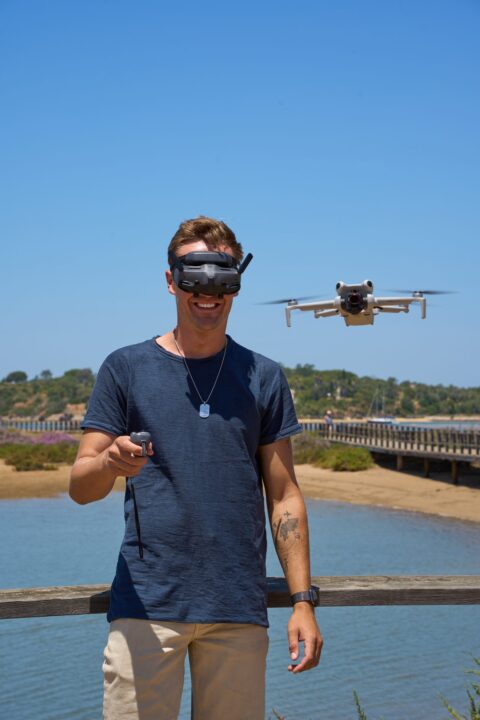
- Drone 2: DJI Mini 5 Pro Fly More Combo Plus — under 249g, usable worldwide without problems
- Action Cam: DJI Action 6 Pro — waterproof, stabilized, perfect for underwater and POV photography
- Storage: Sony Tough CFexpress Type A 160 GB plus Sony Tough SD UHS-II 128 GB — dual-slot recording
Total value of the setup: around €10,000 — and every euro has paid for itself over the years. This is obviously a professional setup and not what I would recommend to a beginner. But it shows where things can lead.
Category 1: Best camera for amateur and professional photographers (mirrorless)
Sony A7V — My main camera (approx. €2,800 body only)
The Sony A7V has been my main camera body since 2025 and is a real upgrade from the A7 IV. The new sensor, the improved AI autofocus with subject recognition for humans, animals, and birds, and the further enhanced video quality make the A7V the perfect workhorse for professional travel content production. For travel content, this means: you press the shutter button and the focus is spot on—even in souks, temples, or at sunset.
The internal 10-bit 4:2:2 recording is a game-changer for a hybrid shooter. I can take photos one moment and shoot a reel the next without switching cameras. Dual slots with CFexpress Type A and SD card provide backup security for every mission. Weaknesses: The body stabilizer is good, but for pure walk-and-talk vlogs, a gimbal or post-stabilization is still necessary.
Sony A7 IV — My tried and tested second body (approx. €1,800 used)
The Sony A7 IV It's been my main camera since 2022 and now accompanies me on every important trip as my second body. 33 megapixels, 4K60, excellent autofocus—it still delivers fantastic results and is an absolute bargain on the used market. For anyone wanting to get into the full-frame Sony system today without immediately buying the A7V, the A7 IV might be the best deal on the market.
View the Sony A7 IV on Amazon →
Sony A7C II — The compact alternative (approx. €2,100 body only)
If the A7 IV is too big and heavy for you (it easily weighs over 1.2 kg with a lens), the A7C II is the perfect alternative. Same sensor, same autofocus, but in a significantly more compact body that's more reminiscent of a point-and-shoot camera. For travelers who don't want to look like a professional photographer (which attracts attention in some countries), that's a real selling point.
View the Fujifilm X-T5 on Amazon →
Fujifilm X-T5 — For cinematic aesthetics (approx. €1,700 body only)
Fujifilm enjoys cult status among content creators, and for good reason: The built-in film simulations (Classic Chrome, Nostalgic Neg, Eterna) produce a look that appears fantastic straight out of the camera—without hours of post-processing. If you love the "film look" and don't want to spend all your time in Lightroom, the X-T5 is the camera for you.
View Canon EOS R6 Mark II on Amazon →
Canon EOS R6 Mark II — The Video King (approx. €2,500 body)
If video is your priority, the Canon R6 II is hard to beat. 4K60 without cropping, excellent autofocus with Dual Pixel AF, and the best in-body image stabilization in its class—you can literally film while walking and the result will look stable. It's the top choice for vloggers and travel filmmakers. Canon's colors are also natural and skin-friendly, which is a huge plus for people-focused content.
My lenses: Three Tamron lenses for Sony E-mount
The Sony system has the largest lens lineup of all mirrorless systems. For travel content, three Tamron lenses are my complete solution—they cover everything from ultra-wide-angle to super-telephoto and cost only a fraction of comparable Sony G Master lenses.
Tamron 17-28mm f/2.8 Di III RXD (~800 €)
My go-to wide-angle lens for landscapes, architecture, and storytelling. Compact, lightweight, and with a constant f/2.8 aperture for low-light performance. I take about half of my travel photos with this lens.
Tamron 28-200mm f/2.8-5.6 Di III RXD (~800 €)
The most versatile lens in the setup. From portraits and street photography to medium-sized wildlife photography—a single lens for most travel situations. When I need to save weight, it's often the only lens in my backpack.
Tamron 50-400mm f/4.5-6.3 Di III VC VXD (~1,300 €)
My special lens for safaris, wildlife, and distant subjects. The focal length range up to 400mm opens up perspectives that would be impossible with shorter zooms. The built-in image stabilizer even makes handheld shooting at 400mm possible.
Category 2: Drones — My most important content tool
DJI Mini 5 Pro Fly More Combo Plus — Under 249g, exceeding all expectations (approx. €1,199)
The DJI Mini 5 Pro The DJI Mini 5 Pro is the piece of equipment that has changed my content the most. Weighing less than 249 grams, it means in most countries: no registration, no permit, just take off. And the image quality is absurdly good for its size—4K HDR video, 48MP photos, obstacle avoidance in all directions.
Approximately 601,033 of my most-liked Instagram posts are drone shots. The bird's-eye view opens up a completely new dimension of travel content—beaches, mountain landscapes, and cities simply look spectacular from above. DJI Mini 5 Pro It fits in any jacket pocket and weighs less than a smartphone with a case.
My workflow: I typically fly at sunrise or sunset (the "golden hour") when the light is best. I take 3-4 photos and 2-3 short video clips per flight, then land and head to the next location. With three batteries, I get about 90 minutes of total flight time—more than enough for a day of shooting.
DJI Air 3S — The upgrade for enthusiasts (approx. €1,100)
The Air 3S has two cameras (wide-angle + 3x telephoto) and a larger sensor than the Mini. If you frequently fly in low light or need the telephoto look (e.g., for wildlife from above), the Air 3S is worth the upgrade. The downside: it weighs over 249g and must be registered in most EU countries. Outside of Europe, this isn't a concern.
older travel drone
The Mavic 3 Classic has a Micro Four Thirds sensor — the same type of sensor used in some system cameras. Accordingly, the image quality is at a level that, just a few years ago, was only possible with cinema drones costing €5,000+. For professional commissioned work (Tourism BoardFor projects like hotels and commercials, I sometimes use the Mavic 3 when image quality absolutely has to be perfect. But for personal content, the DJI Mini 5 Pro is perfectly adequate.
Category 3: Action Cams — For extreme moments
DJI Action 6 Pro — My favorite (approx. €350)
The DJI Action 6 Pro has completely replaced the GoPro in my setup. Why? The magnetic quick-release system is brilliant—you can click the camera onto different mounts in seconds, without any fiddly screws. The image stabilization ("RockSteady 3.0 Plus") is the best on the market. And it's waterproof to 20 meters without an additional housing.
I mainly use the Action 6 Pro for snorkeling, kitesurfing, quad biking, and whenever a "real" camera would be too risky or bulky. The 4K 120fps slow-motion underwater scenes are regularly among my favorite reels.
GoPro Hero 13 — The classic (approx. 400 €)
The GoPro is still an excellent action camera, especially if you're invested in the GoPro ecosystem (mounts, subscriber cloud). Image quality and stabilization are on par with the DJI Action 6. Where the GoPro wins: the accessory ecosystem is huge, and there's a mount for every conceivable situation. Where it loses: battery life and the annoying touchscreen, which doesn't work underwater.
Category 4: Smartphones — Don't underestimate them
I say this as someone who has invested thousands of euros in camera equipment: The current flagship smartphones (iPhone 16 Pro Max, Samsung S25 Ultra, Google Pixel 9 Pro) take fantastic photos and videos for social media. If you primarily produce for Instagram and TikTok and don't need print-quality resolution, you can start with a good smartphone and don't need to be ashamed.
I use my smartphone (iPhone 16 Pro Max) for: spontaneous stories, behind-the-scenes footage, time-sensitive situations where I don't have time to get out my Sony camera, and as a backup. Approximately 301,000 of my Instagram stories are filmed with my smartphone—and nobody notices the difference.
Good camera: cheap or professional? My budget guide for beginners
| budget | Set up | Cost |
|---|---|---|
| Beginners | Smartphone + DJI Mini 5 Pro | ~1.000 € |
| Advanced | Fujifilm X-T5 + Kit Lens + DJI Mini 5 Pro + Action Cam Cam | ~3.000 € |
| professional | Sony A7 IV + 2 lenses + DJI Mini 5 Pro + DJI Action 6 Pro | ~6.000 € |
| High-end | Sony A7 IV + GM lenses + older travel drone | ~10.000+ € |
Accessories that make the difference
Besides the camera, there are accessories that I consider indispensable:
- ND filters for drones: Without ND filters, drone videos look "stuttering" in bright sunlight (due to insufficient exposure time). A set (ND8, ND16, ND32, ND64) costs €30-50 and makes a huge difference.
- Fast memory card reader: A USB-C card reader for on the go, to back up data to your laptop. Nothing is worse than full cards and no backup.
- Spare batteries: At least 2 extra batteries for the camera and drone. There are no power outlets in remote locations.
- For vlogs and voiceovers, a Rode Wireless GO II (approx. €250) — a wireless microphone that clips directly onto the camera.
- Peak Design Everyday Backpack or Wandrd PRVKE. My equipment needs to be protected, but the backpack shouldn't look like it's designed to "steal me".
- Cleaning kit: Lens pen, microfiber cloth, blower. Essential in tropical and dusty environments.
What really matters — Beyond technology
I say this after over 10 years of experience: The camera accounts for at most 201 of the result. 801 of the results are light, composition, and timing. I've taken photos with an iPhone that got 200,000 likes, and photos with a Sony A7 IV that flopped. The difference was never the camera—it was always the situation, the light, and the story behind it.
Frequently Asked Questions
Which camera do you recommend for absolute beginners?
A good smartphone plus the DJI Mini 5 Pro. Seriously. You already have the smartphone, the drone costs €900 and gives you a perspective that no matter how expensive a camera is, it can't offer from the ground. With this, you'll produce content that stands out from the 90% of travel accounts. If after six months you realize you want more: the Fujifilm X-T5 is the next step.
Sony or Canon for travel content?
Both are excellent. Sony has better autofocus and a more compact system. Canon has more natural colors and better in-body image stabilization. For photo-focused creators: Sony. For video-focused creators: Canon. In practice, the differences are minimal—just choose the camera that feels better in your hand.
Do I need a full-frame camera?
No. APS-C cameras like the Fujifilm X-T5 or Sony A6700 deliver perfectly adequate quality for social media and the web. Full-frame is only worthwhile if you're shooting in very low light, want extreme bokeh effects, or are producing for print. For Instagram, nobody will notice the difference in normal lighting conditions.
How do I transport my equipment safely when traveling?
Camera body and lenses always go in hand luggage—never in checked baggage. Drone batteries also go in hand luggage (lithium batteries are prohibited in the cargo hold). I use a Peak Design Everyday Backpack 20L as hand luggage, in which everything is stored. The drone and its batteries go in a small bag that fits in the side pocket of the backpack.
Is a gimbal worth it for travel videos?
It depends. If you do a lot of "walk and talk" content or want cinematic B-roll: yes. The DJI RS 4 Mini (around €300) is compact enough for travel and offers excellent stabilization. If you mainly take photos and short clips: no. The in-body stabilization of modern cameras is sufficient for most situations, and a gimbal is just another bulky item to carry in your backpack.
Max Haase
Travel Content Creator · Drone Photographer · Visual Storyteller
A professional travel creator for over 10 years with over 4 million followers. Specializing in high-end tourism board collaborations and visual travel storytelling.
 German
 English