
Spain Part 2 – Andalusia, Granada & the beaches of…
Andalusia – the south of Spain – was the emotional highlight of our Spain stage. The blend of Moorish architecture, flamenco culture, white mountain villages, and the wild Atlantic coast makes Andalusia one of the most diverse regions in Europe. Andalusia travelogue I will share our route, the most beautiful places, and practical tips.
Granada & the Alhambra – Moorish Masterpiece
The Alhambra The Generalife in Granada is the most impressive building I have seen in Europe – and I have seen many. The intricate details of the Islamic ornamentation, the water features of the Generalife gardens, and the view over Granada to the Sierra Nevada are breathtaking. Important: Tickets MUST be booked online weeks in advance. Sold out on site = no chance.
The Albaicín district (UNESCO) with its white alleyways and viewpoints is magical at sunset – when the Alhambra glows golden against the backdrop of the snow-capped Sierra Nevada. Mirador de San Nicolás It's THE sunset spot, but don't expect solitude: there are 200 other tourists there.
Seville, Córdoba & the white villages
Seville is the most passionate city in Spain: Flamenco in the bars of the Triana district, tapas for €2-3 per portion, the Giralda Cathedral and the Alcázar Palace (Game of Thrones filming location!). Córdoba Impressive with the Mezquita – a mosque in a cathedral in a mosque, an architectural paradox that must be seen to be understood.
The Pueblos Blancos (White villages) in the mountains between Ronda and Cádiz are pure Andalusia: whitewashed houses, narrow streets, flower pots on every corner. Ronda Its spectacular bridge over the 100m deep gorge is the highlight – and a fantastic drone subject.
Costa de la Luz – Andalusia’s wild Atlantic coast
The Costa de la Luz Between Cádiz and Tarifa lies Andalusia's best-kept secret: endless golden sandy beaches, constant winds for kitesurfing, and an atmosphere light years away from the high-rise hotels of the Costa del Sol. Tarifa It is the southernmost point of mainland Europe and the kitesurfing capital of Europe – on clear days you can see Africa on the horizon.
For campers: The Costa de la Luz is one of the last havens for van life in Southern Europe. Away from the main beaches, there are still tolerated campsites right by the sea. How long this will remain the case is uncertain – so take advantage of it while you can.
FAQ – Andalusia Travel
What are the must-see sights in Andalusia?
The Alhambra in Granada (book tickets in advance!), Seville (Alcázar + Flamenco), Córdoba (Mezquita), Ronda (bridge) and the Costa de la Luz.
How many days do you need for Andalusia?
Minimum 7 days for Granada + Seville + Córdoba + coast. Ideal: 10-14 days for a relaxed experience including the White Villages.
When is the best time to travel to Andalusia?
March-May and September-October. In the height of summer (July/August) it becomes unbearably hot (40°C+ in Seville/Córdoba).
From Andalusia we continued to Portugal. Back: Spain Mediterranean | Van Life Overview | Request Collaboration
Through the Desierto de Tabernas (the only desert in Europe) and past the Sierra Nevada (Spain's highest mountain range), we continued on to the Francisco Abellán Reservoir - a beautiful blue lake surrounded by mountains. Once again, we were lucky to have a spot with a view of the lake. The next day, we even went swimming before continuing on to Granada. Granada is a city with a rich history - it was once occupied by the Arabs (Kingdom of Granada). Of course, we also visited the Alhambra - an old Arabic fortress. In the parking lot, we noticed something again - we had another rock chip! For some reason, our Sprinter seems to attract stones.
We spent the night at a reservoir again - we were headed back to the coast! ☺️ Here, we had a dreamy starry sky and an absolutely cloudless night. 😍


After another short stop in Malaga, we continued on to Gibraltar. Here, we parked at a campsite for the first time (right at the port of Gibraltar), as there are actually no free parking spaces and Gibraltar is known for its parking shortage. The border was only a 10-minute walk from there, so we grabbed our backpacks and walked to Gibraltar over the famous airport runway. There, we explored the typically English city center (Gibraltar is actually part of England, so the pound is the currency) on foot and then walked around the famous monkey rock, including its attractions, in 35 degree Celsius heat. The main attractions include, of course, the impeccable view of the surrounding area, but also a cave with impressive audio and light effects. Finally, we also checked out the old bunkers in the monkey rock, which couldn't be more historic. 😬👏
Unlike some others, we were well equipped... as soon as we arrived at the top, we were surprised by Spanish tourists who were completely exhausted and asked us for a sip of water. 😂


But Gibraltar was not our last stop in Spain... we headed to my long-awaited kite spot - Tarifa. 😍 In the last 2 years, I've learned a bit of kiting in South Africa and Bali, but never really mastered it. Here, we had enough time and of course the best conditions - Tarifa is not for nothing the top spot for kiting in Europe. At the same time, a friend of mine was also in Tarifa, whom I met a year ago in South Africa - also while kiting! 😁 Head over heels (as always), I decided to buy a kite equipment, which turned out to be very affordable in Tarifa.
With absolute half-knowledge, it was the first time in over a year that I went back on the water. The first time, however, I spent more time in the water than on it... The second day was also far from successful because my chicken loop (attachment of the kite) broke on the first attempt, and I had to save myself from the water with the kite for the first time - practice makes perfect! 😂 After the chicken loop was replaced in the store, I went back on the water two days later, and finally spent more time on the water than in it for the first time! 😋
In total, we spent two weeks in Tarifa and met many great people during this time. In Tarifa, you can stand directly on the beach in large company (dozens of campers line the beach car park). Additionally, there's a lot going on every evening at the two beach bars and twice a week there are also parties. However, due to Covid, they are currently only allowed until 10 pm. This didn't stop us from continuing the party afterwards at our camper, which escalated a bit since there were sometimes around 100 people around our camper and the party was only disbanded by the police the next morning at 6 am. 😂🥳


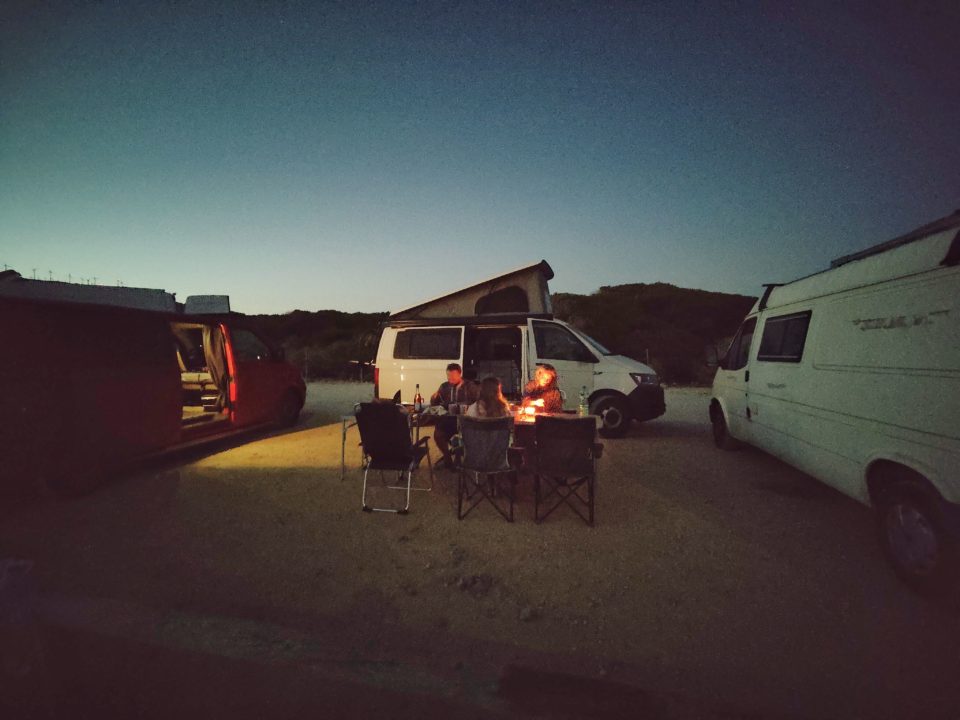
At some point, it was time to leave Tarifa behind and head towards Portugal. After a short stop in Cadiz, our next longer stop was in Seville, where we explored the city center and celebrated Janet's own little birthday party in the camper. 🎉☺️ From there, we continued to Portugal - passing another completely open border station. 😁


 German
  English