Skip to content

Max Haase

About Max Haase

http://max-haase.com

Posts by Max Haase:

kite-featured-1

Kitesurfing in the Algarve: Portugal spots, Faro & beginner tips

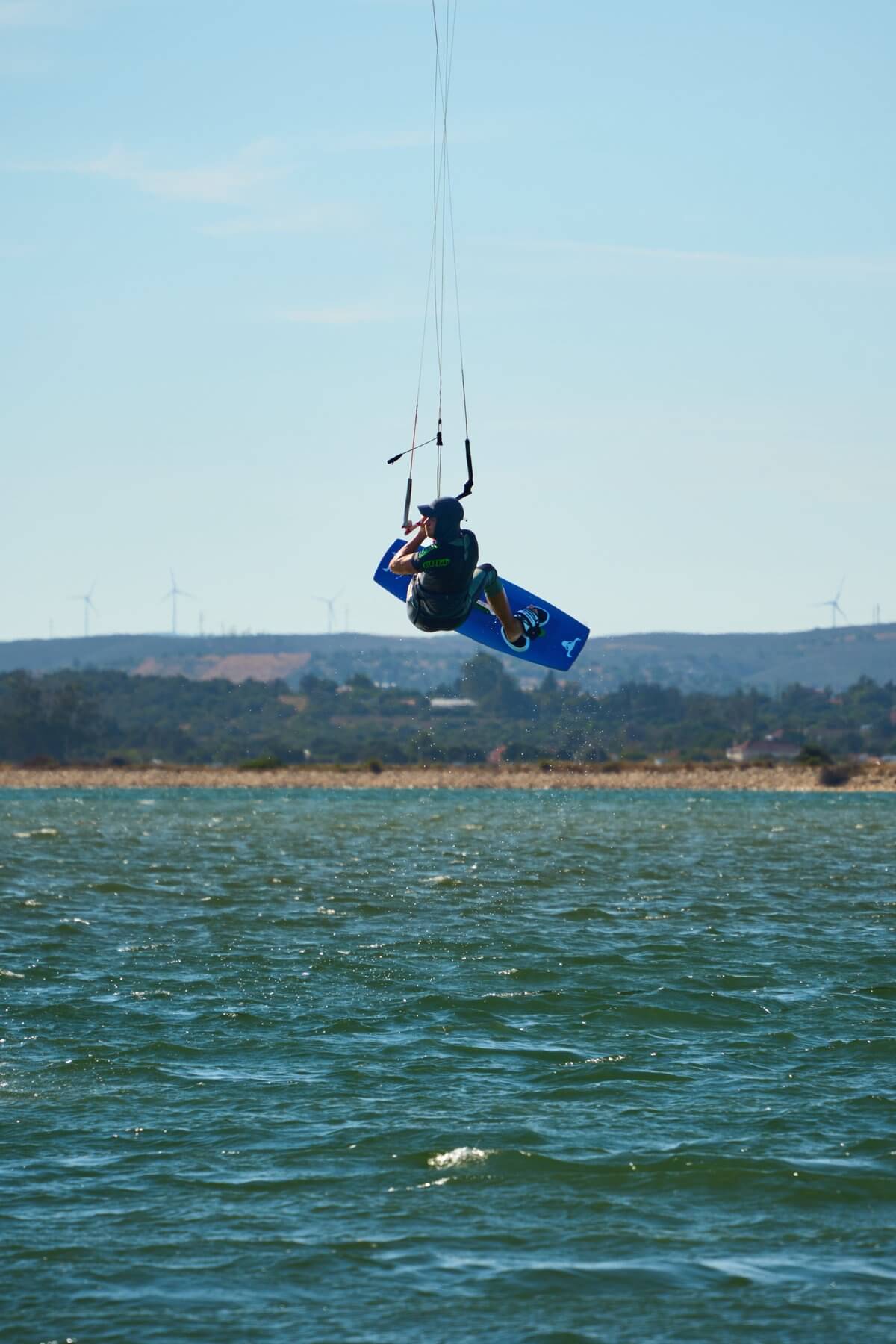
Kitesurfing in the Algarve – hardly any other place in Europe combines such a spectacular coastal landscape with reliable wind and warm water. Since my first visit in 2024, the Algarve has become my absolute favorite kitesurfing spot in Europe. Between golden sandstone cliffs, turquoise Atlantic Ocean, and the relaxed Portuguese lifestyle, I've experienced some of the best kitesurfing sessions of my life.

In this guide, I share everything you need to know about kitesurfing in the Algarve: the best spots, wind statistics, costs, schools, and my personal insider tips after several months there. Whether you're a beginner or an advanced kitesurfer, the Algarve has the perfect spot for every level.

  • Wind season: The Nortada wind blows reliably from north/northwest from May to October at a constant 15–25 knots — more evenly and predictably than in the Canary Islands.
  • Top spots: Alvor for flat water and freestyle, Martinhal near Sagres for wave kiting, Meia Praia in Lagos as an all-round spot with sideshore from the left.
  • Kite setup: Summer 9–12 m², spring and autumn 12–14 m² and a 4/3 wetsuit — water temperature 19–22 °C in summer, refreshing but usually possible without a wetsuit.
  • Budget: 2-week kitesurfing trip for €1,200–1,800 including flight (Ryanair/easyJet €80–200 from Düsseldorf/Berlin/Munich), rental car and apartment.
  • Off-day tips: On windless days, explore Ponta da Piedade, paddle to Benagil Cave by kayak, and photograph Praia da Marinha from a drone perspective.

Algarve & Lagoon: Why Portugal is perfect for kitesurfing


The Algarve has a decisive advantage over other European kite destinations: the Nortada. This thermal northerly wind blows reliably from May to October, bringing a constant 15–25 knots. Unlike in the Canary Islands, where the wind can sometimes be gusty and unpredictable, the Algarve wind is even and constant – perfect for freeriding and freestyle.

The water temperature in summer is between 19 and 22°C – cool enough for a thin wetsuit, but warm enough to jump in without one. In spring and autumn, a 4/3 wetsuit is necessary, but even then the water is significantly more pleasant than in the North Sea.

Add to that the infrastructure: several professional kite schools, board shops, affordable accommodation, and – often underestimated – excellent Portuguese food after a session. Fresh grilled fish for under €15 right on the beach? Everyday life in the Algarve.

Kitesurfing spots Portugal Map: The best spots in the Algarve & Faro


1. Alvor – My favorite for shallow water

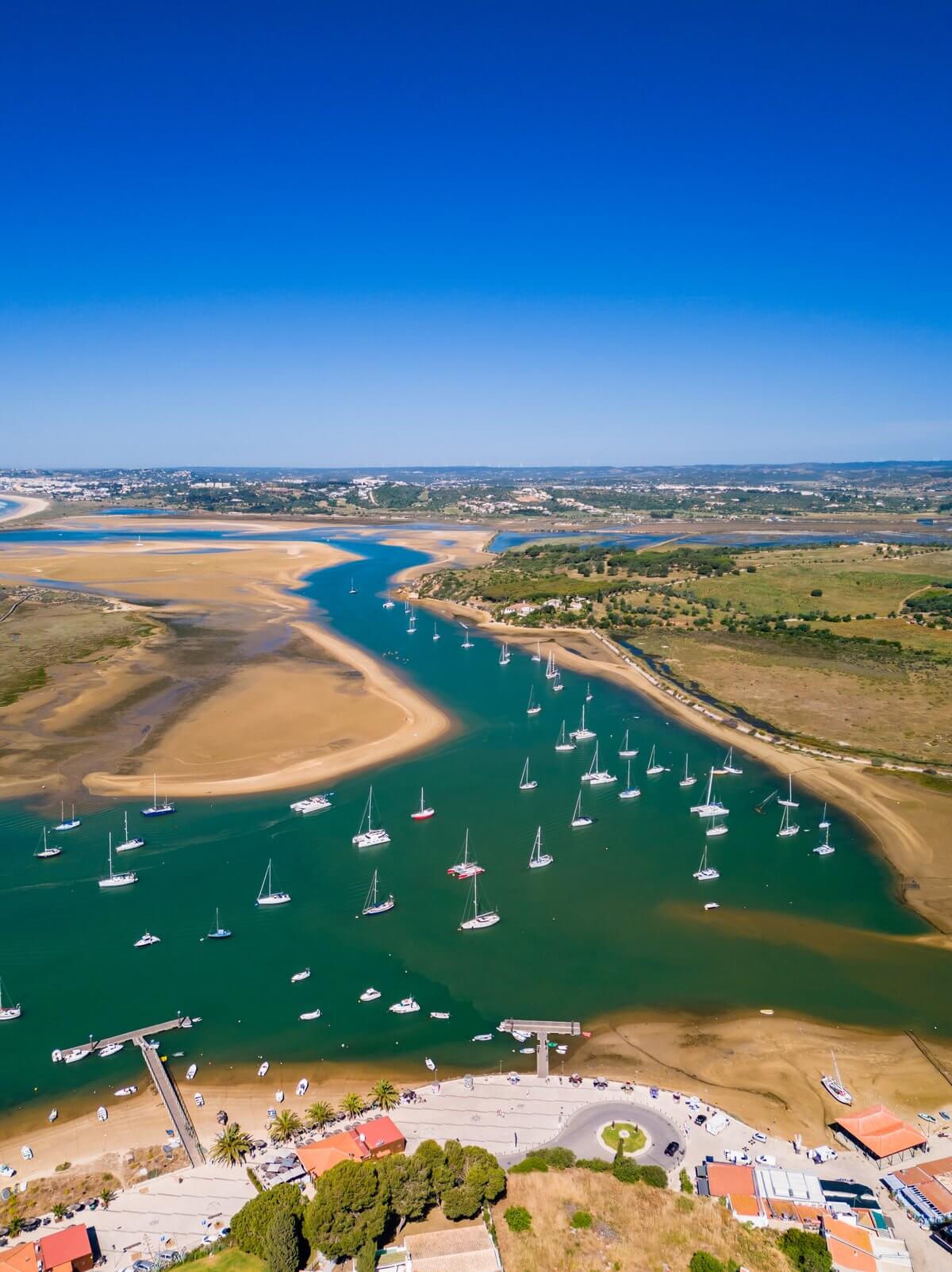
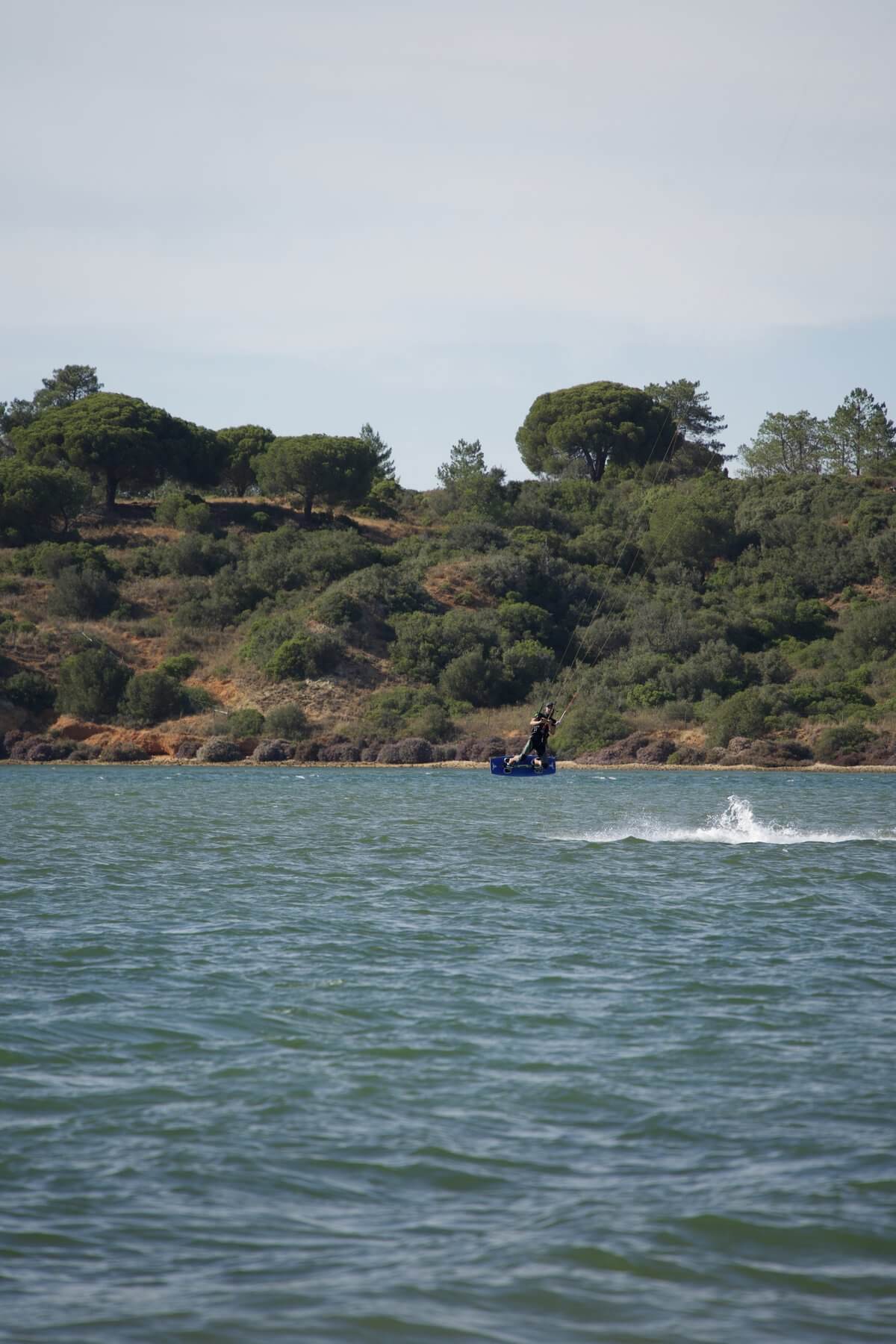
Alvor is THE spot if you're looking for flat water conditions. Ria de Alvor It's a shallow lagoon that's only knee-deep at low tide – perfect for practicing and freestyle tricks. I had one of the best sessions of my life here in June 2024: a constant 20 knots, mirror-smooth water, and golden evening light.

The spot is best at low tide and during the first few hours of high tide. At high tide, the lagoon can become too deep, and the surrounding hills somewhat block the wind. My tip: Check the tide tables and plan your session around low tide.

Level: Beginners to advanced
Ideal conditions: Low tide to mid-tide, Nortada from north/northwest
Kite size: 9–12m² (summer), 12–14m² (spring/autumn)

2. Praia do Martinhal (Sagres) – For surfers

Anyone who loves wave kitesurfing simply must visit Martinhal. The spot is located on the west coast near Sagres, where the Atlantic swell crashes directly onto the shore. The waves are clean and between 1 and 2 meters high – enough for strapless sessions, but not as brutal as on the Portuguese west coast further north.

Caution: Caution: Martinhal is only suitable for experienced kiters. Rocks, currents, and unpredictable gusts from the surrounding cliffs make the spot challenging. But when the conditions are right, it's perhaps the most beautiful wave kitesurfing spot in all of Europe.

Level: Advanced to expert
Ideal conditions: Northwest swell + Northada
Kite size: 7–10m²

3. Meia Praia (Lagos) – The all-rounder

Meia Praia is the longest beach in the Algarve and offers plenty of space for everyone. The wide sandy beach is perfect for launching and landing, and the wind blows sideshore from the left – ideal because you'll always be carried back to the beach. There are schools right on the beach for beginners, while more advanced kitesurfers will find open water with small waves further out.

Lagos itself is one of the most beautiful cities in the Algarve, with a historic old town, great restaurants, and a vibrant nightlife. After a session, a pastel de nata and an espresso in the old town – it doesn't get any better than that.

Level: All levels
Ideal conditions: Nortada, all day
Kite size: 9–14m²

4. Praia da Ilha de Tavira – a hidden gem in the east

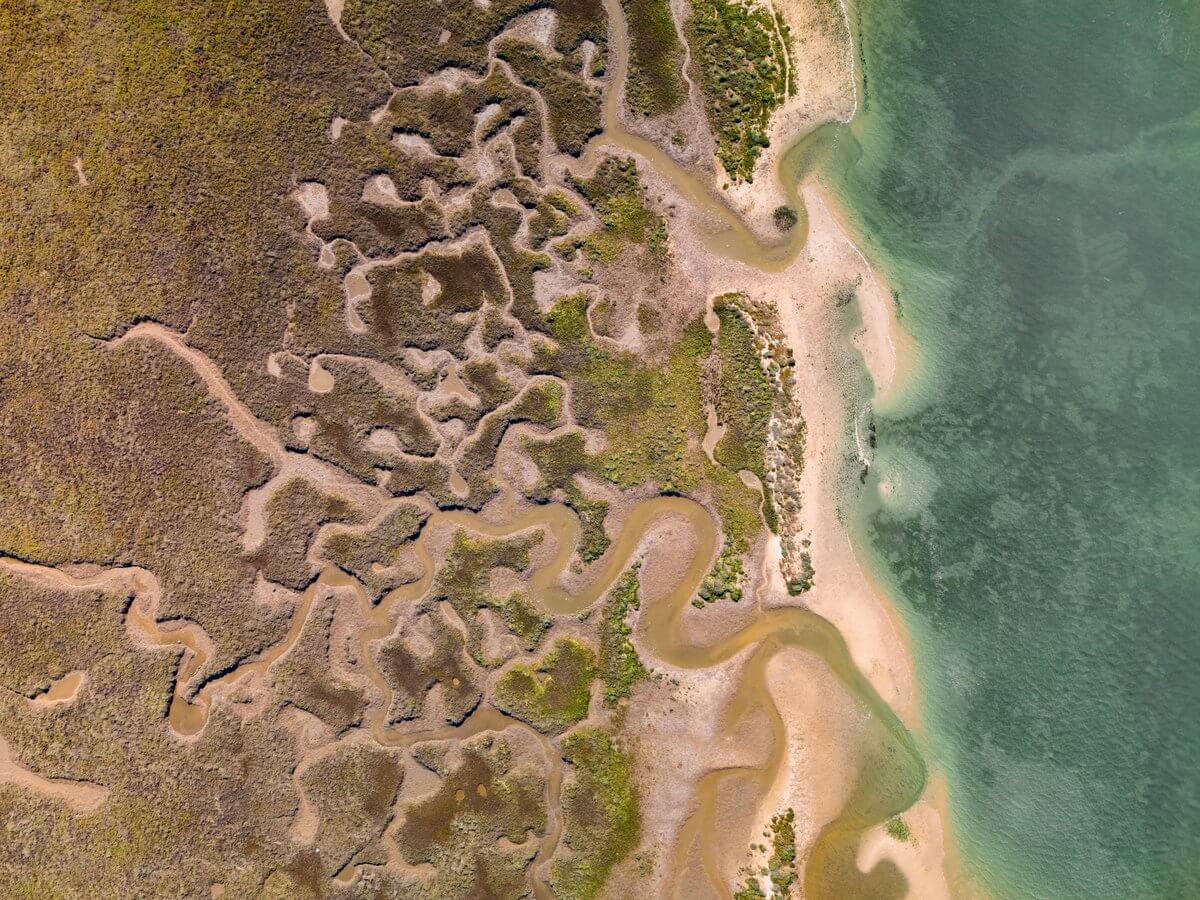
Tavira is located in the less touristy eastern part of the Algarve and is therefore often much less crowded than the spots in the west. The offshore sandbar offers an endless beach with consistent thermal winds. The catch: you have to take a boat across, which makes setting up a bit more complicated. But the peace and quiet and the available space definitely make it worth it.

Level: All levels
Ideal conditions: Summer thermals, midday to evening
Kite size: 10–14m²

The Algarve away from the kite – a coast to marvel at


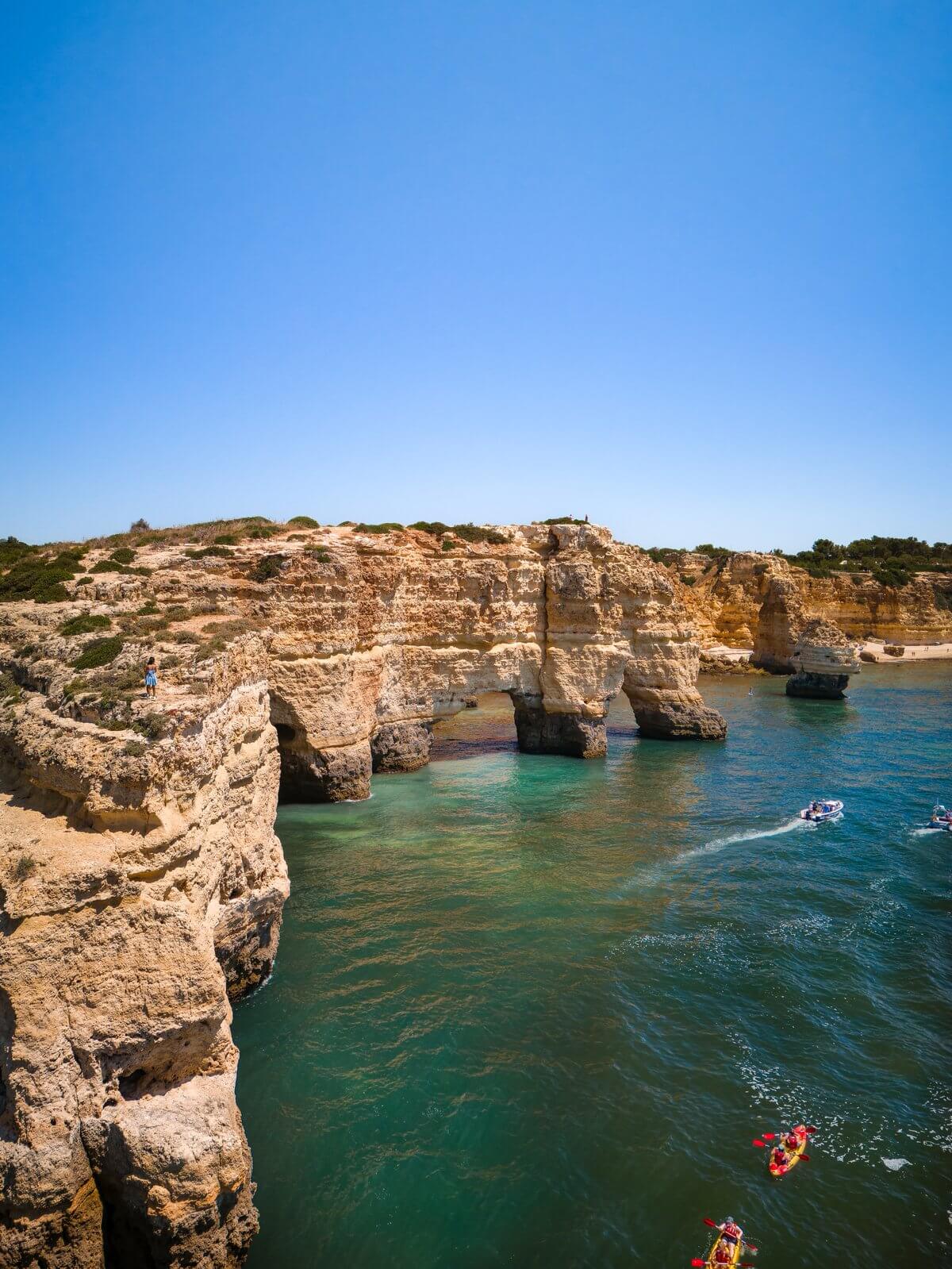
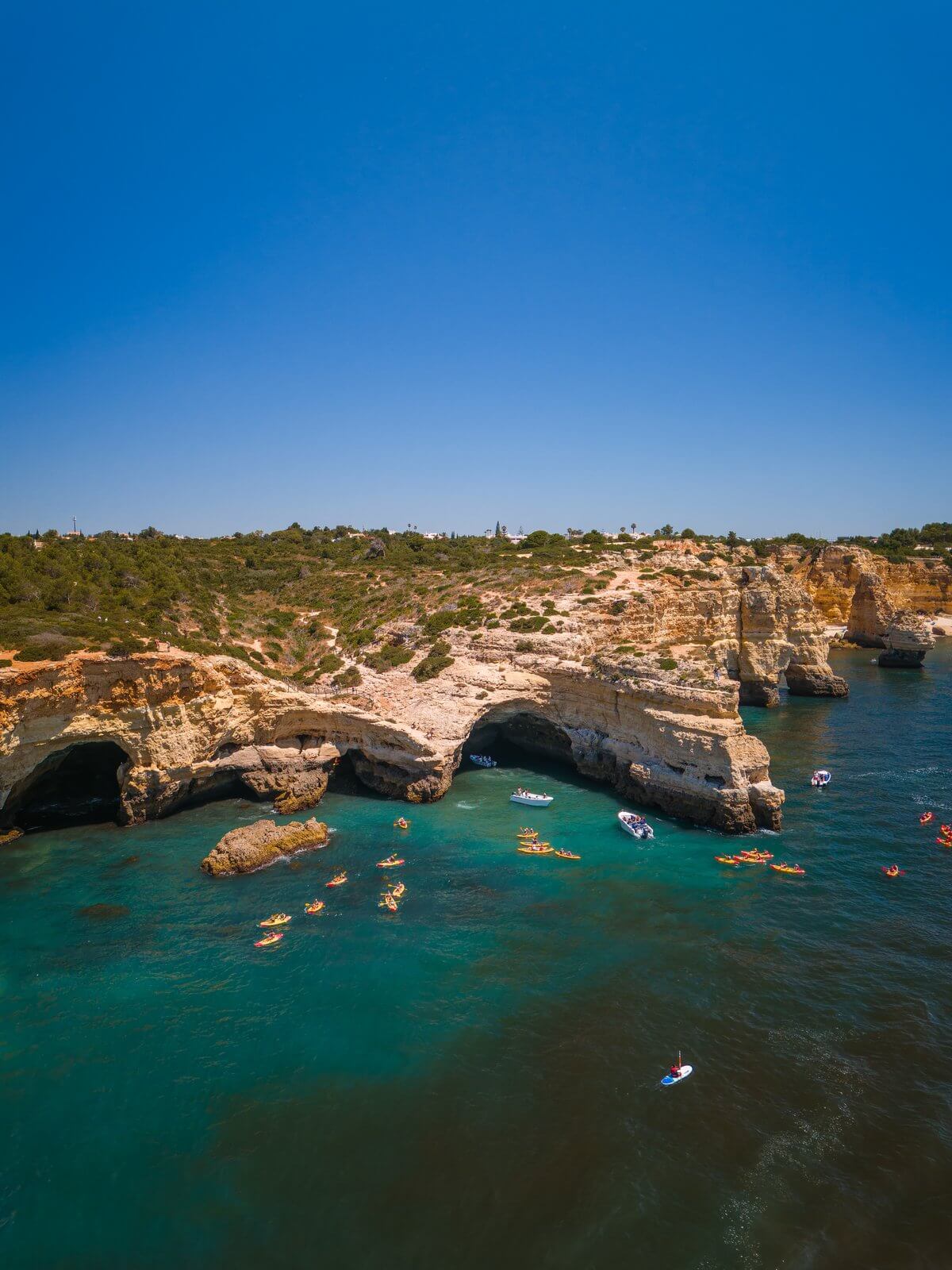
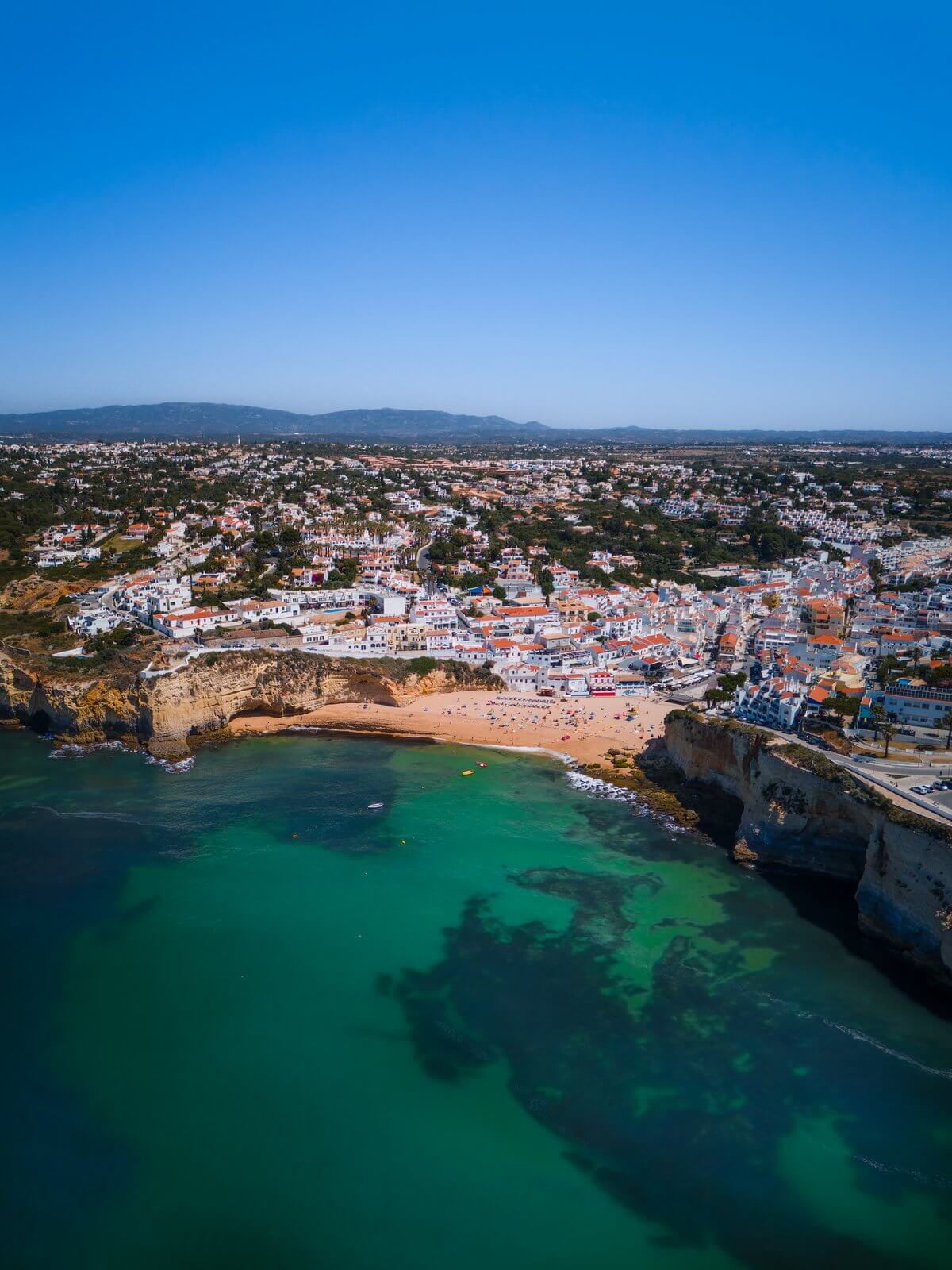
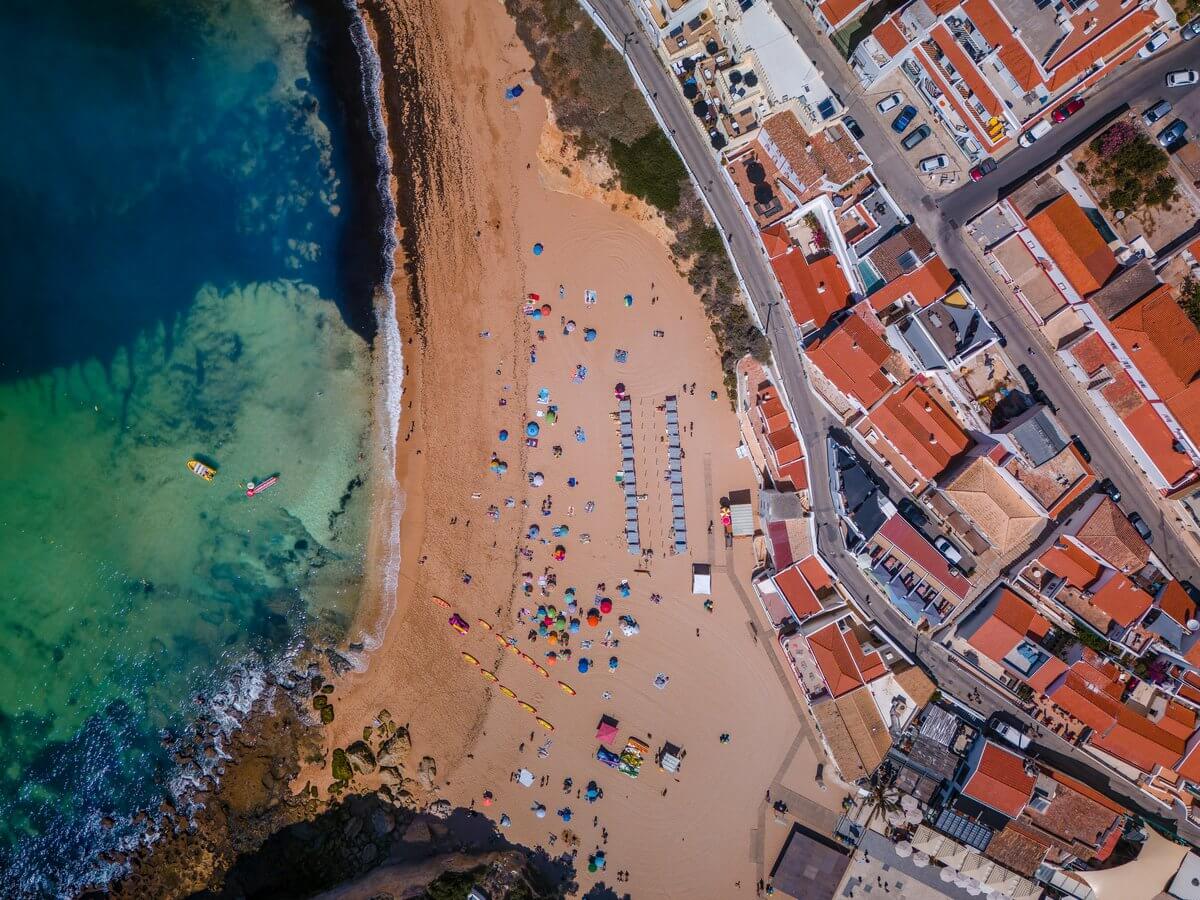
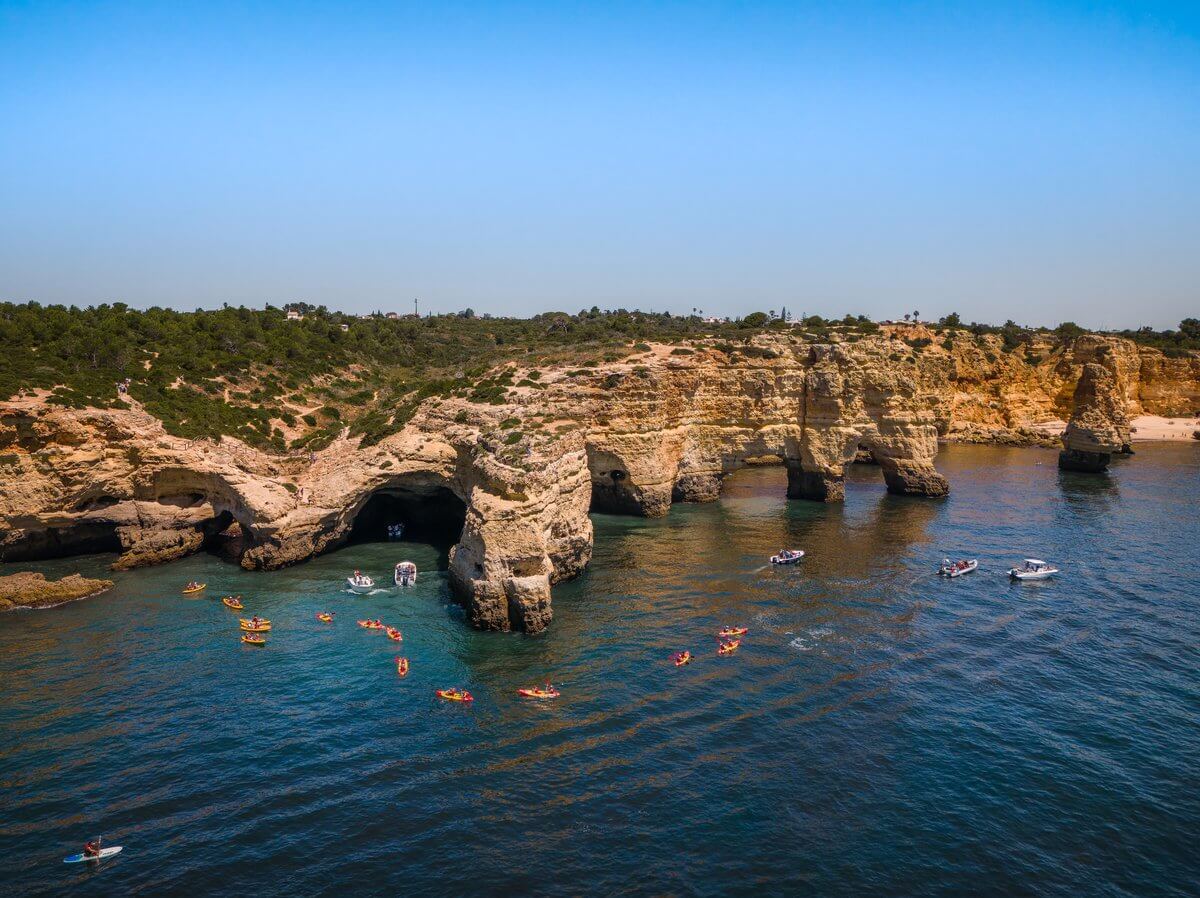
The Algarve is so much more than just a kitesurfing spot. Its coastal scenery is among the most impressive in all of Europe – and this is truly revealed from a drone. Golden sandstone cliffs plunging vertically into the turquoise sea, hidden sea caves, and natural rock bridges – every kilometer of coastline is different.

On my windless days, I have the Ponta da Piedade explored near Lagos, the Benagil Cave visited by kayak and the Praia da Marinha Photographed from above. Anyone who travels to the Algarve as a kitesurfer and only stands on the water misses half the story.

Costs – Kitesurfing in the Algarve


category Cost (per day/unit) note
Kiteboarding course (beginners) €80–120/day 3-day packages from €250
Equipment rental (kite + board) €50–80/day Weekly discounts possible
Accommodation (apartment) €40–80/night Off-season significantly cheaper
rental car €25–40/day Recommended for spot-hopping
Food (Restaurant) €10–20 per meal Fresh fish from €12
Flights (e.g. Faro) 80–200 € (round trip) Ryanair/easyJet from Düsseldorf, Berlin, Munich

My total budget for a 2-week kitesurfing trip: around €1,200–1,800 including my own equipment, rental car, and apartment. As a couple, splitting the fixed costs makes it even cheaper. For European standards, Portugal is still a real bargain.

Kitesurfing in Portugal in October: Best time to travel to the Algarve


The kiteboarding season in the Algarve runs from May to October, with the most constant winds in July and August. During these months, the Nortada blows almost daily – wind probability above 80%.

May/June: The season is starting, the wind is becoming more consistent. Fewer tourists, lower prices. Water temperature around 17–19°C. My personal favorite – a perfect balance of wind, weather, and tranquility.

July/August: Peak season. Most consistent wind (15–25 knots almost daily), hot weather (35°C+), but also crowded spots and higher prices. If possible, kite during the week.

September/October: The off-season is fantastic. There's still wind, the tourists are gone, and the water temperature is at its highest (22°C+). My second favorite time to visit.

November to April: No reliable kite wind. But perfect conditions for surfers (large Atlantic swell) and hikers (pleasant temperatures, blooming landscape).

Kitesurfing in Portugal for beginners: Kite schools in the Algarve


The Algarve has a fantastic kiteboarding infrastructure with several established schools. Here are my top recommendations:

Kite Culture Lagos: Located directly on Meia Praia, they offer IKO-certified courses in German and English. The team is young, motivated, and has excellent local knowledge. Beginner packages start from €280 for 3 days.

Algarve Watersports (Alvor): Specializing in the shallow water spot in the Ria de Alvor. Perfect for beginners because you can practice safely in the lagoon. They also offer stand-up paddleboarding and wing foiling.

Windsurf Point (Praia da Rocha): The oldest school in the region with over 20 years of experience. Large pool of equipment (ideal if you want to try different sizes) and experienced instructors.

My equipment setup for the Algarve


For the Algarve, I travel with the following setup:

  • Kites: 9m² and 12m² (covers 90% of all days)
  • Board: Twintip 136cm for flat water, directional for wave riding days
  • Neo: 3/2mm Shorty (Summer) + 4/3mm Full (Spring/Autumn)
  • Helmet & Vest: Always included – some of the spots have rocks.
  • Drone: Drone for recordings after the session
  • Camera: Camera with 24-70mm lens for beach and lifestyle photos
Tip: Most airlines allow kite equipment as sports baggage (20–30 € extra per flight). With Ryanair, you have to register it online in advance. Alternatively, you can rent equipment from the schools on site.

Drone rules in Portugal – What you need to know


Portugal falls under the EU drone regulations. Less stringent rules apply to drones under 250g, but you still need:

  • EU drone license A1/A3 (free online test)
  • Registration with the AAN (Portuguese Civil Aviation Authority)
  • No flights over crowds of people. (Beaches in summer!)
  • Max. 120m height
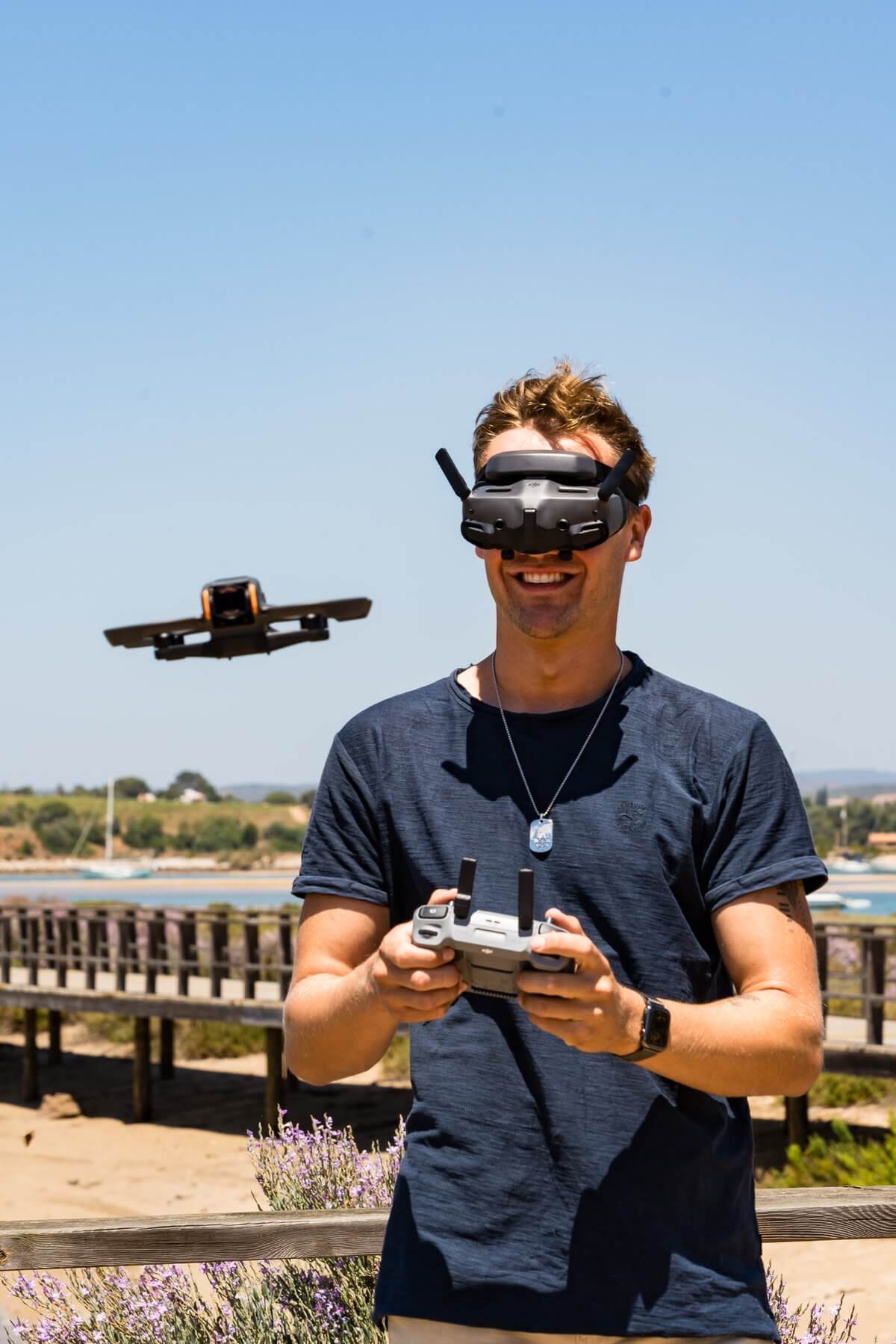
My drone in the Algarve: I'm flying the DJI Mini 5 Pro — under 250g, foldable, and with impressive image quality. It's my absolute favorite setup for travel. You can find all the details, flight characteristics, and my honest conclusion in the full review.

In practice: Fly early in the morning or late in the evening when the beaches are empty. The Algarve is a drone paradise – but please be respectful of other beachgoers.

More on this in my Drone guide for use abroad.

Practical tips for your kitesurfing trip


  • A rental car is mandatory: The spots are spread out. With a car, you're flexible and can chase the best wind.
  • Refueling in Portugal: Diesel approx. €1.60/l – cheaper than in Germany.
  • Wind forecast: Windy.com and Windguru are reliable. Local schools post daily updates on Instagram.
  • Don't forget sunscreen: The sun beats down brutally in the Algarve, even in spring. Use SPF 50+ and wear a lycra shirt on the water.
  • Tap water: It's safe to drink, but many locals prefer filtered water.
  • Portuguese helps: „Obrigado“ (thank you) and „Uma imperial, por favor“ (a beer, please) are always well received.

Getting there – How to get to the Algarve


The Faro Airport (FAO) It's the gateway to the Algarve. Ryanair, easyJet, Eurowings and TAP Air Portugal offer direct flights from Germany. Flight time: approximately 3 hours.

The cheapest flights: From Düsseldorf, Berlin, or Munich, you can find round-trip flights from €80 if you book 6–8 weeks in advance. During the off-season (May/October), bargains under €60 are possible.

From the airport to the spot: Pick up your rental car directly at the airport (from €15/day with early booking). The A22 motorway will take you to any spot on the coast in 30–60 minutes. Please note: A22 tolls are collected electronically – activate the Via Verde system with your rental car company or pay the toll online afterwards.

FAQ – Frequently Asked Questions about Kitesurfing in the Algarve

Can I learn to kitesurf in the Algarve as a beginner?

Absolutely — the Algarve is one of the best beginner spots in Europe. Alvor and Meia Praia offer flat water, consistent winds, and professional schools with IKO-certified instructors. In a 3–5 day intensive course, you'll be standing on a board and able to ride independently. The cost for a complete beginner course (including equipment) is around €350–€500. Important: Book schools with small groups (max. 2 students per instructor) — this makes a huge difference to your learning progress.

What kite size do I need?

It depends heavily on the season. In summer (Nortada season, May–September), the wind blows consistently at 15–25 knots—here, 9–12m² is sufficient. In spring and autumn, the wind is more variable, so 12–14m² is recommended. If you only want to take one kite: 10m² or 11m² is the best compromise for the Algarve. I recommend that beginners rent equipment locally (approx. €50–80/day including board)—that way you don't have to load anything onto the plane and can choose the kite according to the wind strength.

Is the Algarve better than Fuerteventura for kitesurfing?

Both are great, but different. Fuerteventura It has more waves and rougher conditions. The Algarve offers more diverse spots (flat water + waves) and is significantly richer in terms of cuisine and culture. For pure kiteboarding holidays focusing on flat water: Algarve. For wave kiting: Fuerteventura.

What is the internet like for digital nomads?

Excellent — Portugal is one of the best remote work destinations in Europe. Most accommodations have stable Wi-Fi with speeds of 50–200 Mbps. Lagos, Portimão, and Faro have established coworking spaces (around €15–25/day), many of them right by the sea. The D7 visa for digital nomads also makes Portugal attractive for longer stays. As a content creator, I kitesurf in the morning, edit videos at midday, and am back on the water in the afternoon — the setup works perfectly.

Do I need a drone permit?

Yes — even for drones under 250g, you need an EU drone license A1/A3 in Portugal (free online test, approx. 1-2 hours) and registration with the AAN (Portuguese Civil Aviation Authority). Registration costs around €10 and can be done online in just a few minutes. On beaches in summer, additional rules apply: do not fly over crowds, maximum altitude 120m. Early mornings (before 9 am) are ideal for drone photography. All details and country comparisons can be found in my Drone Guide.

My conclusion – the Algarve is a kiteboarding paradise


The Algarve has it all: reliable wind, a warm climate, diverse spots for every level, a spectacular coastline perfect for drone photography, and the best value for money in Southern Europe. Add to that the relaxed Portuguese mentality, affordable and excellent food, and a growing community of kiters and digital nomads.

If you're thinking about where to go on your next kiteboarding trip, the Algarve should be at the top of your list. I come back every year and always discover new spots and new favorite places.

Also read my other Portugal articles: the Algarve travelogue, the Portugal road trip cost guide and my Porto Travel Report.


Max Haase Travel Creator
About the author

Max Haase

Travel Content Creator · Drone Photographer · Visual Storyteller

Since over 10 years professional travel creator with over 4.2 million followers. Specializing in high-end tourism board collaborations and visual travel storytelling.

4.2MFollowers
82+Countries
500+Cooperations
10+Years

ptrd-featured-1

Portugal road trip: 14 days costs & route 2026 | Max Haase

Portugal is one of the best travel destinations in Europe—and one of the most affordable. I spent a total of three months in Portugal in 2024, traveling from Porto to Lisbon and on to the Algarve, tracking every single expense. In this guide, you'll find an honest budget breakdown for a two-week road trip through Portugal—with concrete figures, money-saving tips, and my personal recommendations.

  • Route: 14 days Open-Jaw Porto → Lisbon → Algarve (or vice versa) — only 600 km total distance, perfect for rental cars without rushing.
  • Total budget: Per person €610–965 in budget mode, €940–1,575 in mid-range — even in comfort under €3,000 including flight and rental car for 2 weeks.
  • Rental cars & tolls: Small cars €25–35/day, petrol €1.70–1.80/l, toll Porto–Algarve approx. €50–80 — A22 electronically via Via Verde, otherwise penalty fees will be incurred.
  • Accommodation: Hostels €18–30, guesthouses €45–80, boutique apartments from €70 in a quality that costs around €150 per night in Germany.
  • Eat: Lunch menu €10–15, dinner typically €25 with wine — fresh grilled fish right on the beach in the Algarve often under €15.

Whether you're a backpacker or a traveler seeking comfort, Portugal works for every budget. A rental car gives you flexibility, the highways are well-developed, and the distances are manageable. From Porto to Faro it's only 600 km—you can easily see the whole country in two weeks.

Portugal road trip by car: Total costs for 14 days


category Budget (2 people) Middle class (2 people) Comfort (2 people)
Flights (round trip) €120–200 €200–350 €350–600
Rental car (14 days) €180–280 €280–400 €400–700
Petrol/Toll 100–150 € 100–150 € 100–150 €
Accommodation (14 nights) €420–700 €700–1,200 €1,200–2,500
Food & Drink €350–500 €500–800 €800–1,400
Activities 50–100 € €100–250 €250–500
TOTAL (2 people) €1,220–1,930 €1,880–3,150 €3,100–€5,850
Per person €610–965 €940–1,575 €1,550–2,925

A two-week road trip including flights for under €1,000 per person is hard to find in any other Western European country. Even with mid-range options, you'll stay well below €2,000. For comparison, a similar trip through Italy or Spain costs at least €30,501,000 more.

From Germany to Portugal by car or plane: Cost comparison


The cheapest flights go to Porto (OPO), Lisbon (LIS) or Faro (FAO). For a road trip from north to south, the combination of Porto (outbound flight) + Faro (return flight) is ideal — a so-called "open jaw". This saves you the return journey and often only costs 10–20 euros more with Ryanair.

My savings strategy:

  • Book 6-8 weeks in advance (sweet spot for prices)
  • Fly Tuesday to Thursday (30-50% cheaper than weekends)
  • Check Google Flights + Skyscanner at the same time
  • Hand luggage is sufficient for 2 weeks (saves €30–50 baggage fees per leg)

Rental cars — The most important cost factor


A rental car is essential for a road trip in Portugal. While the public transport network connects the major cities, the most beautiful places—secluded beaches, mountain villages, viewpoints—can only be reached by car.

My rental car tips:

  • Cheap car rental / CHECK24: Comparison websites are often cheaper than direct booking in Portugal.
  • Fully comprehensive insurance without excess: Always cover through the provider or a credit card — the Portuguese roads have potholes.
  • A small car is sufficient: The streets in the old towns are narrow. A Fiat 500 or Renault Clio is perfect.
  • Refueling: Diesel approx. 1.55-1.65 €/l, petrol approx. 1.70-1.80 €/l (as of 2024)
  • Toll (Portagens): The motorways are toll roads. Budget: approx. €50–80 for the entire route Porto → Algarve

Beware of the toll trap on the A22: The motorway in the Algarve (A22/Via do Infante) has no toll stations — The toll is recorded electronically. Activate it when renting a car from Via Verde or add the toll later on pagamentodeportagens.pt Pay up. Otherwise, you risk hefty penalty fees.

Accommodation — Where to sleep in Portugal


Portugal has something for every budget. Here's the range:

Budget (30–50 €/night for 2): Hostels, simple pensões (guesthouses), Airbnb rooms. In the off-season, you can even find entire apartments for under €40.

Mid-range (50–90 €/night): Boutique hotels, beautiful Airbnb apartments, renovated townhouses. My favorite — in Portugal you get for €70 the quality that would cost €150 in Germany.

Comfort (90–180 €/night): Design hotels, pousadas (historic state houses), pool villas. In the Algarve, there are dream villas with private pools from €120/night.

My tip: A mix of different accommodation types. In Porto and Lisbon, a centrally located apartment; in the countryside, a quinta (country estate); and in the Algarve, a villa. This keeps the trip varied and lowers the average price.

Food & Drink — Europe's best value for money


Portuguese cuisine is the unsung hero of any road trip. The value for money is unbeatable — even in tourist areas, you'll rarely pay more than €20–25 per person for a complete meal with wine.

Typical prices (restaurant):

  • Daily special (Prato do Dia): €7–10
  • Grilled fish (Peixe Grelhado): €10-18
  • Francesinha in Porto: €8-12
  • Pastel de Nata: €1.00-1.50
  • Espresso (café): €0.70–1.00
  • Beer (Imperial/Fino): €1.50–2.50
  • House wine (bottle): €8–15

Money-saving tip: The "Prato do Dia" (daily special) is often the best deal in many restaurants: main course + side dish + drink from 7 euros. Often better than the regular menu.

Money-saving tip 2: Supermarkets like Pingo Doce and Lidl have an excellent selection of Portuguese wine, cheese and cold cuts for picnic stops along the way.

Self-guided tour of Portugal: My 14-day route from Porto to Faro


Days 1–3: Porto & Douro Valley
Porto's old town (Ribeira), port wine cellars in Vila Nova de Gaia, Livraria Lello, Douro Valley day trip. Budget accommodation in the old town: €40–60/night.

Day 4-5: Peneda-Gerês National Park
Portugal's only national park. Waterfalls, granite villages, hiking trails. A hidden gem — almost untouched by tourism. Accommodation: Quintas or country houses from €35.

Days 6–8: Lisbon
Alfama, Belém, LX Factory, Tram 28, Pastéis de Belém. Lisbon is a must-see. Parking in the city center is expensive — a hotel on the outskirts + metro is cheaper. Budget: €50–80/night.

Days 9–10: Sintra & Cascais
Pena Palace, Quinta da Regaleira, Cabo da Roca (the westernmost point of Europe). Cascais for dinner. Day trip from Lisbon or overnight stay in Sintra.

Days 11–14: Algarve
Lagos, Ponta da Piedade, Benagil Cave by kayak, Praia da Marinha, Kitesurfing in Alvor. Final days at the beach. Faro for the return flight. Budget: €40–70/night.

Money-saving tips — How to cut costs


  1. Travel in the off-season (May/June or September/October): 30–50% cheaper for accommodation and car rental
  2. Cook yourself: Airbnb with kitchen + supermarket shopping saves a lot of money.
  3. Via Verde toll transponder: Often cheaper than single payments
  4. Lisboa Card / Porto Card: Only worthwhile with intensive museum use — calculate beforehand
  5. Free activities: Beaches, hiking trails, and viewpoints are free of charge.
  6. Travel credit card with no foreign currency fees: DKB, N26 or Wise — no surcharge in Portugal

FAQ — Frequently Asked Questions about the Portugal Road Trip Budget

How much money do I need per day in Portugal?

Budget: €40–60 per person/day (self-catering, basic accommodation). Mid-range: €70–110. Comfort: €110–200. Excludes flights and rental car.

Is Portugal cheaper than Spain?

Yes, in most categories. Food, accommodation, and car rental in particular are cheaper in Portugal (20-30%) than in comparable Spanish regions.

Do I need cash in Portugal?

Card payments work almost everywhere — even for small amounts. Nevertheless, take €50–100 in cash as a reserve (for small cafes, markets, parking meters).

Which time of year is the most favorable?

November to March is the cheapest time. However, the weather is changeable, and some activities are limited. The best compromise is May/June or September/October—good weather AND moderate prices.

Is it worth renting a car for a week?

Definitely. Even for a week, a rental car is the most cost-effective way to explore Portugal. Without a car, you'll miss out on 701 of the best spots.

Max Haase Travel Creator
About the author

Max Haase

Travel Content Creator · Drone Photographer · Visual Storyteller

Since over 10 years professional travel creator with over 4.2 million followers. Specializing in high-end tourism board collaborations and visual travel storytelling.
4.2MFollowers
82+Countries
500+Cooperations
10+Years


You might also be interested in this

Madeira-featured

Madeira Levada Walks: The 5 Most Beautiful Tours 2026

Madeira Levada Hikes — The 5 most beautiful tours on the flower island

Madeira is a hiker's paradise — and the levadas are the reason. These historic irrigation channels were built from the 15th century onwards to carry water from the rain-drenched northern slopes to the arid south. Today, over 2,500 kilometers of levadas crisscross the entire island — and along these channels run the most beautiful hiking trails I have ever experienced. Through ancient laurel forests, past waterfalls, through dark tunnels, and over gorges with views of the Atlantic Ocean.

  • Europe's best hiking island: Madeira offers a mild climate all year round (18-24°C), subtropical laurel forest (UNESCO) and over 2,500 km of marked hiking trails in a very small area.
  • Levadas explained: Historic irrigation canals from the 16th century, which carry water from the rainy north to the dry south — the paths alongside them are mostly flat and manageable even for beginners.
  • Top 3 tours: Levada do Caldeirão Verde (13 km, medium, waterfall cauldron), Levada das 25 Fontes (11 km, medium, 25 springs) and Pico do Arieiro → Pico Ruivo (7 km, difficult, ridge hike above the clouds).
  • Equipment & Difficulty: Sturdy hiking boots with good tread, a headlamp (for tunnels), a rain jacket and 2 liters of water are mandatory — many levadas have unsecured drops, sure-footedness is required.
  • Best time to travel: April-June and September-October — stable weather, clear views on the peaks, fewer tourists and lush green vegetation after the winter rains.

I spent a week in Madeira, used the drone and the camera I had them in my backpack and hiked every day. Here are my 5 favorites — with all the information you need for planning.

1. Levada do Caldeirão Verde — My absolute favorite (13 km, medium)

If you only hike one levada on Madeira, make it this one. The trail starts at Queimadas Forest Park and leads you through a laurel forest that feels like another dimension. Moss-covered trees, wisps of mist drifting through the canopy, birdsong—like something out of Jurassic Park, only more real.

The hike leads through four tunnels—and this is where things get adventurous. The longest is about 100 meters long, pitch black, and so low that you sometimes have to duck. A headlamp is essential. The floor is wet, the ceiling drips, and all you hear is the echo of your footsteps and the gentle lapping of the levada beside you. Sounds intimidating? It's awesome.

At the end awaits Caldeirão Verde — a "Green Cauldron" into which a 100-meter-high waterfall plunges into an emerald-green pool. The surrounding rock walls are covered with moss and ferns. I sent the drone up, and the view from above took my breath away — the lush green of the pool nestled within the vertical rock faces, the waterfall a white thread in between.

Practical information Caldeirão Verde

  • Distance: 13 km (round trip)
  • Duration: 4-5 hours
  • Difficulty: Medium (tunnels, partly narrow paths)
  • Start: Queimadas Forest Park (parking available, arrive early!)
  • Elevation gain: Minimal — typical Levada, almost flat
  • Highlight: The waterfall at the end + the mystical laurel forest

2. Pico do Arieiro to Pico Ruivo — The royal tour above the clouds (7 km, difficult)

Technically not a levada hike, but the most spectacular tour on Madeira. You hike from the island's third highest point (Pico do Arieiro, 1,818m) to its highest (Pico Ruivo, 1,862m). And the special thing about it: you hike above the clouds. Literally.

I set off from Pico do Arieiro at 5:30 a.m. to catch the sunrise. Below me was a solid blanket of clouds, above me a starry sky that slowly turned orange. When the sun rose above the clouds and the surrounding peaks emerged like islands from a white sea—that was one of the top three moments of my entire Creator career. The drone was running at full speed, and I had goosebumps despite my fleece jacket.

The trail itself is challenging: narrow paths on steep slopes, steps carved into the rock, a tunnel, and steep ascents and descents. Don't underestimate it in wet or windy conditions—people have slipped and fallen here. But in good weather and with sturdy footwear, the hike is manageable for anyone with a reasonable level of fitness.

Once you reach Pico Ruivo, you'll have a 360-degree view of the entire island—on clear days you can see Porto Santo and the Desertas Islands on the horizon. There's a small mountain hut where you can warm up and have a coffee before heading back down.

Practical information Pico-Tour

  • Distance: 7 km (one way) or 14 km round trip
  • Duration: 3-4 hours each way
  • Difficulty: Difficult (steep sections, altitude, changeable weather)
  • Start: Pico do Arieiro parking lot (accessible by car)
  • Elevation gain: Approximately 600 meters of elevation gain and loss
  • Tip: Start before 6 a.m. for sunrise. Dress in layers — it's 10-15°C colder up there than in Funchal.

3. Levada das 25 Fontes: The Instagram classic (route & tips)

25 Fontes — 25 springs. At the end of this levada hike, 25 small waterfalls cascade from a moss-covered rock face into a natural pool. This is the spot you know from Instagram and Pinterest. And it's just as impressive in real life as in the pictures — which isn't the case with every Instagram spot.

The hike starts at the Rabaçal car park and initially descends steeply (remember: downhill at the beginning means uphill at the end). Then it follows the levada through a dense laurel forest—a UNESCO World Heritage Site, one of the last remnants of the primeval forest that once covered all of Southern Europe. The air smells of damp moss and earth. Every now and then, a Madeira chaffinch appears—they are found only here.

Once you arrive at the pool, I recommend setting up a tripod, attaching an ND filter, and using a long exposure. The waterfalls will become silken threads, and the pool will be mirror-smooth. It's one of my best landscape photos ever. The circular shape of the pool is particularly visible from above with a drone—but be careful: the rock walls are steep, and the wind inside is unpredictable.

Bonus tip: Combine this tour with the Levada do Risco. From the same starting point, you can reach another waterfall in 20 minutes—a 100-meter free fall into a narrow pool. This adds perhaps two hours to the hike and is absolutely worth it.

Practical information 25 Fonts

  • Distance: 11 km (round trip, including Risco detour)
  • Duration: 3-4 hours
  • Difficulty: Light to medium
  • Start: Rabaçal Parking Lot (shuttle bus from above or 20 min walk)
  • Highlight: The pool with 25 waterfalls + Risco as a bonus

4. Levada do Rei — The Royal Levada (10 km, easy)

If you're looking for something more relaxed after the Pico tour or the Caldeirão Verde hike, the Levada do Rei is perfect. "The Royal" — and the name is fitting. You'll hike through one of the most beautiful and best-preserved laurel forests on the island, almost entirely flat and shady, with the gentle babbling of the levada as your constant companion.

The hike starts in Ribeiro Bonito and leads through dense greenery. What makes this levada so special is the tranquility. Unlike 25 Fontes or Caldeirão Verde, there's hardly anyone around. I was completely alone on a Tuesday morning—just me, the forest, and the water. A photographer's dream: The diffused light in the laurel forest creates an almost otherworldly atmosphere. Long exposures by the water, macro shots of moss and ferns, the Sony A7 IV with the 16-35mm wide-angle lens—I could have photographed for hours.

At the end, you reach a picturesque spring area where several small tributaries converge. Not a dramatic waterfall, but a quiet beauty that is almost more meditative than the grander spectacles. Perfect for families, older hikers, or days when you simply want to be in nature without exerting yourself.

Practical information Levada do Rei

  • Distance: 10 km (round trip)
  • Duration: 2.5-3 hours
  • Difficulty: Light
  • Start: Ribeiro Bonito
  • Special feature: Quiet, few tourists, perfect for photography

5. Vereda do Pico Ruivo via Achada do Teixeira — The short route to the summit (6 km, medium)

Want to reach Madeira's highest point but don't have 7 hours for the challenging hike? Then take this route. From Achada do Teixeira, you can reach Pico Ruivo in about 45 minutes — the shortest and easiest way to the summit.

Less dramatic than the route from Pico do Arieiro, but the view from the top is identical: a 360-degree panorama, a sea of clouds, the entire island below. I hiked this route in the late afternoon and experienced the sunset at the top—a completely different experience than the sunrise on the longer route, but just as magical. The warm, golden light bathed the volcanic rocks in shades of orange, while below me the clouds slowly filled the valleys.

The path is well-paved, with a few steps, and manageable for anyone with a reasonable level of fitness. At the starting point, there's a curiosity: the "Homem em Pé" ("Standing Man") — a natural basalt formation that looks like a standing person. A good photo opportunity before the actual hike begins.

Practical information short Pico route

  • Distance: 6 km (round trip)
  • Duration: 1.5-2 hours
  • Difficulty: Medium (stairs, some elevation)
  • Start: Achada do Teixeira Parking Lot
  • Tip: Start for sunset around 4 pm (depending on the time of year)

Hiking in Madeira: Tips to avoid robberies on circular hiking trails

equipment

Sturdy hiking boots with good tread are essential—the trails are often wet and slippery, especially after rain. A headlamp is necessary for the tunnels (a smartphone flashlight will do in a pinch, but a proper headlamp leaves your hands free). Always carry a rain jacket—on Madeira, the weather can change from sunshine to fog and rain in 30 minutes. Bring at least 1 liter of water, and 1.5 liters for longer hikes. Hiking poles are optional, but recommended for the Pico hike.

Best time to travel for hiking in Madeira

Possible year-round – that's the beauty of Madeira. Temperatures range from 16°C (winter) to 25°C (summer). Best months: April to June and September to November. In summer, it can get humid in the valleys, while in winter the higher elevations are often shrouded in clouds. But even in December, I usually had good hiking weather on the levadas.

Drones on Madeira

Drones are officially prohibited in the Madeira Natural Park (Parque Natural da Madeira). In practice, this is enforced differently—I would avoid them at popular spots like 25 Fontes and Caldeirão Verde. Outside the protected areas (coast, Funchal, Pico do Arieiro), I had no problems. Always fly respectfully, don't disturb other hikers, and ask if in doubt.

Costs for a hiking week in Madeira

Position Cost
Flight (from Germany, return) €120–250
Rental car (7 days, small car) €140–200
Accommodation in Funchal (7 nights, mid-range) €350–500
Food & Drinks €200–300
Activities & Extras 50–100 €
Total per person €860–1,350

Madeira is surprisingly affordable for an Atlantic island. Eating out costs about half of what you'd pay in Germany. An espresso is €0.70, a beer €1.50, and a complete meal with fish and wine is under €15. Renting a car is highly recommended: the levada trailheads are scattered all over the island and difficult to reach by bus.

FAQ

Do I need a guide for the Levada hikes?

No — all 5 hikes in this guide are well signposted and doable without a guide. The paths are clear (you follow the levada). For the Pico hike, a guide might be helpful in bad weather, as orientation can be difficult in fog. Otherwise, a good hiking app (I use Komoot) and basic hiking knowledge are all you need.

Can I do the tours in the rain?

Yes, the levada walks are great—you're mostly in the forest, and a bit of rain actually makes the atmosphere even more mystical. I would cancel the Pico tour (No. 2) in case of rain or strong winds—the exposed sections become dangerous. Generally speaking, Madeira has microclimates. It can be sunny in the south while it's raining in the north. Always check the weather forecast for the specific region.

Are the levadas suitable for children?

The Levada do Rei (No. 4) is perfect for children from about 6 years old — flat, shady, and short. The 25 Fontes (No. 3) is also suitable if the children are used to hiking. Caldeirão Verde (No. 1), with its tunnels and narrow sections, is only suitable for children from about 10 years old. The Pico Tour (No. 2) is only suitable for children from about 12-14 years old, depending on their fitness level.

When is the best time of day for hiking?

Start early—7 to 8 a.m. Firstly, because of the light (especially on the Pico tour), secondly, because of the tourists (25 Fontes is overcrowded from 11 a.m. onwards), and thirdly, because of the weather (clouds often form in the mountains in the afternoon). I started every tour before 8 a.m. and had the trails largely to myself.

Which levada is the most beautiful for photos?

Caldeirão Verde (No. 1) for its mystical forest atmosphere and waterfall. 25 Fontes (No. 3) for the perfect Instagram shot at the pool. Pico-Tour (No. 2) for epic landscape shots and drone footage above the clouds. Levada do Rei (No. 4) for tranquil, meditative forest scenes. Each has its own unique visual character.

More about Madeira: My complete Madeira travel report

Max Haase Travel Creator
About the author

Max Haase

Travel Content Creator · Drone Photographer · Visual Storyteller

Since over 10 years professional travel creator with over 4.2 million followers. Specializing in high-end tourism board collaborations and visual travel storytelling.
4.2MFollowers
82+Countries
500+Cooperations
10+Years

e5-featured-1

E5 Alpine Crossing 2026: Stages, packing list & map for beginners

The E5 Alpine crossing from Oberstdorf to Merano It's one of the most famous long-distance hiking trails in Europe – and rightly so. In July 2024, I set off with my DJI Mini 4 Pro in my backpack, not only to hike the classic E5 route, but also to capture it with drone footage from perspectives that hikers would never see. In this report, I share everything you need to know for your own E5 hike: the individual sections. E5 stages in detail, an honest assessment of the difficulty, my entire Packing list, all Cost and the best drone spots along the route.

  • Route: Oberstdorf (Allgäu) to Merano (South Tyrol) via Kemptner Hütte, Memminger Hütte and Braunschweiger Hütte at 2,759 meters.
  • Distance: Approximately 71 km of pure hiking distance in 5-6 stages with 4,650 meters of ascent and 5,150 meters of descent.
  • Best time to travel: From the end of June to mid-September — only then are all DAV huts open and the high alpine passes accessible without snow.
  • Cost: Between 450 and 650 euros per person including overnight stay in a mountain hut with half board, cable car rides and bus transfers.
  • Difficulty: T2 to T3 difficulty, sure-footedness required. Anyone who can manage 10 km with 500 meters of elevation gain in everyday life can handle the route.

Here are the key facts: The E5 trail leads from Oberstdorf in the Allgäu region of Germany, through the Austrian Lechtal valley and the Ötztal Alps, to Merano in South Tyrol in five to six days. You'll cover around 20,000 meters of elevation gain and loss, cross three countries, and experience four completely different landscapes within a single week – from the lush Allgäu countryside to rugged high mountain scenery and Mediterranean vineyards. Over 13,000 people hike this route every year, and from my own experience, I understand why.

E5 Alpine Crossing Stages: The route on the map


Before I delve into the details of each individual stage, here's an overview of the classic route. E5 route:

stage From → To distance Ascent Walking time difficulty
1 Oberstdorf → Kemptner Haus ~16 km 1,050 m 5-6h Medium
2 Kemptner House → Memminger Hut ~15 km 1,200 m 7-8h Difficult
3 Memminger Hut → Braunschweig Hut ~12 km 1,400 m 6-7h Difficult
4 Braunschweiger Hütte → Sölden ~10 km 200 hm 4-5h Medium
5 Sölden → Timmelsjoch → Merano ~18 km 800 hm 6-7h Medium

Total distance: ~71 km | Overall ascent: ~4,650 m elevation gain | Overall relegation: ~5,150 m hm | Duration: 5-6 days

Stage 1: Oberstdorf to the Kemptner Haus (1,846m) – The green start


The first stage of the E5 Alpine Crossing The hike starts at Oberstdorf train station (813m) and leads south through the Trettach Valley. The landscape is typical of the Allgäu region: lush alpine meadows, mountain farms, and the sound of cowbells in the background. It almost feels too tame for the start of a long-distance alpine hike.

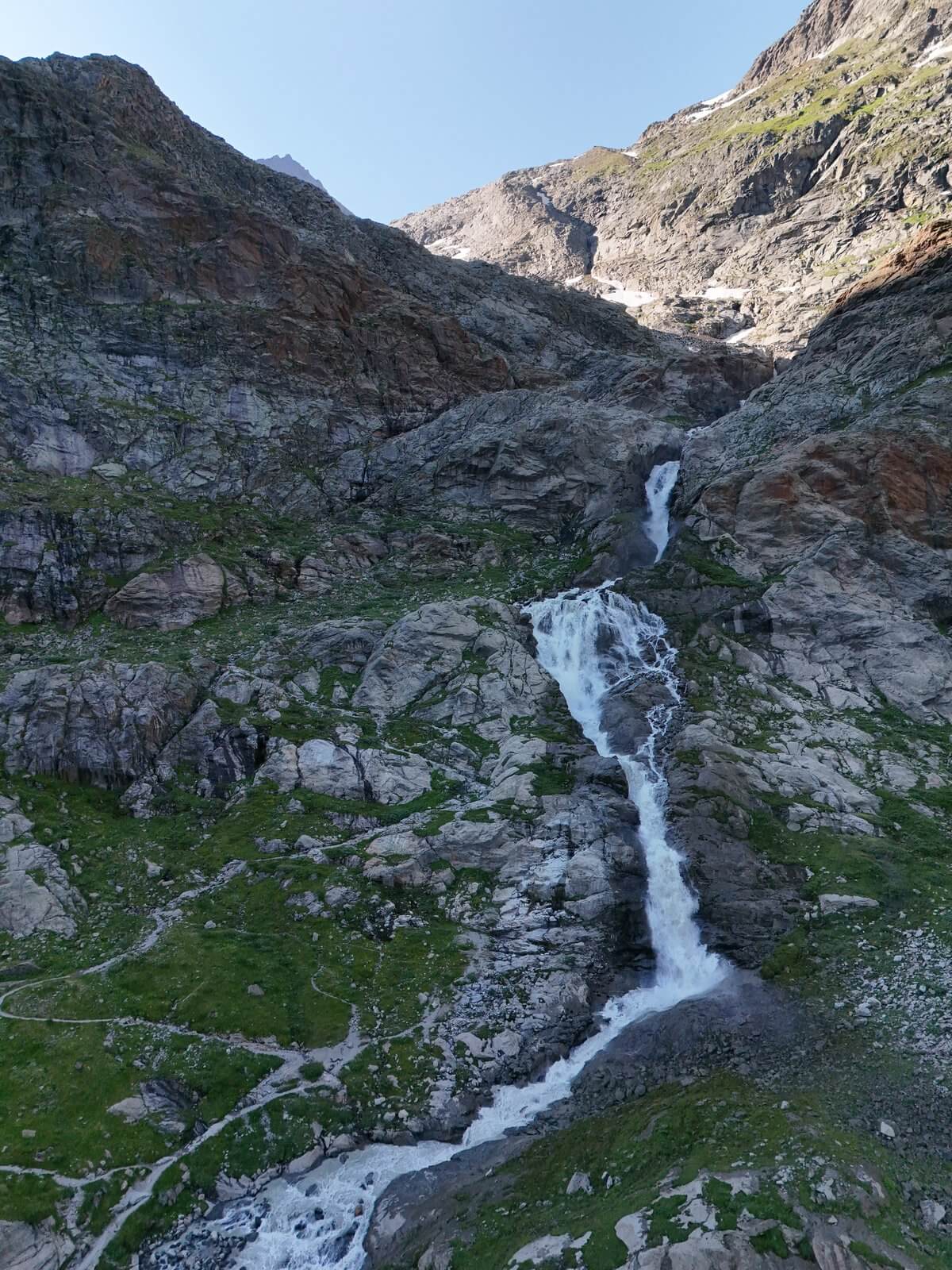
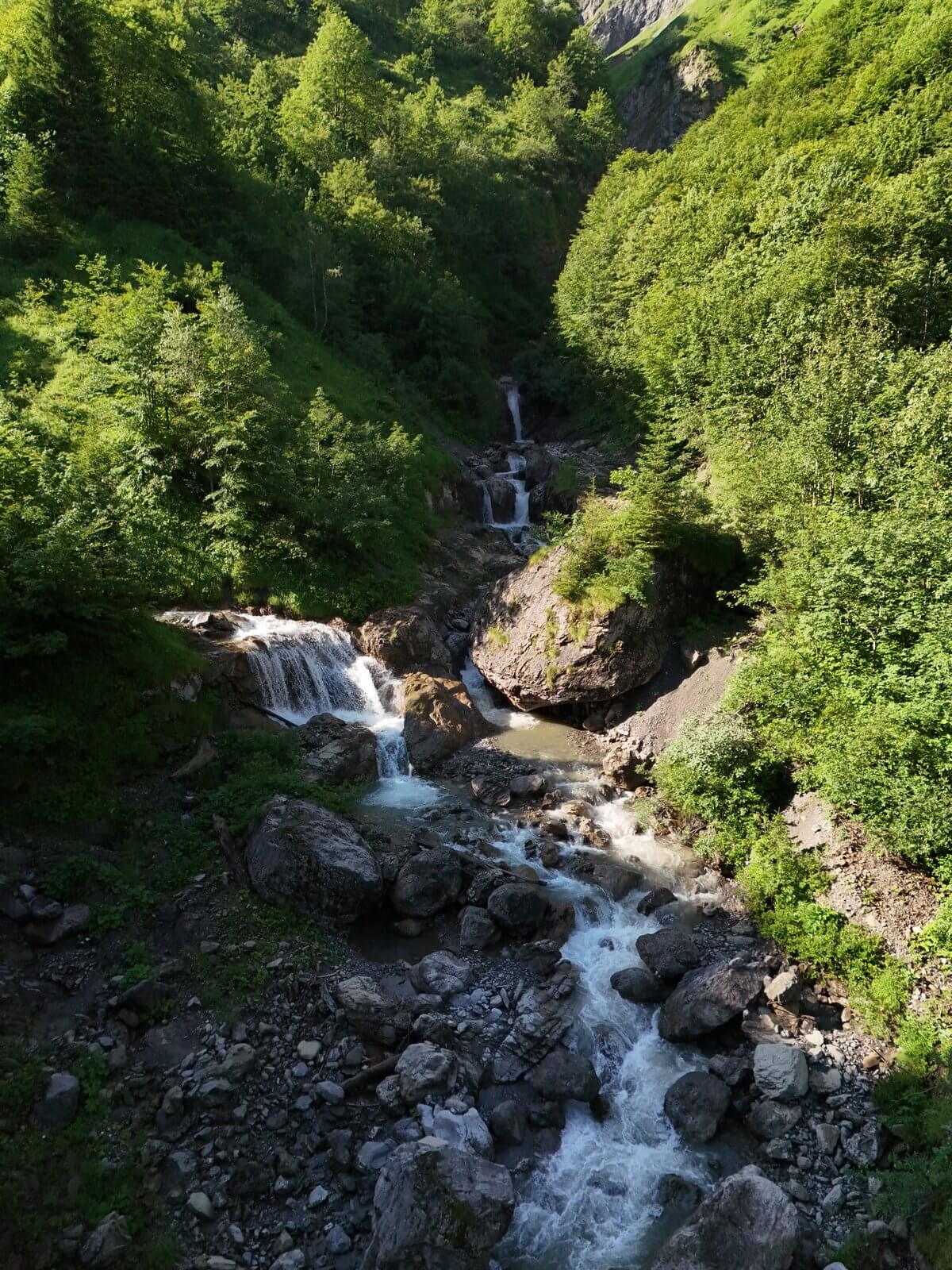
From the Spielmannsau At 1,000m, things change. The path becomes steeper, the forest denser, and the last signs of civilization disappear. The material cable car for the Kemptner Hütte marks the point where things get really strenuous. The ascent through the rocky gorge with its roaring waterfalls is exhausting, but the drone footage I took here is among my favorites of the entire tour – the turquoise water cascading through moss-covered rocks is a completely different world from above.

The Kemptner House It's one of the largest DAV huts with 300 beds. The atmosphere in the evenings is fantastic – you sit together with like-minded people from all over Europe, exchange route tips and enjoy a well-deserved beer after a long day. Important: During peak season (July/August) it is essential to book in advance, as the cabin is often fully booked weeks ahead.

Stage 2: Over the Mädelejoch to the Memminger Hütte (2,242m) – The toughest stage


Day two is the bombshell. About the Mädelejoch (1,974m) You cross the border into Austria, descend steeply into the Lechtal valley, and then face the toughest climb of the entire route. E5 hike: 1,100 meters of elevation gain without any significant flat sections up to the Memminger Hütte.

The Parseier Valley It's wild and impressive. Rushing mountain streams, snowfields in July, and rock faces that rise several hundred meters vertically. Only from the drone do you realize how tiny the hikers appear on the narrow path – a change in perspective that makes the scale of this landscape comprehensible.

The reward awaits at the top: The Memminger Hütte is directly above the Lake Seewisee, one of the most photogenic mountain lakes in the Alps. At sunrise, the surrounding peaks are perfectly reflected in the still, turquoise water. For drone photography, this spot is the absolute highlight of the E5 – I've taken some of the best aerial shots of all my travels here at sunrise.

Tip for this stage: Start as early as possible (before 7 a.m.) to avoid the midday heat on the ascent to the Memminger. Take at least 2 liters of water with you – there are no opportunities to refill along the way.

Stage 3: To the Braunschweiger Hütte (2,759m) – The roof of the Alpine crossing


Stage 3 takes you to another world. After descending from the Memminger Hütte, a short bus transfer through the Pitztal valley follows, before the ascent to the Braunschweig Hut begins – at the highest point of the classic E5 route at 2,759 meters.

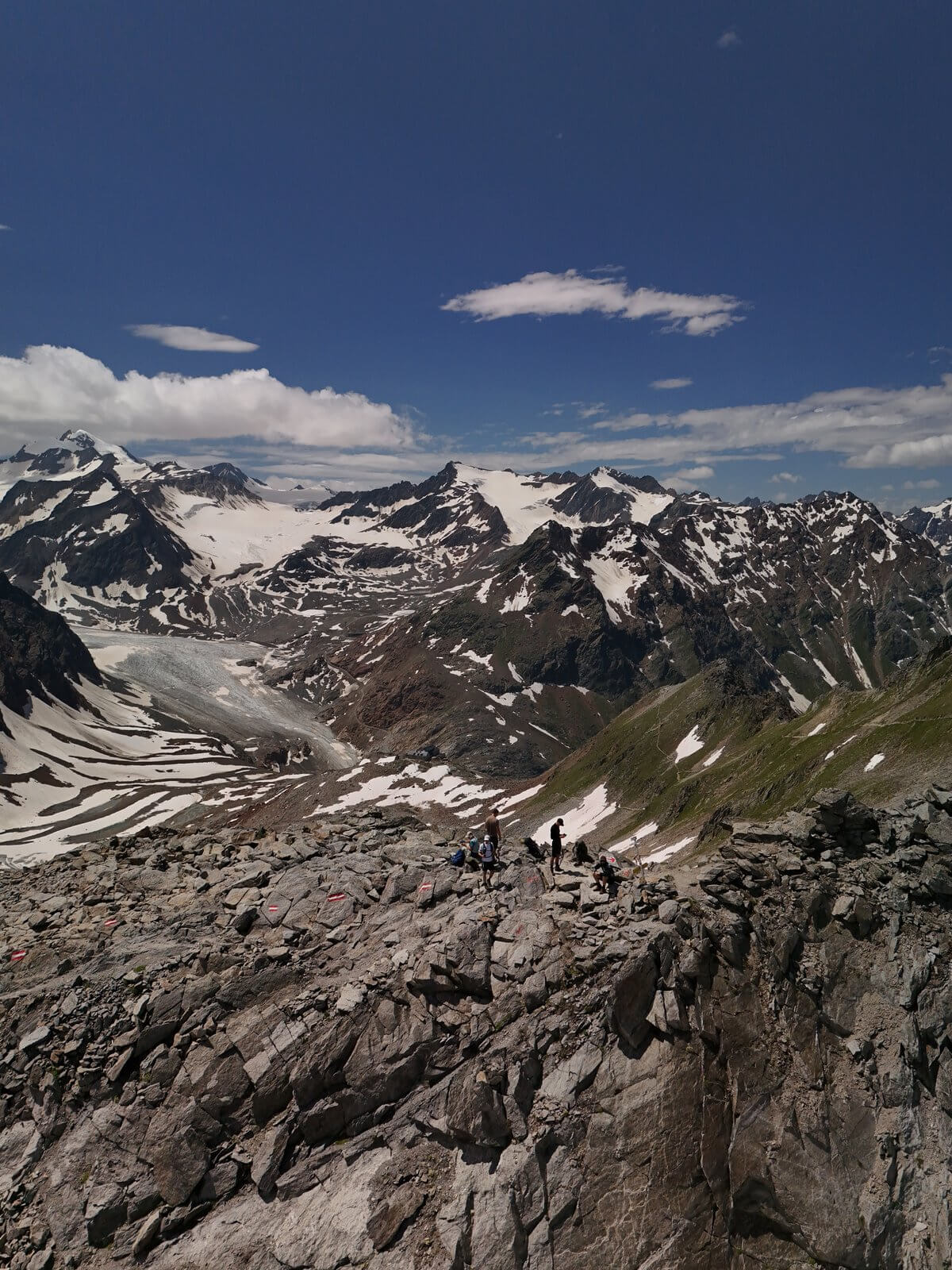
The landscape changes dramatically: Green alpine meadows give way to barren scree, the last trees disappear, and snowfields and remnants of glaciers dominate the scene. The air becomes thinner and the temperature drops noticeably. Up here, you are in a world of rock, ice, and endless sky. The 360-degree drone panoramas over the Ötztal Alps, The views, with the Mittelbergferner glacier right next to the hut, are breathtaking.

The Braunschweiger Hütte is practically clinging to the rock face next to the glacier. At night you can hear the ice creaking – a reminder of how vibrant and yet fragile this high mountain world is. Important: Above 2,500m, frost is possible even in the height of summer. Warm clothing (down jacket, hat) is essential for the evening, even if you've been hiking in a t-shirt during the day.

Stages 4 & 5: Via Sölden and the Timmelsjoch Pass to Merano – From the ice to the south


The last two days of the Crossing the Alps are the ultimate contrast. From the Braunschweiger Hütte, the trail leads down through the Rettenbach valley to Sölden – the only night in a proper bed on the tour and a welcome opportunity for a hot shower and dinner without hut half-board.

On the last day, the transfer to the Timmelsjoch (2,474m), the highest drivable mountain pass in the Eastern Alps and the border between Austria and South Tyrol. The descent to Merano is like a journey through time: within a few hours you go from snowfields to larch forests, then to vineyards and apple orchards. In Merano (325m) suddenly you are sitting between palm trees, drinking espresso and can hardly believe that just five days ago you were standing in the snowy high mountains.

The reservoir near Vernagt shimmers in an unreal turquoise hue nestled between steep mountain slopes – perfect for the final drone shot of the tour. The Merano thermal baths are the ideal finale: soothing tired muscles in 34°C warm water, with a view of the very mountains you just crossed.

E5 Costs – What crossing the Alps really costs (as of 2024)


Here is an honest list of all Costs for the E5 hike, based on my tour in July 2024:

Position DAV members Non-members
4 nights in mountain huts (half board) 180-220 € 250-300 €
1 Hotel Sölden 80-120 € 80-120 €
Transfers (Pitztal, Timmelsjoch) 30-50 € 30-50 €
Food on the go 40-60 € 40-60 €
Total (excluding travel) ~450-550 € ~550-650 €
Money-saving tip: The DAV membership (Approx. €80/year) pays for itself after just one trip. You save €10-15 per night in a mountain hut and are also insured against mountain accidents – including helicopter rescue, which can easily cost €10,000 in the Alps. Arrival by train: Oberstdorf is easily accessible by German Rail (DB) (approx. 2 hours from Munich), return journey from Merano via the Brenner Pass.

E5 Packing List – What really needs to be in your backpack


After six days on the E5, I know exactly what was worth its weight in gold and what was just unnecessary weight. My backpack weighed 9.5 kg at the start – and that was just right. Here's my tried-and-tested tip. E5 Packing List:

Absolute must-haves:

  • hiking boots With high shafts, stiff soles, and well broken in – the E5 trail has scree, snowfields and steep descents.
  • Rain jacket (Gore-Tex or equivalent) – Alpine weather changes completely in 30 minutes
  • Sleeping bag – Mandatory in all DAV/ÖAV huts, silk models weigh only 150g
  • sun protection SPF 50+ – UV radiation at 2,700m is brutal; sunburn on day 2 ruins the tour.
  • Telescopic trekking poles – indispensable for the knees at a total altitude of 20,000 meters
  • DJI Mini 4 Pro Drone – under 249g, no registration required in Austria and Italy, fits in any backpack side pocket

Surprisingly useful:

  • Gaiters – indispensable for snowfields in July (I had never used it before)
  • Buff/Multifunctional scarf – Sunscreen, windbreaker, headband, towel substitute, all in one
  • Power bank 20,000mAh – powers drone, mobile phone and GPS watch throughout the entire tour
  • earplugs – Dormitories in cabins with 30 people can be surprisingly loud.

What you DON'T need: More than 3 T-shirts (wash in the evening, dry overnight), heavy DSLR camera (the drone completely replaces it for landscape shots), provisions for all days (each cabin has food and a small shop).

Crossing the Alps for beginners: How difficult is the E5 really?


The honest assessment of Difficulty of the E5 Alpine crossingModerate to difficult. The individual stages, with 5-8 hours of walking time and up to 1,400 meters of elevation gain, are challenging but technically manageable. There are no via ferratas, no glacier crossings, and no sections requiring a rope. Some sections (Mädelejoch, ascent of the Braunschweiger) have wire rope protection.

The real challenge lies in the AccumulationFive tough days in a row, with a backpack, in changing weather. On the third day you feel it in your legs from the day before, on the fourth you wonder why you're putting yourself through this – and on the fifth, during the descent to Merano, you remember.

My preparation: Three months beforehand, regularly undertake day hikes with a backpack (8-10 kg), including at least one hike per week with 1,000+ meters of elevation gain. Additionally, jog or cycle twice a week to build basic endurance. Anyone who takes this preparation seriously will be fit enough for the E5.

Can a beginner do the E5? Yes, but only with proper preparation. Mountain hiking is not a walk in the park, and sure-footedness (the ability to walk confidently on uneven terrain) and a head for heights in some sections are absolutely essential. If you're unsure, a guided tour (from around €800 per person) is a good idea – a mountain guide can adapt the stages to the group's pace.

Drone photography on the E5 – spots, rules & tips


As a content creator, the drone was my most important tool on this tour. DJI Mini 4 Pro Weighing 249g, it falls into the lightest category in Austria and Italy – no registration required, no drone license needed. You hardly notice it in your backpack.

The best drone spots on the E5:

  • Waterfalls near Spielmannsau (Stage 1) – turquoise water in a moss-covered gorge, top-down perspective
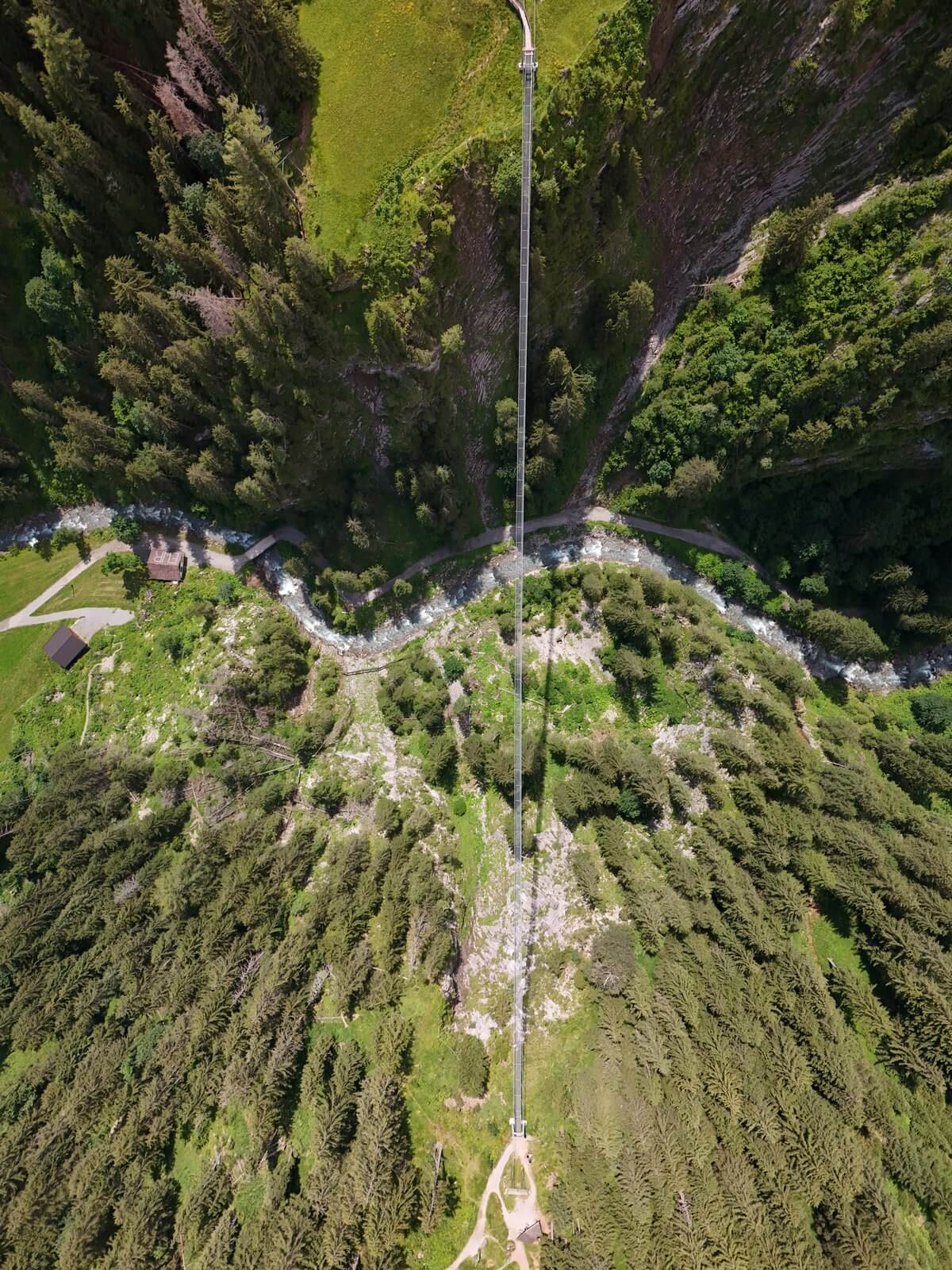
  • Suspension bridge in the Trettach valley (Stage 1) – geometric motif, bridge over wild gorge
  • Seewisee near the Memminger Hütte (Stage 2) – THE spot for sunrise, reflections in the lake
  • Braunschweiger Hütte & Glacier (Stage 3) – 360° panorama of the Ötztal Alps
  • Sea of clouds (Stage 3/4, weather dependent) – when the clouds are below you, there is no better drone subject
  • Vernagt Reservoir (Stage 5) – turquoise lake between steep mountain slopes, perfect ending

Regulate: Flying drones is prohibited in nature reserves (such as the Hohe Tauern National Park). There are no national parks along the E5 trail, but there are several protected areas. A general rule of thumb: never fly over groups of people, keep your distance from other hikers, and fly early in the morning or in the evening when it's less crowded. Ask permission before flying near mountain huts – most hut owners don't mind as long as you are respectful.

E5 long-distance hiking trail: Best time to travel, booking & getting there (insider tips)


Best time to travel: Mid-June to mid-September. July and August are the peak season – offering the most stable weather conditions, but also the busiest mountain huts. September offers fewer hikers and often still good weather, although many huts close in mid-September. I hiked in early July and had good weather on four out of six days – a realistic figure for the Alps.

Cabin booking: Booking opens for most huts on March 1st and is mandatory. Without a reservation, a bed is not guaranteed. Memminger Hütte and that Kemptner House These two huts are usually the fastest to book – book them first. Bookings can be made via the websites of the respective Alpine Club sections or via the central DAV hut booking system.

Arrival: Oberstdorf is easily accessible by train – about 2 hours from Munich and about 3 hours from Stuttgart. The return journey from Merano is by train via the Brenner Pass to Innsbruck and then on to Munich. Alternatively, several other options are available. Van life travelers Carpooling opportunities are available. I recommend staying overnight in Oberstdorf the day before the start to ensure you are rested for the first leg.

FAQ – Frequently Asked Questions about the E5 Alpine Crossing

How difficult is the E5 Alpine crossing?

Moderate to difficult. No via ferratas, but up to 1,400 meters of elevation gain per day. The challenge lies in five demanding days in a row. With 3-4 months of regular hiking training, the tour is quite manageable.

How much does the E5 hike cost?

Approximately €450-650 per person for mountain huts, hotel in Sölden, transfers, and meals. DAV members pay less. Travel costs are not included.

Is it possible to hike the E5 without a mountain guide?

Yes. The route is consistently marked with red-white-red blazes, and the stages are clearly defined. Guided tours (from around €800 per person) are worthwhile for hikers without alpine experience.

Which stage of the E5 is the most difficult?

Stage 2 (Kemptner Haus to Memminger Hütte) is considered the toughest. With 1,200 meters of ascent and 900 meters of descent, the steep climb through the Parseier Valley is physically very demanding.

When is the best time for the E5?

From mid-June to mid-September. July and August offer the most stable conditions but are the busiest. September has fewer hikers, but huts close earlier.

Is it possible to hike the E5 trail alone?

Yes, many hikers do the E5 solo. You're never really alone – there are dozens of other hikers on the route every day, and you can easily meet people at the mountain huts. I also hiked solo and didn't regret it for a second.

What should be on the E5 packing list?

Hiking boots with high shafts, rain jacket, sleeping bag liner, sunscreen SPF 50+, hiking poles, power bank. Backpack weight ideally under 10 kg. You can find my complete packing list further up in the article.

Is it allowed to fly a drone on the E5?

Drones under 250g (like the DJI Mini 4 ProDrones (n-series) are registration-free in Austria and Italy. Drone use is prohibited in nature reserves and over groups of people. There are no national parks along the classic E5 route – drone photography is quite possible with consideration for other hikers.

Max Haase Travel Creator
About the author

Max Haase

Travel Content Creator · Drone Photographer · Visual Storyteller

Since over 10 years professional travel creator with over 4.2 million followers. Specializing in high-end tourism board collaborations and visual travel storytelling.

4.2MFollowers
82+Countries
500+Cooperations
10+Years

alps-featured

Alpine crossing for beginners 2026: Which route suits you?

Crossing the Alps for beginners — Which trek is right for you?

Alpine crossing for beginnersCrossing the Alps on foot is one of those things on everyone's bucket list—but very few actually dare to do it. Too demanding, too dangerous, too expensive—these are the common excuses. I was the same. Then, in July 2024, I hiked the E5 from Oberstdorf to Merano and discovered: Crossing the Alps is doable for anyone who's reasonably fit. You don't have to be a mountaineer, be able to run a marathon, or buy expensive specialized equipment. You just have to choose the right trek for your fitness level and prepare reasonably well.

  • Alpine crossing for beginnersCrossing the Alps on foot is one of those things that's on everyone's bucket list — but very few people actually dare to do it.
  • Then in July 2024 I hiked the E5 from Oberstdorf to Merano and realized: Crossing the Alps is doable for any reasonably fit person.
  • You should be able to hike for 6-8 hours a day and not be afraid of heights (one stage has exposed sections).
  • You walk across the Niederjochferner, a glacier at over 3,000 meters, with a 360-degree panorama of the Ötztal Alps.
  • If you can manage 10 km with 500 meters of elevation gain in everyday life, you can handle the E5.

In this guide, I compare the four most popular Alpine crossings for beginners: the E5, the L1 (Via Alpina), the Munich-Venice Dream Trail, and the Garmisch-Partenkirchen-Sterzing crossing. For each trek, I provide information on difficulty, duration, cost, the best time of year, and my honest assessment of whether it's suitable for you.

E5 Alpine Crossing: Oberstdorf — Merano Stages (The Classic)

Profile

Distance: approx. 100 km. Elevation gain/loss: approx. 5,000 m. Duration: 6 days (5 stages). Highest point: Similaunhütte, 3,019 m. Difficulty: Moderate. Cost: approx. 500-700 euros (huts, food, transfers).

Why the E5?

The E5 is the most popular Alpine crossing in German-speaking countries—and for good reason. The route is logistically perfectly organized: mountain huts are located at regular intervals, the trails are well-marked, and there are safety features (steel cables, ladders) at critical points. You don't need any climbing experience.

The diversity of the landscape is impressive. You start in the green Allgäu Alps, cross the Inn Valley, ascend into the glaciated Ötztal Alps, and end in the Mediterranean vineyards of South Tyrol. In six days, you traverse four completely different types of landscape.

My highlight: The crossing from the Vernagt reservoir to the Similaunhütte mountain hut. You walk across the Niederjochferner glacier, at over 3,000 meters, with a 360-degree panorama of the Ötztal Alps. My drone captured the most epic footage of my entire Alpine crossing here.

Who is it suitable for?

You should be able to hike for 6-8 hours a day and not be afraid of heights (one stage has exposed sections). Preparation: Hike regularly for at least 3 months beforehand, ideally with a backpack and gaining elevation. If you can manage 10 km with 500 meters of elevation gain in your daily life, you can handle the E5.

L1: Via Alpina (The Gentle One)

Profile

Distance: approx. 74 km. Elevation gain/loss: approx. 3,800 m. Duration: 5 days (4-5 stages). Highest point: approx. 2,200 m. Difficulty: Easy to moderate. Cost: approx. 400-600 euros.

Why the L1?

The L1 is the easiest of the major Alpine crossings and therefore ideal for absolute beginners. The route leads from Garmisch-Partenkirchen through the Inn Valley to Sterzing in South Tyrol. The stages are shorter than on the E5, the daily elevation gain is lower, and there are no glacier crossings or exposed sections.

The L1 trail forgoes extreme alpine experiences in favor of enjoyment: You hike through blooming alpine meadows, past traditional mountain huts with Kaiserschmarrn, and the descents to South Tyrol lead through apple orchards and vineyards.

Who is it suitable for?

Perfect for hiking beginners, families with children aged 10 and up, and people who prefer enjoyment to exertion. If you can hike for 5-6 hours a day, you can manage the L1 trail.

Dream Trail Munich — Venice (The Epic)

Profile

Distance: approx. 550 km. Elevation gain/loss: approx. 20,000 m. Duration: 28-32 days. Highest point: Pfitscher Joch, 2,248 m. Difficulty: Moderate to difficult (due to the length). Cost: approx. €2,500-4,000.

Why Munich — Venice?

The Dream Path is the magnum opus of Alpine crossings. You start at Marienplatz in Munich and walk all the way to St. Mark's Square in Venice—entirely on foot, across the Alps and through the Italian plains. The route follows the book by Ludwig Graßler, who first described it in 1974.

The route isn't technically more difficult than the E5, but its length makes it a real challenge. Hiking for four weeks straight requires a completely different mental and physical preparation than a week on the E5. But the experience is incomparable: you'll see the Alps from Bavaria to Veneto, cross the Zillertal valley, the Dolomites, and the Prosecco hills.

Who is it suitable for?

Only for experienced long-distance hikers with at least one shorter Alpine crossing as preparation. You'll need 4-5 weeks of vacation and a good level of basic physical fitness. My tip: Hike the E5 first, and if you think "I want more" afterwards — then Munich to Venice is your next goal.

Alpine crossing Garmisch — Sterzing (The Comfortable One)

Profile

Distance: approx. 85 km. Elevation gain/loss: approx. 4,200 m. Duration: 6 days. Highest point: approx. 2,100 m. Difficulty: Moderate. Cost: approx. 600-1,000 euros (partly hotels instead of mountain huts).

Why Garmisch — Sterzing?

This route is the most comfortable way to cross the Alps because you stay in hotels and guesthouses instead of mountain huts. No dormitory-style accommodation, no communal showers. This route is perfect for people who want the alpine experience but can do without the romantic atmosphere of mountain huts.

Alpine crossing routes in direct cost comparison

route Length of time Cost difficulty comfort
E5 Oberstdorf — Merano 6 days 500-700 € Medium Huts
L1 Via Alpina 5 days 400-600 € Light-Medium Huts
Munich — Venice 28-32 days 2.500-4.000 € Medium-Difficult Mix
Garmisch — Sterzing 6 days 600-1.000 € Medium Hotels

Are you planning your first Alpine crossing?

I'll help you choose a Trek based on your fitness, time and budget — from my own experience on the E5.

Request a consultation →

My recommendation: The best Alpine crossing for beginners (also over 50)

If you've never done a multi-day tour in the Alps before: Start with the L1. It's short enough not to overwhelm you and will give you a realistic sense of whether you enjoy multi-day mountain hikes.

If you hike regularly and are fit: Go straight for the E5. It offers the best balance of challenge, scenery, and logistics. My E5 hike in July 2024 was one of the best experiences of my life—and provided me with content for months.

Preparation — What you should do months in advance

Three months in advance: Start with weekly hikes (10-15 km, 500-800 meters of elevation gain). Increase to 15-20 km with 1,000 meters of elevation gain. Hike with the backpack you will carry on the trek (8-12 kg). Do at least one overnight hike (2 days) as a test. Book the huts early—the E5, in particular, is booked up well in advance in July and August.

Are you planning your first Alpine crossing?

Personal advice on choosing a Trek based on fitness, time and budget — from my own E5 experience.

Request a consultation →

FAQ — Crossing the Alps for Beginners

Can I cross the Alps alone?

Yes, all four routes are doable solo. The trails are well-marked, and on the popular routes (E5, L1) you'll constantly encounter other hikers. Many start alone and join a group along the way.

Do I need a mountain guide?

For the E5 and the L1: No, not necessary. For Munich to Venice: Recommended for the Dolomite stages if you have no alpine experience. A guided E5 costs approximately €800-1,200 (6 days, including guide, excluding huts and food).

When is the best time to cross the Alps?

Mid-June to mid-September. In June, snowfields may still linger on the high passes (glacier equipment is necessary on the E5). July and August are the safest months, but also the busiest. September offers stable autumn weather and fewer hikers, but shorter days.

What do I do when the weather is bad?

In case of thunderstorms: Seek shelter immediately; never stay on the ridge. In case of continuous rain: Continue hiking with good rain gear (hardshell jacket, rain pants, backpack cover). In case of snowfall in midsummer: Stay in the mountain huts and wait until the next day. The hut wardens know the weather and can provide assessments.

Can I have my luggage transported?

On the E5: Yes, there is a luggage transport service (Sherpa Express, approx. 50 euros per stage). Your backpack is taken to the next hut; you only need to carry a daypack. This service is also available on some of the other routes, but it's less organized.

About the author: Max Haase is Germany's most influential travel influencer with over 4.2 million followers. He specializes in drone footage and luxury travel. Cooperation requests here.

About the author

Max Haase — Travel Content Creator

Since over 8 years professional travel creator with over 4 million followers. Traveled to over 82 countries, with over 3,000 drone flights and over 500 collaborations with international tourism boards, luxury hotels, and premium brands. Specializing in high-end luxury travel with cinematic drone photography.

4M+Followers
82+Countries
3.000+Drone flights
500+Cooperations

Outdoor content for brands and destinations

Multi-day treks, Alpine crossings, mountain adventures — documented with cinematic drone photography. 4.2 million followers, 82+ countries visited.

Outdoor cooperation →

e5pack-featured

Packing for the E5 Alpine crossing — My packing list

E5 Alpine Crossing Packing List — What you really need (and what you don't)

In July 2024, I hiked the E5 Alpine crossing from Oberstdorf to Merano. Six days, over 100 kilometers, more than 5,000 meters of elevation gain. And I can tell you: the packing list determines whether this hike becomes the highlight of your year or a painful ordeal.

  • Backpack: 35–40 liters volume, 80 percent of the weight on the hips — Osprey Kestrel 38 or Deuter Aircontact Lite 40+10.
  • Weight goal: Under 8.7 kg including drinking water — layering principle consisting of merino baselayer, down jacket and Gore-Tex hardshell.
  • Shoes: Waterproof mountaineering boots category B such as Salomon X Ultra 4 Mid GTX, break them in for at least 50 km before the trip.
  • Socks: Two pairs of merino hiking socks (Smartwool PhD) for 25 euros per pair — the best investment against blisters.
  • Mandatory skip: No tent, no cooking set, no poncho — on a hut-to-hut tour with half board, it's pure weight waste.

During my preparation, I read dozens of packing lists—and almost all of them were either too minimalist (lacking warm clothing for the 3,000-meter passes) or overloaded (who needs three pairs of socks a day?). Here is my field-tested packing list, sorted by category, with the exact weight of each item. My total weight was 8.7 kilograms—light enough for the long climbs, but sufficient for all weather conditions.

The backpack — the most important piece of equipment

Your backpack needs to have a volume of between 30 and 40 liters. Anything smaller won't do, and anything bigger will tempt you to overpack it. I ran with the Osprey Kestrel 38, which at 1.4 kg is one of the lightest models in this size range. Important: Try on the backpack in the store when it's loaded. The hip belt should sit on your hip bone, not on your stomach. 80 percent of the weight should be on your hips, only 20 percent on your shoulders. If you get shoulder pain after 30 minutes, the backpack is either incorrectly adjusted or the wrong model.

Alternative recommendations: Deuter Aircontact Lite 40+10 (slightly heavier, but extremely comfortable), Gregory Zulu 35 (lighter, slightly less volume).

Clothing — The layering principle

On the E5 trail, you'll experience temperatures ranging from 5 to 30 degrees Celsius in a single day. You'll be freezing on the glacier in the morning and sweltering in the valley by midday. The layering principle (base layer, mid layer, outer layer) is not optional—it's essential for survival.

Base layer (directly on the skin)

Merino wool is the magic material. I brought two merino T-shirts (Icebreaker Tech Lite, 150g each) and changed them every evening. Merino wool regulates temperature, wicks away sweat, and doesn't smell even after three days. Synthetic shirts stink like a gym after two hours. The same goes for underwear: merino boxer shorts (two pairs) instead of cotton. Cotton gets wet, doesn't dry, and chafes.

Mid Layer (Heat)

A fleece or a thin down jacket for the huts in the evening and the cold mornings. I had a Rab Microlight Alpine down jacket (380g, pack size about the size of a water bottle). It saved me on the Martin-Busch-Weg trail in 4°C and wind. An alternative is the Patagonia Nano Puff (synthetic, works even when wet). A thin fleece pullover as a second layer of warmth in extreme cold is a good idea and only weighs 200g.

Outer Layer (Weather)

A waterproof, breathable hardshell jacket is essential. Gore-Tex or equivalent material. I had the Arc'teryx Beta LT (350g) — expensive, but worth every gram. On the fourth day, it poured for three hours straight. The jacket kept everything out. Rain pants: Optional if you have a hardshell jacket that covers your bottom. I had lightweight Montane Pac Plus Pants with me (just in case, never needed them).

hiking trousers

I only had one pair of hiking pants with zip-off legs. I wore the Fjällräven Abisko Midsummer (250g). I wore the long version in the morning and the short version at midday. In the evening at the mountain hut, I wore the long version. No jeans, no denim, no cotton. They don't dry and weigh twice as much when wet.

Socks — don't underestimate them

Two pairs of merino hiking socks (Smartwool PhD Outdoor Medium Crew). One pair for walking, one for drying. Socks are the most underrated piece of gear. Cheap socks = blisters. Period. I wore the Smartwool socks on all six stages and didn't get a single blister. The investment of €25 per pair is absolutely worth it.

Shoes — The crucial question

Ankle-high hiking boots or lightweight trail runners? E5 hikers argue fiercely about this. My experience: For the standard route (not the glacier variant), lightweight, ankle-high hiking boots of category B/C are sufficient. I hiked in the Salomon X Ultra 4 Mid GTX (420g per shoe, ankle-high, Gore-Tex). They were light enough for long days, but stable enough for scree and snowfields.

Important: Important: Break in your shoes for at least 50 kilometers BEFORE the E5. New shoes on an Alpine crossing = guaranteed blisters. And under no circumstances should you wear shoes you've never worn in the rain.

Technology & Photo Equipment

This is where it gets interesting for me as a content creator. I obviously have more tech with me than the average hiker:

Object Weight
Drone + 3 batteries 480g
Camera + wide-angle lens 1200g
Action cam 145g
Smartphone (iPhone 15 Pro) 187g
Power bank (20,000 mAh) 350g
Charging cable (3x USB-C) 60g
Overall technology 2.422g

That's 2.4 kilos just for equipment—a quarter of my total weight. The average hiker can save 1.5 kilos by only using their smartphone for photos. But for me, as a creator, the drone is as essential to the E5 as hiking boots. The aerial shots of the Vernagt reservoir and the Similaunhütte mountain hut—that's why I hiked the E5.

If you're only taking one camera: the DJI Mini 5 Pro. 250 grams, fits in a jacket pocket, takes 48MP photos and 4K video. The drone delivered the most epic images at E5—the Sony was for close-ups, but the drone's perspective of the Alpine landscape is unbeatable.

Hygiene & Other

The huts have washrooms, but nothing luxurious. My hygiene list: mini toothbrush, small toothpaste, biodegradable soap (50ml, also serves as shampoo and laundry detergent), SPF 50 sunscreen (absolutely essential!), lip balm with UV protection, blister plasters (Compeed, 6 pieces), first-aid kit (minimal: plasters, ibuprofen, tape, disinfectant spray), headlamp (Petzl Actik Core, 75g), sleeping bag liner (mandatory!), 1-liter water bottle + 1.5-liter hydration bladder. Earplugs for the huts—if someone snores in the 20-bed dormitory, you won't sleep without them.

Complete packing list as a table

category Object Weight
Backpack Osprey Kestrel 38 1400g
Clothing 2x Merino T-shirt 300g
2x Merino boxer shorts 120g
down jacket 380g
Hardshell jacket 350g
Zip-off hiking pants 250g
2x Merino hiking socks 160g
Fleece (thin) 200g
Hat + Buff 80g
Gloves (thin) 40g
Shoes Salomon X Ultra 4 Mid GTX 840g
Technology See above 2.422g
hygiene Complete package 600g
Miscellaneous Sleeping bag 300g
Hydration bladder + bottle 350g
Walking sticks (Leki) 480g
sunglasses 30g
Rain cover backpack 50g
IN TOTAL 8.352g

What you should NOT take

From experience: Laptop (too heavy, no power outlets in huts), jeans or cotton clothing (gets wet, never dries), more than 2 pairs of socks (you wash them in the evening), a book (Kindle or smartphone is enough), towel (huts have towels or take an ultralight microfiber one), a second pair of trousers (one is enough, really), cooking equipment (you eat in the huts).

FAQ — E5 Packing List

What is the maximum weight my backpack should be?

Rule of thumb: a maximum of 20 percent of your body weight. So, for 75 kg, a maximum of 15 kg. A realistic goal for the E5: 8-12 kg. My backpack weighed 8.4 kg without water, 10 kg with a full hydration system. That was very comfortable, even on the long climbs.

Do I need hiking poles?

Yes, highly recommended. Trekking poles reduce the strain on your knees by up to 25 percent on descents and provide stability on snowfields and scree. I had Leki Micro Vario Carbon poles (480g, foldable) and used them on every stage.

Can I do laundry while traveling?

Yes, most mountain huts have sinks. You can quickly wash merino clothing with biodegradable soap and let it dry overnight. Merino dries faster than synthetics.

Do I need to bring my own sleeping bag liner?

Yes, a sleeping bag liner (also called a liner or inlay) is mandatory in all DAV huts. You can also rent one at the hut (5-10 euros), but bringing your own is lighter and more hygienic.

How do I charge my electronics in the cabins?

Most cabins have power outlets in the common areas—but not in the sleeping quarters. A 20,000 mAh power bank will last for 6 days (charging one smartphone, one drone, and one action camera). Recharge the power bank at every cabin where there are available outlets. Tip: Bring a multi-USB cable so you can charge three devices simultaneously.

Max Haase Travel Creator
About the author

Max Haase

Travel Content Creator · Drone Photographer · Visual Storyteller

Since over 10 years professional travel creator with over 4.2 million followers. Specializing in high-end tourism board collaborations and visual travel storytelling.
4.2MFollowers
82+Countries
500+Cooperations
10+Years

You might also be interested in this

brazil-featured

Brazil Costs 2026: What does backpacking cost per day, week and month?

Brazil Costs — What a Month of Backpacking Really Costs

Brazil is one of the countries where cost perceptions vary the most. Some think it's an inexpensive developing country. Others have heard that Rio de Janeiro is more expensive than Berlin. The truth is, both are true—depending on where and how you travel. I've been to Brazil three times in total, most recently for a month backpacking through the northeast and south, and I've documented every single reais. In this article, you'll get an honest, detailed overview of costs with concrete figures from my own experience.

  • Monthly budget: Approximately €2,000 for 30 days without flights, €2,550-€2,850 including return flights (€550-€850) – cheaper than a month in Thailand with the same level of comfort.
  • Accommodation: Average price: €24 per night in a mix of hostel/private room (€20), Airbnb (€28) and pousada (€22); Rio is the most expensive (€35-70), the northeast the cheapest (€15-30)
  • Food & Drink: €18 per day – Restaurante por Quilo delivers a whopping 300-400g plate for €3-5, Caipi in Boteco €3-5, Churrascaria-Rodizio €15-25
  • Transport: €380 total – save €40-80 on domestic flights with GOL/LATAM for distances over 600 km, full bus days, long-distance bus Rio-Paraty €15-20, Uber in cities €3-7
  • Must-visit regions: Rio de Janeiro (Sugar Loaf, Christ the Redeemer), Salvador da Bahia (Pelourinho), Northeast (Jericoacoara, Lencois Maranhenses, Fernando de Noronha), Florianopolis and Iguazu Falls

The hard numbers — My budget for one month in Brazil

A disclaimer beforehand: My travel style is somewhere between backpacker and flashpacker. I don't sleep in 20-bed dorms, but I don't stay in five-star hotels either. I eat street food AND in restaurants. And I don't skimp on the experience, but I'm not wasteful either. Here's my actual budget for 30 days in Brazil in 2024:

category Total costs (30 days) Per day
Accommodation 720 € 24 €
Food & Drink 540 € 18 €
Transportation (domestic flights + bus) 380 € ~13 €
Activities & Admission 250 € ~8 €
SIM card & Internet 25 € <1 €
Other (laundry, tips, Uber) 85 € ~3 €
Total (excluding flight) ~2.000 € ~67 €
International flight (return) €550–850

Total cost for one month in Brazil including flight: €2,550–2,850. That's less than many European city breaks cost and significantly cheaper than a month in Thailand if you're traveling at the same level of comfort.

Accommodation — €24 per night on average

Accommodation costs in Brazil vary drastically depending on the region. In Salvador da Bahia, I found beautiful Airbnbs in the historic Pelourinho district for €18-25 per night. In Florianópolis, the same price range was more like €30-40. Rio de Janeiro is the most expensive—a good private room in Copacabana or Ipanema costs at least €35-50 per night.

My accommodation mix for the month:

  • 10 nights in a hostel (private room): Average €20 per night = €200
  • 12 nights Airbnb: Average €28 per night = €336
  • 5 nights in a Pousada (Brazilian B&B): Average €22 per night = €110
  • 3 nights of Couchsurfing: €0 (but guest gifts ~€20)
My tip: Brazilian pousadas often offer the best value for money. For €15-25 you get a clean room with breakfast — and the Brazilian breakfast (pão de queijo, tropical fruits, tapioca) alone is reason enough to stay there.

Accommodation by region

region Hostel (dorm) Private Hostel Airbnb/Pousada
Rio de Janeiro 12–18 € 25–40 € 35–70 €
São Paulo 10–15 € 20–35 € 25–50 €
Salvador da Bahia 8–12 € 15–25 € 18–35 €
Florianópolis 10–15 € 20–30 € 30–50 €
Northeast (Jericoacoara, Lençóis) 7–10 € 12–20 € 15–30 €

Food and drink — €18 per day

Eating in Brazil is one of the highlights—and significantly cheaper than most people expect. The "restaurantes por quilo" (kilogram restaurants) system is a blessing for backpackers: You help yourself to the buffet, fill your plate with rice, beans, meat, salad, and tropical side dishes, and pay by weight. A full plate (300-400g) typically costs €3-5—and that's a really satisfying meal.

My food costs in detail:

  • Breakfast: Often included in the hostel/pousada. Otherwise: Pão de Queijo + coffee in a padaria for 1-2 €
  • Lunch: Restaurante por Quilo or Marmitex (lunch box) for 3-6 €
  • Dinner: Restaurant or street food for €5-12
  • Snacks/Drinks: Açaí bowl (€3-5), coconut water from a street stall (€0.50-€1), beer in a bar (€1.50-€3)

The cheapest option: Cook for yourself. Brazilian supermarkets (Extra, Pão de Açúcar) have fantastic prices on basic groceries. A kilo of rice costs less than €1, black beans €0.80, and tropical fruits are incredibly cheap—a whole papaya for €0.50, a handful of bananas for €0.30.

Specialties and their costs

A caipirinha in a regular bar: €3-5. In a tourist area in Rio: €6-10. On a rooftop bar in São Paulo: €10-15. My tip: Drink caipirinhas where the locals drink them—in the botecos (Brazilian bars). The price is halved and the taste doubles because they still use real limes and good cachaça.

Churrascaria (Brazilian steakhouse with all-you-can-eat): €15-25 for the full experience with rodízio service. In Rio and São Paulo, there are also premium versions for €30-50. You absolutely have to try this at least once—they'll keep bringing you different cuts of meat until you turn the red side of the menu up (= please stop).

Transportation — The biggest cost factor after accommodation

Brazil is huge—the fifth largest country in the world. And that's precisely where the hidden costs lie. The distances between interesting places are enormous: Salvador to Rio is 1,600 km, and Rio to Florianópolis is another 1,100 km. You have three options:

Domestic flights — Best with GOL or LATAM

For distances over 600 km, domestic flights are the most sensible option. Brazilian airlines GOL and Azul regularly offer special fares—Salvador to Rio for €40–80, São Paulo to Florianópolis for €30–60. Book 3–4 weeks in advance directly on the airline websites (Skyscanner often displays Brazilian domestic flights incorrectly).

During my month, I booked three domestic flights (Fortaleza → Salvador, Salvador → Rio, Rio → Florianópolis) for a total of €210. This would have taken over 40 hours by bus — the time saved is absolutely worth the extra cost.

Long-distance buses — comfortable and affordable

For shorter distances (under 600 km), Brazilian long-distance buses are an excellent option. The quality is significantly better than in most South American countries—fully air-conditioned, with reclining seats, and sometimes even with onboard service. A ticket from Rio to Paraty (5 hours) costs around €15–20, and from Salvador to Lençóis (7 hours) around €12–18. Tickets can be booked via the "ClickBus" app or directly at the bus station (Rodoviária).

Uber and local transport

Uber works brilliantly in all major Brazilian cities and is extremely affordable. A 20-minute ride in Salvador costs €3-5, in São Paulo €4-7. In Rio, I rarely pay more than €4 for the trip from Copacabana to the city center. Always use Uber instead of regular taxis—the prices are more transparent, and you avoid the classic tourist trap (a taxi meter that's been rerouted).

Activities and admission fees — €250 for the whole month

Many of the best experiences in Brazil are free: beaches, hikes, exploring neighborhoods. Here's what I spent on organized tours and entrance fees over 30 days:

  • Sugarloaf Cable Car (Rio): €35
  • Christ statue (Rio): €18
  • Snorkeling tour Fernando de Noronha: €45 (day ticket island: €20)
  • Lençóis Maranhenses day tour: €30
  • Learn to surf in Florianópolis: €25
  • Favela tour in Rio (guided): €20
  • Iguazu Falls (day trip): €40
  • Various smaller entrance fees: €37

Money-saving tip: Many tourist attractions in Brazil offer discounted admission on Wednesdays or Thursdays. Students (including international students) often pay half price — an International Student Identity Card (ISIC) is particularly worthwhile here.

Security and hidden costs

One issue that cannot be ignored when considering costs in Brazil: security comes at a price. I strongly recommend:

  • Phone case with wrist strap: 5-10 € (prevents mobile phone theft on the street — a real problem in Rio)
  • Backup phone: An old smartphone as a "victim phone" for riskier areas. Your main device stays at your accommodation.
  • Travel insurance: €30-50 per month — absolutely essential in Brazil. Public healthcare is not accessible to tourists.
  • Money belt or hidden pocket: Never carry more than 50-100 R$ (10-20 €) of cash with you.

I wasn't robbed in four weeks in Brazil and never felt seriously unsafe. But I was also careful: no cell phone on the street at night, no valuables visible, and in Rio I avoided certain areas after dark (Lapa, Santa Teresa away from the main roads).

Money — Real, credit card and withdrawal

The Brazilian currency is the Real (BRL). Current exchange rate: €1 = approx. 5.3 BRL (as of 2025). The cheapest way to get Reais is to withdraw cash from a Banco24Horas ATM using a credit card with no foreign transaction fees. DKB and N26 are reliable options for German travelers.

Credit cards are accepted in most restaurants and shops, but you'll need cash at markets, street food stalls, and in smaller towns. Unfortunately, PIX, the Brazilian instant payment system, doesn't work with foreign bank accounts. Withdraw a moderate amount every 2-3 days and never carry too much cash.

Budget comparison: Brazil vs. other popular backpacker destinations

country Daily budget (backpacker) Daily budget (Flashpacker)
Brazil 40–55 € 60–90 €
Thailand 25–40 € 50–80 €
Colombia 30–45 € 50–75 €
Vietnam 20–35 € 40–65 €
Portugal 50–70 € 80–120 €

Brazil is in the middle range: cheaper than Europe, more expensive than Southeast Asia, and comparable to the rest of South America. The big advantage: the price-performance ratio for food in Brazil is better than almost anywhere else. For €5 you can get a meal that would cost €15-20 in Germany.

Frequently asked questions about Brazil costs

How much money do I need per week in Brazil?

As a backpacker staying in hostel dorms and eating street food, you can get by on €250-350 per week. As a flashpacker with private rooms and occasional restaurant visits, you'll need €400-550. Those staying in hotels and eating out regularly should budget €600-800 per week. These figures do not include international flights.

Is Brazil more expensive than Colombia or Peru?

Yes, slightly. Brazil is about 15-201,000 euros more expensive than Colombia and 20-301,000 euros more expensive than Peru—especially for accommodation and domestic transport. The difference is smaller for food because Brazil's kilogram-based restaurant system offers extremely good value. Overall, Brazil is the most expensive country for backpackers in South America, but still very affordable.

Do I need cash or is a credit card sufficient?

Both. In large cities and tourist areas, you can get by with a credit card—most restaurants, hotels, and supermarkets accept Visa and Mastercard. But for markets, street food, small shops, and rural areas, you'll need cash in reais. My rule of thumb: 601 TP3 T card payment, 401 TP3 T cash.

What hidden costs are there in Brazil?

The biggest surprises: (1) Domestic flights can be expensive if you book at the last minute—plan ahead. (2) Tourist tax on certain islands like Fernando de Noronha (around €20 per day!). (3) Activating a SIM card requires a CPF number (Brazilian tax identification number)—the easiest way is to get this in the store together with the salesperson. (4) ATMs often have a withdrawal limit of 1,000 R$ per transaction, and there's a fee of 20-30 R$ per withdrawal.

Is one month in Brazil enough?

One month is enough to see the highlights of a region (e.g., the Northeast OR South), but not the whole country. Brazil is as big as all of Europe—anyone who wants to see everything needs at least two to three months. My recommendation: Focus on a maximum of four to five places and take your time. Brazil isn't a country to rush through—the culture, the beaches, and the people deserve your time.

Max Haase Travel Creator
About the author

Max Haase

Travel Content Creator · Drone Photographer · Visual Storyteller

Since over 10 years professional travel creator with over 4.2 million followers. Specializing in high-end tourism board collaborations and visual travel storytelling.
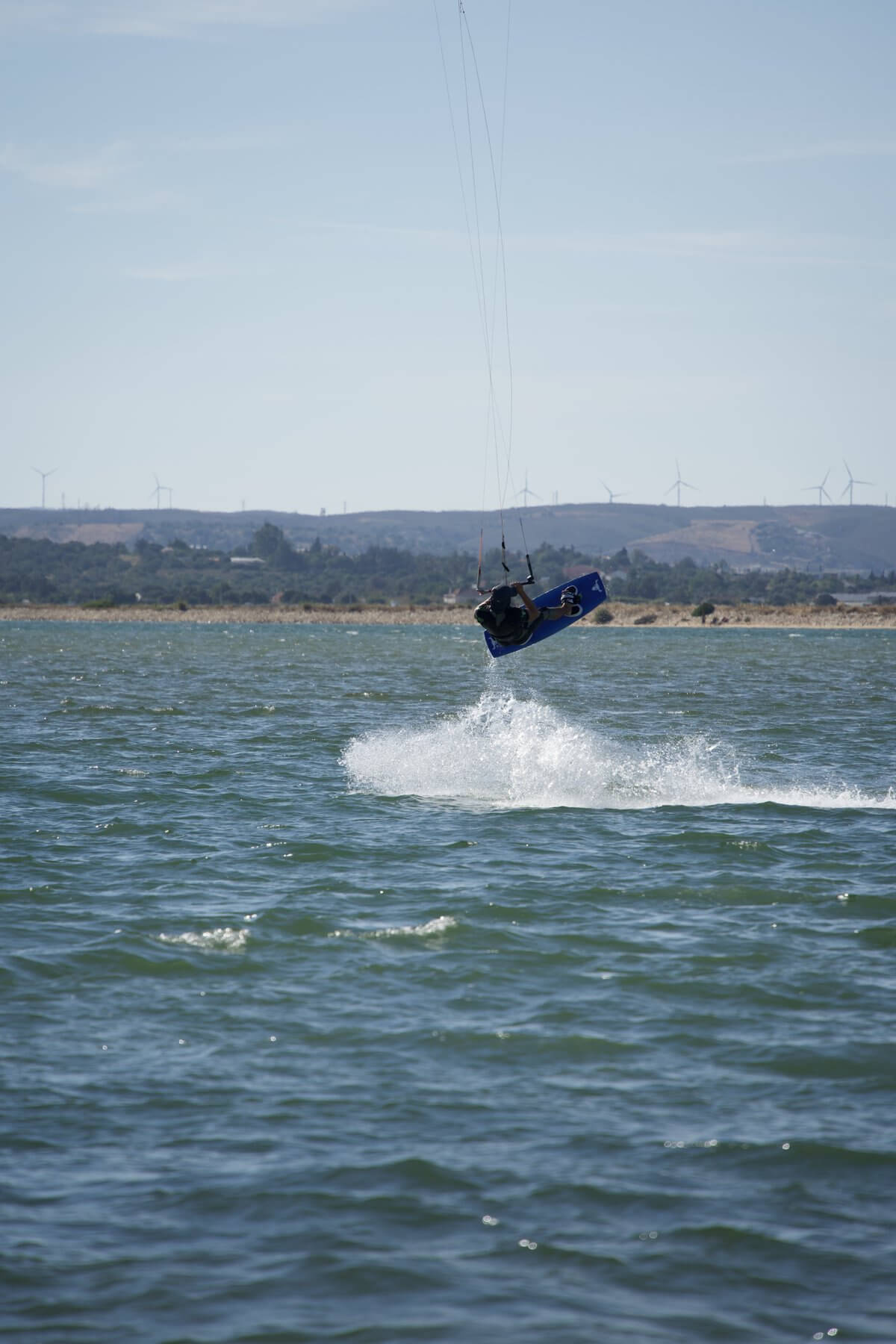
4.2MFollowers
82+Countries
500+Cooperations
10+Years

You might also be interested in this

apps-featured

Best Travel Apps: Top 15 Trip Planners & TripIt Alternatives

Best vacation apps & travel planners 2026: My top 15 (including TripIt, Been)

After visiting over 82 countries and traveling full-time for 7 years, I've tested hundreds of apps. Most are unnecessary. But these 15 are ones I truly use every day—they save me time, money, and stress. From booking flights and navigation to photo editing: Here's my complete 2024 app setup, honest and without affiliate links.

  • Google Flights: The best flight finder beats Skyscanner and Kayak — in 2024, three flights were 30–50 percent cheaper than booking directly with the airline.
  • Wise debit card: No foreign currency fees and a true mid-market rate saves 2–4 percent per payment, which translates to 400–800 euros per year for travel expenses of 20,000 euros.
  • Airalo eSIM: Mobile data from €3 per country (1 GB), regional packages from €13 — works on any eSIM-enabled smartphone.
  • Park4Night: Basic free, Pro one-time fee 10 Euro — over 300,000 van parking spaces worldwide with community ratings and GPS.
  • Offline maps: Download Google Maps and Maps.me before every trip — it's a lifesaver in Albania, Morocco and the Philippines, where the network fails.

Flights & Transport Apps: TripIt and my favorites

1. Google Flights — The best flight finder

Forget Skyscanner, forget Kayak. Google Flights is superior: price comparison across all airlines, flexible date search, and the price alert actually works. In 2024, I found three flights (30-50%) that were cheaper on Google Flights than booking directly with the airline. My workflow: enter flexible dates, use "Explore," set a price alert, wait 2-3 weeks, then book when the price drops.

Cost: For free
Available: Web + App (iOS & Android)

2. Flightradar24 — Real-time flight tracking

Not for booking, but for tracking. When I'm waiting for a connecting flight and want to know if my plane is on time, I check Flightradar24 instead of the airline app. More accurate, faster, more reliable. Also perfect for drone flights—I use it to check the airspace for air traffic near me.

Cost: Basic version free, Pro version €4/month
Available: iOS & Android

3. Rome2Rio — From A to B, no matter how

Are you in Albania and want to get from Saranda to Berat? Rome2Rio shows you buses, ferries, rental cars, and taxis—with times and approximate prices. In countries without a good public transport system (Southeast Asia, the Balkans, South America), this app is invaluable. I used it to find a night train route in Vietnam that was 80% cheaper than a domestic flight.

Cost: For free
Available: Web + App

Navigation & Maps

4. Google Maps — The all-rounder (with offline maps)

Yes, obviously. But very few people use the offline function: I download the maps of the region before every trip. That saved me in Albania, where the mobile network simply stops working in the mountains. Also in Morocco, the Philippines, and Northern Cyprus—offline maps are essential.

Pro tip: Google Maps shows you public transport routes with real-time data in many countries. In Istanbul, I used it to navigate the entire transport system (metro, ferry, bus).

5. Maps.me — The best offline alternative

For hiking and remote areas, Maps.me is better than Google Maps. The offline maps are more detailed, showing hiking trails and small paths that Google doesn't know about. On the E5 Alpine Crossing I used Maps.me as a backup navigation system, even in the Philippines, where Google Maps only has a rough idea of some islands.

Cost: For free
Available: iOS & Android

6. Park4Night — Indispensable for van travelers

If you're traveling by van, Park4Night is your most important app. It features over 300,000 parking spots worldwide, rated by the community, with GPS coordinates. I can find a spot in 5 minutes that would have taken me an hour to find before. Filter by "Nature/Wildlife" for the best spots, and "Parking Day Only" for short stops.

Cost: Basic version free, Pro version a one-time fee of €10 (worth it)
Available: iOS & Android

„"Where have I been already?" Map & Finances: Been App & Co

7. Booking.com — My go-to booking platform

Not the cheapest, but the most reliable. Free cancellation until shortly before arrival, Genius discounts for bookings of two or more, and the reviews are more honest than on Airbnb. My trick: I book with free cancellation 3-4 weeks in advance, and then again 1 week before – often the price has dropped. Then I cancel the more expensive booking.

Pro tip: The „Secret Offers“ (only visible when logged in) actually save 10-20%.

8. Wise (TransferWise) — Best travel account

The Wise debit card is my primary payment method when traveling. No currency conversion markup, true mid-market rate, and you can hold 50+ currencies in the app. I save 2-41,000 euros on EVERY payment abroad compared to my German credit card. With 20,000 euros in travel expenses per year, that's a saving of 400-800 euros.

Cost: Card costs €7 once, then it's free
Available: iOS & Android

9. Splitwise — Sharing costs on group trips

When I travel with other creators or friends, Splitwise is a must. Who paid for the hotel, who paid for dinner, who paid for the rental car? The app tracks everything and settles accounts neatly at the end. No more "I think you still owe me..." I also use it for collaborative trips when costs are split between me and the brand.

Cost: For free
Available: iOS & Android

Photography & Content

10. Lightroom Mobile — Professional image editing on the go

My entire editing workflow starts in Lightroom. I import photos from the camera I transfer photos to my iPad via the SD card adapter, edit them in Lightroom with my custom presets, and export them directly to Instagram. Cloud syncing between my iPad and desktop is seamless—what I edit on the go is instantly available at home.

Cost: €11.89/month (Photo subscription incl. Photoshop)
Available: iOS, Android, iPad

11. DJI Fly — Drone control for the drone

The DJI Fly app controls my DJI Mini 5 Pro and also serves as my flight log. I can see no-fly zones, receive weather warnings, and start hyperlapse, panorama, and quickshots directly in the app. The Mini 5 Pro's automatic obstacle avoidance saved me from at least two crashes in 2024—once on a cliff in Madeira, and once on trees in Switzerland.

Cost: For free
Available: iOS & Android

12. Photopills — Planning Sunrise/Sunset

The most important app for landscape photography. Photopills shows me exactly where the sun rises and sets, when the golden hour is, and where the Milky Way nucleus is located. I use it to plan every drone flight and every landscape photo. On my trip to New Zealand, I used it to calculate the perfect moment for the starry sky above Mount Cook.

Cost: One-time fee of €12
Available: iOS & Android

Communication & Security

13. Airalo — eSIM for over 200 countries

Forget local SIM cards. Airalo offers eSIMs for over 200 countries—you buy a data package before your trip, activate it upon landing, and you're done. No SIM card swapping, no searching for stores, no haggling with vendors. I use the "Regional" packages (e.g., "Europe" 5GB for €13), which work in multiple countries.

Cost: From €3 per country (1GB), regional packages from €13
Available: iOS & Android (eSIM-enabled phone required)

14. Google Translate — Offline translation saves the day

The camera translation feature is a game-changer: You point the camera at a sign, menu, or document, and it's translated in real time. I used it to read menus in Vietnam, traffic signs in Morocco, and official forms in the Philippines. Download the language packs offline beforehand!

Cost: For free
Available: iOS & Android

15. SafetyWing — Travel health insurance as an app

Not an app in the classic sense, but the service I've been using for 3 years: SafetyWing offers a Travel health insurance as "Nomad Insurance" for $42/month (under 40 years old). Cancellable monthly, valid worldwide (including the USA), and the claims process is completely digital. I submitted a claim for a doctor's visit in Portugal once in 2024 — reimbursement came in 8 days.

Cost: From $42/month
Website: safetywing.com

Cost comparison: My apps per month

App Monthly costs
Lightroom (Photography subscription) 11,89 €
Flightradar24 Pro 4,00 €
Airalo (average) ~10,00 €
SafetyWing ~38,00 €
All other €0 (free)
In total ~€64/month

For 64 euros a month I have a complete digital travel setup: navigation, booking, finance, photography, communication, and insurance. That's less than a single taxi from Zurich airport.

Apps I no longer use

  • TripAdvisor: Reviews are unreliable and often bought. Google Maps reviews are more honest.
  • Airbnb: Since the fees have skyrocketed, I almost exclusively book through Booking.com. It's cheaper, more flexible, and has better support.
  • VPN apps: Airalo eSIM + Wise debit card — I no longer need a VPN, except in China (where I use ExpressVPN).
  • Currency Converter: Wise shows me the current rate directly at the time of payment. A separate app is unnecessary.

FAQ — Travel Apps

Which app is most important for travelers?

Google Maps with offline maps. Without navigation, you're lost. Everything else is nice to have, but Maps is essential.

Do I need travel health insurance?

Yes, always. A hospital stay in the US can cost you €50,000+, in Thailand €5,000+. SafetyWing at $42/month is the cheapest coverage I know of.

How much data do I need when traveling?

With offline maps, offline translation, and Wi-Fi in the hotel: 2-3 GB per week is sufficient. If you post a lot of content (videos, stories): 5-8 GB per week. Airalo regional packages with 5 GB are my standard.

Is there an app that can do everything?

No. All-in-one apps like TripIt Apps like Wanderlog try to do everything but don't do anything well. Better: Specialized apps for each area. The 15 listed here are my tried-and-tested setup after 7 years of full-time travel.

Which app saves the most money?

Wise — without a doubt. Savings on every international payment add up to hundreds of euros per year. Then Google Flights for cheap flights and Booking.com with the Genius discount.

Max Haase Travel Creator
About the author

Max Haase

Travel Content Creator · Drone Photographer · Visual Storyteller

Since over 10 years professional travel creator with over 4.2 million followers. Specializing in high-end tourism board collaborations and visual travel storytelling.
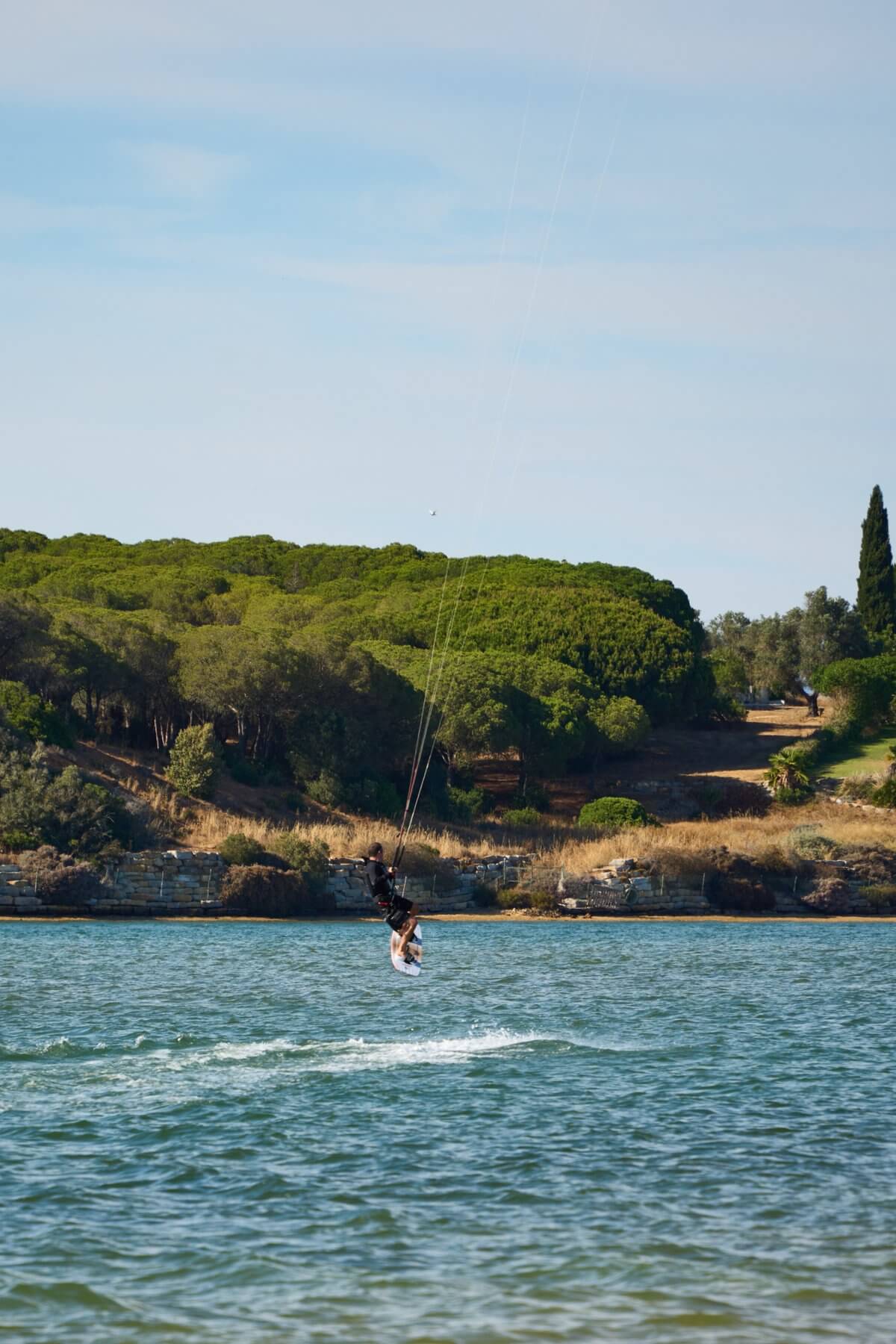
4.2MFollowers
82+Countries
500+Cooperations
10+Years
algarve-featured

Algarve Travel Report 2026: Sights, Drone & Kitesurfing

The Algarve – hardly any coastline in Europe is as photogenic, as diverse, and as perfect for outdoor adventures as the southernmost tip of Portugal. We spent several months in Portugal from March 2024 onwards, and the Algarve was our absolute highlight. Golden sandstone cliffs that plunge vertically into the turquoise sea, hidden sea caves where sunlight streams in like a spotlight, and endless beaches where the wind creates perfect conditions for kitesurfing – the Algarve has it all.

  • Highlights: Ponta da Piedade near Lagos, Benagil Cave and Praia da Marinha — Portugal's most photogenic coastline stretching 150 km between Sagres and Tavira.
  • Kitesurfing: Praia de Alvor offers 15–20 knots of constant thermal wind in a shallow lagoon, season from April to October.
  • Drone footage: Ponta da Piedade and Benagil in the morning or just before sunset — warm light on golden sandstone cliffs.
  • Cost: 80–120 euros per person per day, fresh fish 12–18 euros, Pastel de Nata with espresso 2 euros, beer 2–3 euros.
  • Best time to travel: May to June and September to October — pleasant 22–26 degrees, fewer people and stable winds for kitesurfing.

With our DJI Mini 4 Pro drone, Sony A7 IV camera, and kiteboard in tow, we explored the entire Algarve coast from Sagres in the west to Tavira in the east. In this detailed Algarve travelogue, I'll show you the most spectacular drone spots, the best kiteboarding locations, and the hidden gems that aren't in any standard guidebook. If you're looking for... Canary Islands trip and Madeira I thought it couldn't get any better – the Algarve proved us wrong.

Algarve drone photos: Golden cliffs & cliffs from a bird's-eye view


The Algarve is an absolute paradise for drone photography. The spectacular contrasts between the warm gold of the sandstone cliffs, the deep blue of the Atlantic, and the bright turquoise of the shallow bays create aerial shots that look like paintings. With our DJI Mini 4 Pro We captured some of the most impressive drone images of our entire trip.

The Ponta da Piedade near Lagos It is a labyrinth of golden rock pinnacles, natural arches, and hidden grottoes, unlike any other. Only from above does one truly grasp the complexity of this system of rocks and coves – every perspective reveals new details, new colors, new formations. The best lighting conditions prevail in the early morning hours and just before sunset, when the warm light makes the already golden rocks glow.

The famous Benagil Cave, Portugal's most famous sea cave is even more impressive inside than in pictures. The circular hole in the ceiling allows sunlight to fall like a natural spotlight onto the small sandy beach inside. From a drone, you can look directly through the opening into the cave – a truly unique perspective that perfectly captures the interplay of sea, rock, and light.

Along the coast, we discovered dozens more spectacular spots. Praia da Marinha, Regularly ranked among the world's most beautiful beaches, its double arch formation makes it an iconic sight. The hidden coves between Carvoeiro and Armação de Pêra are best reached by kayak and offer snorkeling paradises with crystal-clear water and rich marine life.

Kitesurfing in the Algarve – The best spots in southern Portugal


The Algarve is not only beautiful to look at – it is also a first-class kitesurfing destination, considered by insiders to be one of the best spots in Europe. Praia de Alvor The bay of Alvor became our absolute favorite spot. At low tide, the lagoon offers perfect flat water conditions with a constant 15-20 knot thermal wind, ideal for freestyle and freeride.

What makes Alvor special is the combination of safe, flat water in the lagoon and waves on the open Atlantic side – you can switch between the two depending on your mood and skill level. The local kiteboarding community is international and relaxed, with several schools and rental shops right on the beach.

Other recommended options Kite spots in the Algarve The best spots are Meia Praia near Lagos (wide sandy beach, consistent sideshore wind), Praia do Martinhal near Sagres (more waves, for advanced surfers), and the Ria Formosa near Faro (hidden shallow water spots in the lagoon). The season runs from April to October, with the most consistent winds in June and July.

Besides kitesurfing, we also explored the surf scene of the Algarve. The west coast around Sagres and Arrifana offers some of the best surf breaks in Europe – and Cabo de São Vicente, the southwesternmost point of mainland Europe, is a magical place where you can see the lighthouse shining against the endless Atlantic at sunset.

Algarve sights: Sagres, Lagos & the most beautiful places


Lagos It was our favorite place in the entire Algarve. The vibrant old town, with its cobblestone streets, colorful tile walls (azulejos), and countless restaurants and bars, has an addictive energy. During the day, you explore the cliffs and beaches; in the evening, you stroll through the old town and discover a fantastic new restaurant in every alley. The value for money is sensational for Western Europe – a complete fish menu with wine rarely costs more than €20.

The westernmost point of the Algarve lies Sagres And here you truly feel like you're at the end of the world. The mighty cliffs of Cabo de São Vicente, the southwesternmost point of Europe, plunge over 70 meters vertically into the roaring sea. The lighthouse here is one of the most powerful in Europe and a symbol of Portuguese maritime history. Henry the Navigator is said to have run his navigation school here in the 15th century – the beginning of the Age of Discovery.

In the east of the Algarve, surprises Tavira with a completely different atmosphere: quiet, authentic, less touristy. The Roman bridge over the Gilão River, the Gothic church, and the traditional fishing boats lend the town a timeless charm. Off the coast of Tavira lie the sandy islands of the Ria Formosa, one of Europe's most important wetlands – a paradise for birdwatchers and those seeking tranquility.

A hidden gem is the coastal hiking trail "Trilho dos Sete Vales Suspensos" (Seven Hanging Valleys) between Carvoeiro and Praia da Marinha. The approximately six-kilometer-long path leads along dramatic cliffs, past natural stone arches and hidden coves, and has repeatedly been recognized as one of the most beautiful coastal hikes in Europe. Start early in the morning, and bring sunscreen and water – the intense sun can be relentless.

The absolute highlight — and with 5,400 search queries per month The most searched Algarve term of all: the Benagil Cave. The famous sea cave with its natural opening in the ceiling can only be reached by kayak or stand-up paddleboard from Praia de Benagil—swimmers are swept back by the waves. Start early in the morning (before 9 a.m.) when the cave is almost deserted. Paddling into the cave from the water and seeing the light filter through the circular opening in the ceiling onto the turquoise water—it's one of those unforgettable moments. Kayak tours from Lagos or directly from Benagil: approximately €35–50, 2–3 hours.

Algarve travel planning 2026: Round trip, road trip, arrival & best time to travel


Best time to travel to the Algarve: May to October is ideal for beach holidays and kitesurfing, March to May and September to November for hiking and photography. In the height of summer (July/August) it gets hot (35°C+) and the most popular beaches are crowded. The water temperature rises to a pleasant 22-24°C in summer.

Rental cars: The ideal way to explore the Algarve. The roads are excellent, and the Via do Infante (A22) connects the entire coast. From Faro, you can find affordable rental cars starting at €20 per day. Note: Parking spaces at popular beaches fill up quickly during peak season – arriving early is recommended!

Kitesurfing: The best kiteboarding season runs from April to October, with the most consistent winds in June/July. Schools and rentals are available in Alvor, Lagos, and Faro, with equipment starting at €40 per day. Beginners should start in the Alvor lagoon – shallow water and consistent winds.

Kayak tours: The best way to experience the grottos and caves of the Algarve up close. Tours from Lagos or Benagil cost €30-40 and last 2-3 hours. Be sure to book a tour that includes Benagil Cave – the view from inside is priceless.

Drone in the Algarve: The golden cliffs are a dream for drone pilots. Please observe EU drone regulations and the Portuguese rules of the AAN (Autoridade Nacional da Aviação Civil). Drone flights are prohibited in national parks and over crowds. The DJI Mini 4 Pro (under 250g) offers the most flexibility.

Accommodation: Lagos is our favorite base – centrally located, with a vibrant old town, great restaurants, and good connections to all the sights. For those seeking peace and quiet, Carvoeiro or Tavira are better choices. Budget: Airbnb apartments from €50/night, hotels from €80.

Budget: Portugal, and especially the Algarve, offers outstanding value for money in Western Europe. Fresh fish in a restaurant costs €12-18, a pastel de nata with espresso €2, and a beer €2-3. Overall, you can easily get by on €80-120 per person per day.

Frequently asked questions about the Algarve

How do you get to the Benagil Caves?

The Benagil Cave It is only accessible by water — there is no road leading in. Options: Kayak or SUP from Praia de Benagil (Approx. €35–50 for a guided tour), guided boat tours from Lagos or Portimão (approx. €20–30, but you don't go inside the cave—you only pass by). Tip: Start early in the morning (before 9 a.m.), when the cave is almost empty and the light through the opening in the ceiling is most beautiful. Swimming is officially prohibited and also dangerous due to the waves.

What are the most beautiful sights in the Algarve?

The highlights of the Algarve: The Benagil Cave (accessible by kayak, a natural wonder), that Cabo de São Vicente (Southwesternmost point of Europe, spectacular sunset), the Lagos Old Town (Moorish walls, lively restaurants), the Ponta da Piedade (golden rock formations, ideal for drone photography) and the Ria Formosa (Nature park, flamingos, kitesurfing). If you have time: Sagres, with its fortress and historic harbor, is highly recommended.

How much does a holiday in the Algarve cost?

The Algarve offers excellent value for money in Western Europe. Guideline prices per person per day: Accommodation 40–120 € (Airbnb to boutique hotel), Eat 25–50 € (fresh fish from 12 €, Pastel de Nata 1.50 €), transport €15–30 (rental car from €20/day). Two weeks all-inclusive, self-planned: realistically €1,400–2,200 per person excluding flights. It's significantly cheaper in May/September than in the peak summer season.

What hiking trails are available in the Algarve?

The Rota Vicentina It is considered one of the most beautiful coastal hiking trails in Europe — the Fisherman's Trail follows the Atlantic coast for 226 km, with magnificent cliffs and secluded beaches. The sections around [location missing] are recommended for day hikers. Odeceixe or Amado Beach. Shorter highlights: the path from Praia do Camilo to Ponta da Piedade in Lagos (approx. 3 km, easy, drone photos guaranteed) and the cliffs around Carvoeiro.

When is the best time to travel to the Algarve?

May to October For beach holidays and kitesurfing — the water temperature rises to 22–24 °C, with up to 12 hours of sunshine per day. March to May and September to November They are ideal for hiking, photography, and drone flights with fewer tourist crowds. July/August is peak season — beaches are crowded, prices are high, and temperatures reach 38°C. Insider tip: June — Perfect kite weather, not yet overcrowded, golden light in the morning.

What are the most beautiful beaches in the Algarve?

Top 5: Praia da Marinha (golden cliffs, crystal-clear water — one of the most beautiful beaches in Europe), Praia de Benagil (Starting point for cave kayaking), Praia do Camilo in Lagos (spectacular cliffs, wooden staircase), Meia Praia (long sandy beach, ideal for kitesurfing), Praia da Bordeira (Wild, secluded, a surfer's paradise). For quiet coves: beaches around Carvoeiro and Tavira in the Ria Formosa.

Is it allowed to fly drones in the Algarve?

Yes — with the right preparations. You need the EU drone license A1/A3 (free online test, ~1 hour) and a Registration with the AAN (Portuguese Civil Aviation Authority, ~€10). Prohibited: National parks, over crowds, busy beaches. My tip: Fly early in the morning before 9 a.m. — empty beaches, soft light, no restrictions. All details in my Drone Travel Guide for International Use.

Do I need a car in the Algarve?

For the best experience: Yes. The Algarve is well-developed, but the most beautiful beaches and viewpoints are hardly accessible without a car. Rental cars from Faro Airport start at €20/day — book early, especially in summer. Via do Infante (A22) It comfortably connects the entire coast. Important: Tolls apply on the A22 (approx. €10 for the entire Lagos–Faro route).

Where is the best kitesurfing spot in the Algarve?

The Alvor Lagoon and Meia Praia Lagos is the top spot — shallow water, consistent Nortada wind (May–September, 15–25 knots), and professional schools. Alvor is perfect for beginners because of its sheltered shallow water. More advanced sailors head to... Faro Head to the Ria Formosa for more variety. Courses from €350, equipment rental from €40/day. All details in the Kitesurfing Portugal Guide.

Max Haase Travel Creator
About the author

Max Haase

Travel Content Creator · Drone Photographer · Visual Storyteller

Since over 10 years professional travel creator with over 4.2 million followers. Specializing in high-end tourism board collaborations and visual travel storytelling.

4.2MFollowers
82+Countries
500+Cooperations
10+Years


mini5-featured

DJI Mini 5 Pro Review 2026: Price, Fly More Combo & Comparison

EU rule: The DJI Mini 5 Pro is DJI's latest 250-gram travel drone — featuring a 1-inch sensor, 4K/100fps slow motion, omnidirectional obstacle avoidance, and up to 42 minutes of flight time. Weighing in at 249 grams, it qualifies for registration-free operation in EU class C0. Price: From €899 individually, or from €1,199 in the Fly More Combo Plus.

Drones have accompanied me on every trip since 2017. I started with the DJI Mavic Pro, then came the Mavic Air 2, Mini 3 Pro, Mini 4 Pro — and now I fly the DJI Mini 5 Pro. Each generation has been a leap, but the step from the Mini 4 Pro to the Mini 5 Pro feels like going from amateur league to the Bundesliga. In this detailed review after over a year of intensive use and hundreds of flight hours, I'll explain what the Mini 5 Pro is really capable of, where its limitations lie, and whether the upgrade from the Mini 4 Pro is worth it for you.

  • Price: 899 euros individually, Fly More Combo from 1,099 euros, Combo Plus with RC 2 from 1,199 euros — 400 euros surcharge compared to Mini 4 Pro.
  • Sensor: True 1-inch CMOS with 48 MP instead of 1/1.3 inch — around 30 percent more light, clean up to ISO 400 at sunrise.
  • Video: 4K at 100 fps slow motion plus 5.4K/30fps, D-Log M color profile — quality previously only possible with Mavic models.
  • Flight time: Up to 42 minutes according to DJI, realistically 33–37 minutes depending on the wind — the longest flight time of any mini-drone so far.
  • EU Class C0: Weight 249 grams, therefore registration-free, plus omnidirectional obstacle detection and 20 km O5 range.

I took the drone on trips to Saudi Arabia, New Zealand, Albania, Brazil, and the Caribbean—for tourism board campaigns with cinematic landscape shots, for social media reels, and for personal memories. Here's my honest, unsponsored review from real-world experience.

View the DJI Mini 5 Pro Fly More Combo Plus on Amazon →

DJI Mini 5 Pro: Technical specifications at a glance

Before we get into the practical details, here are the most important specs: DJI Mini 5 Pro:

Sensor: 1-inch CMOS, 48 megapixels
Video: 4K/60fps, 4K/100fps (Slow Motion), 5.4K/30fps
Photo: 48 MP RAW (DNG) and JPEG
Weight: 249 grams (below EU registration limit, class C0)
Flight time: Up to 42 minutes (realistically 33–37 minutes depending on wind)
Reach: Up to 20 km (O5 transmission)
Speed: Up to 21 m/s (≈ 76 km/h) in Sport mode
Obstacle detection: Omnidirectional (all directions)
Wind resistance: Up to wind force 5 (38 km/h)
Price: Individually from €899, Fly More Combo from €1,099, Fly More Combo Plus with RC 2 from €1,199

The 1-inch sensor: Finally grown up

The DJI Mini 4 Pro The Mini 4 Pro had a 1/1.3-inch sensor with 48 megapixels. The Mini 5 Pro uses a true 1-inch sensor—and while this size difference may sound marginal, it's enormous in practice. The larger sensor captures approximately 30 percent more light, which is particularly noticeable at sunrises and sunsets, precisely when the best drone footage is taken.

During my shoot over the Tara Canyon in Montenegro, the light in the gorge was already significantly dimmed when I flew around 6 p.m. Where the Mini 4 Pro would have delivered noisy images with muddy shadows, the Mini 5 Pro produced clean, detailed shots—even at ISO 400. The dynamic range is also noticeably better: In backlit situations, I can extract significantly more detail from the shadows in Lightroom without introducing noise.

In direct comparison, the Mini 5 Pro delivers photos that come close to the quality of my old Mavic 2 Pro — and that one had a Hasselblad-branded 1-inch sensor and weighed over 900 grams. The fact that DJI has packed this image quality into a 249-gram body borders on a small miracle of engineering.

Video quality: 4K/100fps is a game changer

The new 4K slow-motion capability at 100 frames per second is the most important new feature for me. Drone footage in slow motion simply looks cinematic—waves breaking against cliffs in slow motion, kitesurfing sessions seen from above at half speed, sunsets with birds in the frame. These kinds of shots were previously only possible with the significantly more expensive and heavier Mavic models.

The regular 4K/60fps recording is sharp, color-neutral (in the D-Log M profile), and lends itself perfectly to color grading. With the D-Log M color profile, DJI has found a good compromise between maximum dynamic range and ease of post-processing. For Instagram reels and TikTok, however, I usually use the normal profile because I don't want to invest time in color grading—and the result straight from the camera already looks very good.

I rarely use 5.4K/30fps, but it has its purpose: If I know that I will have to crop heavily in post-production (for example, for a vertical reel from a horizontal shot), the higher resolution gives me the necessary leeway without loss of quality.

Flight characteristics, range and O5 transmission

The DJI Mini 5 Pro flies like it's on rails. That's no exaggeration—the stabilization is so good that in still air, you feel like the drone is hovering in a vacuum. The new O5 transmission replaces the O4 of the Mini 4 Pro and delivers a live video feed that is virtually latency-free. Even in cities with heavy Wi-Fi traffic (I had massive problems with the Mini 3 Pro in Barcelona), the connection remains stable. The maximum range is 20 km—in practice, I rarely fly further than 2–3 km, but having that extra range provides peace of mind.

Omnidirectional obstacle detection has been significantly improved. The sensors now detect objects in all directions—above, below, in front, behind, and to the sides. In practice, this has saved me from collisions on several occasions, especially when flying backwards through narrow streets in Dubrovnik's old town. The drone gently slows down and shows me the location of the obstacle on the display.

What impresses me: The Mini 5 Pro remains extremely stable even in winds of force 4-5. During my filming at the Cliffs of Moher in Ireland, I had strong crosswinds, and the drone didn't wobble once. The gimbal compensates for movements so well that you see absolutely no shaking in the finished video.

Battery life and flight time: The longest of all mini-drones

DJI specifies 42 minutes. As is always the case with drones, this is a lab result under calm wind conditions and optimal temperature. In practice, I get 33 to 37 minutes, depending on the wind and flying style. That's still five to seven minutes more than the Mini 4 Pro—and those extra minutes make all the difference on a trip.

A concrete example: At Wadi Rum in Jordan, I wanted to film the sunset over the desert. With the Mini 4 Pro, I would have had to land after the third attempt (twice adjusting the composition, once changing the flight altitude) to change the battery. With the Mini 5 Pro, after the perfect take, I still had 14 minutes of battery life left for a second location.

I highly recommend the Fly More Combo Plus with three batteries. On a typical day of filming while traveling, I use two to three batteries—one in the morning, one in the evening, and optionally one at midday for a spontaneous location. The larger battery from the Fly More Combo Plus (weighing 290 g) even extends the flight time to up to 50 minutes (lab value), but increases the weight over the 250 g limit—then stricter regulations apply.

View Fly More Combo Plus on Amazon →

DJI Mini 5 Pro Fly More Combo RC2: The intelligent flight modes put to the test

MasterShots

MasterShots is DJI's automatic video assistant: You choose a subject, the drone flies various pre-programmed maneuvers (Orbit, Helix, Rocket, Dronie), and automatically edits the results into a short clip. It's surprisingly useful for quick social media posts—I use it in locations where I don't have time for manual composition. The quality is good enough for Instagram Stories, but for YouTube videos, I prefer to film manually.

ActiveTrack 5.0

DJI has massively improved the tracking function. The Mini 5 Pro tracks people, vehicles, and boats significantly more reliably than its predecessors. While kitesurfing in Fuerteventura, the drone tracked me for over 8 minutes without losing me—even when I disappeared behind waves. The Mini 4 Pro lost me three times in the same situation.

Limitation: ActiveTrack only works in landscape format. For vertical videos, you either have to fly manually or crop the landscape format in post-production.

Hyperlapse

The hyperlapse function (time-lapse with drone movement) produces impressive results: a drone slowly flying over a city while the traffic below moves in time-lapse – these are the kinds of shots that go viral on Instagram. I especially use it for cityscapes at sunset.

DJI Mini 5 Pro vs. Mini 4 Pro: Is the upgrade worth it?

The honest answer: It depends on what you're filming.

YES, upgrade to the DJI Mini 5 Pro if you: regularly fly in low light (Golden Hour, Blue Hour), need slow-motion recordings (4K/100fps), fly in cities with heavy radio traffic (better O5 transmission), work professionally for clients and need maximum image quality, or appreciate the improved obstacle detection.

NO, save your money and stick with the Mini 4 Pro if you: mainly fly in good weather and plenty of light, don't need slow motion, recently bought your Mini 4 Pro, mainly take photos and not videos (the difference in photo quality is less than in video), or would rather invest the budget in ND filters and accessories.

The price difference between the Mini 4 Pro Fly More Combo (currently around €799) and the DJI Mini 5 Pro Fly More Combo Plus (€1,199) is €400. For hobbyists, the Mini 4 Pro remains a fantastic device. For professional content creators who sell their drone footage or produce content for tourism board campaigns, the higher price is clearly justified.

View the DJI Mini 4 Pro Fly More Combo on Amazon →

DJI Mini 5 Pro vs. Mavic 3 Pro: Small vs. Large

Many people ask me why I don't fly a Mavic 3 Pro. The answer is complex. The Mavic 3 Pro objectively has better image quality—a larger 4/3 sensor, three cameras (wide-angle, mid-telephoto, telephoto), and Hasselblad color science. On paper, it's superior.

In practice, the disadvantages outweigh the advantages for me: 958 grams of weight means registration and a license are required in the EU, in many countries outside Europe it requires a permit or is prohibited, and the larger size takes up valuable space in a backpack. Furthermore, the image quality of the DJI Mini 5 Pro is perfectly adequate for 4K social media content. My clients (Tourism BoardHotels) have never asked for a larger drone.

My advice: The Mavic 3 Pro is only worth it if you primarily work on film/TV productions or absolutely need the multi-camera function. For travel content creation, the Mini 5 Pro is the smarter choice.

Weaknesses of the DJI Mini 5 Pro: What DJI still needs to improve

No drone is perfect, and the Mini 5 Pro has some weaknesses that I don't want to hide:

No adjustable aperture: The aperture is fixed at f/1.7. In very bright sunlight (midday sun in the desert), you'll need an ND filter, otherwise the videos will be overexposed. DJI sells an ND filter set for around €49—it's a must-have.

249 grams means compromises in windy conditions: The drone is lightweight—that's its greatest advantage and its greatest weakness. I wouldn't fly it in winds above force 6. Technically, the drone can handle it, but the battery life drops drastically and the flight path becomes unpredictable.

No ActiveTrack in portrait mode: The tracking function only works in landscape format. For vertical reels formats, you either have to fly manually or crop in post-production.

App performance: The DJI Fly app is still not perfect. Occasional lags when loading maps and a cumbersome menu system have been annoying me ever since the Mini 3 Pro. DJI is working on it, but it's still not where it should be.

Propeller noise when the battery is low: Below 20 percent battery, the propellers become noticeably louder because the drone adjusts its power more aggressively to maintain stability. This is due to physics and not a bug, but it's good to know.

Accessories for the DJI Mini 5 Pro: What do you really need?

After hundreds of hours of flying, here are my accessory recommendations that have proven themselves in everyday travel:

My best tips for the DJI Mini 5 Pro

After hundreds of flights with the DJI Mini 5 Pro, here are my most important practical tips:

Always fly in D-Log M profile when you have time for post-production—the dynamic range is significantly better. Use the AEB (Auto Exposure Bracketing) function for photos in challenging lighting conditions—it automatically takes five exposures that you can then combine into an HDR image in Lightroom. Calibrate the gimbal before the first flight at each new location—the alignment can sometimes shift, especially after air travel. Activate the return-to-home altitude and set it at least 10 meters above the highest obstacle in the vicinity.

And the most important tip: Fly slowly. The best drone footage is achieved with slow, steady movements. Speed 2 out of 3 in Cine mode yields the smoothest results. Hectic flying always looks unprofessional—no matter how good your camera is.

Buy the DJI Mini 5 Pro — My honest conclusion (and where you can get it cheaply)

The DJI Mini 5 Pro is the best travel drone I've ever owned. Its 1-inch sensor, 4K/100fps slow motion, improved obstacle avoidance, and longer battery life make it a true workhorse. At the same time, it weighs under 249 grams, which is a significant advantage over any larger drone when traveling.

Is it perfect? No. It lacks an adjustable aperture, the app could be better, and you notice the 249 grams in strong winds. But for content creators who travel a lot and want to fly legally and easily anywhere in the world, there's currently no better option.

My rating: 9 out of 10. The missing point is due to the fixed aperture and the app. Everything else is world-class in this weight class.

Buy the DJI Mini 5 Pro on Amazon →

Frequently asked questions about the DJI Mini 5 Pro

How much does the DJI Mini 5 Pro cost?

The DJI Mini 5 Pro is available in three versions: Individually (drone + RC-N3 remote controller) from approximately €899. Fly More Combo (3 batteries + charger + carrying case + RC-N3) from approximately €1,099. Fly More Combo Plus (3 batteries + charger + carrying case + RC 2 with display) from approximately €1,199. Prices vary depending on the retailer—travel creators most often buy the Fly More Combo Plus because the RC 2 with its built-in display eliminates the need for a smartphone while traveling, and the extra cost is quickly recouped.

DJI Mini 5 Pro vs. Mini 4 Pro: Which is better?

The DJI Mini 5 Pro is superior in almost every aspect: a 1-inch sensor instead of a 1/1.3-inch (30% more light), 4K/100fps slow motion instead of 4K/60fps, O5 transmission instead of O4, longer flight time (+5-7 minutes in practice), and omnidirectional obstacle avoidance. The Mini 4 Pro remains a strong alternative for hobbyists—the price difference is approximately €400 with the Fly More Combo. Professional content producers should opt for the Mini 5 Pro. Occasional users with good lighting conditions will find the Mini 4 Pro perfectly adequate.

Where can I buy the DJI Mini 5 Pro?

Official retailers in Germany include DJI Direct (store.dji.com), Foto Erhardt, Calumet Photo, Teltec, Amazon, and Media Markt. Prices vary by up to €100, so it's worth comparing prices on Idealo before buying. Beware of grey market offers: flying drones without an EU warranty and CE marking is illegal in the EU. I always buy my drones from official retailers—the 2-year warranty is invaluable in case of damage.

How far does the DJI Mini 5 Pro fly?

The maximum range of the O5 transmission is 20 km under ideal conditions (CE standard). In practice—in Europe, under real-world conditions with interference—I rarely fly further than 2–3 km away. Important: EU regulations require line of sight to the drone, which limits the maximum range to approximately 500 meters anyway. The 20 km is therefore more of a reserve for signal stability than a practical upper limit.

How long is the flight time of the DJI Mini 5 Pro?

DJI specifies a maximum flight time of 42 minutes (laboratory value). In practice, I achieve 33–37 minutes with the standard battery, depending on wind and flying style. With the battery plus (Fly More Combo Plus), it's up to 50 minutes (laboratory value) — however, this increases the weight to over 250 grams, which triggers stricter EU regulations. My tip: Use the standard batteries plus at least three extra. This will effectively give you 1.5 hours of flight time per session.

Do I need a drone pilot's license for the DJI Mini 5 Pro in Germany?

No, the DJI Mini 5 Pro is exempt from the EU A1/A3 competency certificate (the so-called "small drone license") because it weighs under 250 grams and falls into the C0 category. However, you must register with the German Federal Aviation Office (LBA) and affix your e-ID to the drone. This costs €20 and takes about 15 minutes. Important: As soon as you use the Battery Plus and the drone weighs over 250 grams, the rules change—then you will need the A1/A3 competency certificate.

What accessories are needed for the DJI Mini 5 Pro?

The most important accessories are ND filters (ND16, ND64, ND256) for smooth video recording in bright light, at least three batteries (the Fly More Combo Plus covers this), a fast microSD card with at least V30 class and 128 GB for 4K recording, and spare propellers for emergencies. The RC 2 remote control with built-in display isn't essential, but it's extremely practical when traveling because it eliminates the need for a smartphone.

How loud is the DJI Mini 5 Pro compared to the Mini 4 Pro?

Noticeably quieter. DJI has redesigned the propeller geometry, and you can clearly hear the difference. At an altitude of 30 meters, the Mini 5 Pro is barely audible in a typical urban environment. This isn't just good for your ego, but also practical: less noise means fewer annoyed glances from residents and tourists.

Can I fly the DJI Mini 5 Pro in the rain?

No, officially the Mini 5 Pro is not rainproof. Light drizzle is usually fine in practice, but I wouldn't recommend it—moisture on the sensor or in the motors can permanently damage the drone. I haven't had any problems with fog and high humidity (over 80 percent) so far, but I always dry the drone immediately afterward.

How do I transport the Mini 5 Pro on flights?

The drone always goes in my hand luggage—batteries are not allowed in checked baggage according to IATA regulations. I use the original DJI carrying case from the Fly More Combo, which fits in any jacket pocket. The batteries (each under 100 Wh) are permitted in hand luggage without any problems, without having to declare them to security. In over 50 flights with the Mini 5 Pro, I've had absolutely no issues at security.

Which ND filters do you need for the DJI Mini 5 Pro?

I use the DJI ND filter set (ND16, ND64, ND256) for around €49. The ND64 is the one I use most often—it allows me a shutter speed of 1/120s at 4K/60fps in bright sunlight, which, according to the 180-degree rule (double the frame rate), produces the most natural motion blur. For sunrise and sunset, the ND16 is usually sufficient, or sometimes no filter at all.

New: The best travel drone of 2026 — Complete comparison

More on the topic of drones & travel:

Max Haase Travel Creator
About the author

Max Haase

Travel Content Creator · Drone Photographer · Visual Storyteller

Since over 10 years professional travel creator with over 4.2 million followers. Specializing in high-end tourism board collaborations and visual travel storytelling.
4.2MFollowers
82+Countries
500+Cooperations
10+Years
Affiliate disclosure: This article contains Amazon affiliate links. If you purchase through these links, I receive a small commission—at no extra cost to you. You continue to shop at your local Amazon store (Amazon.de, Amazon.at, etc.) and support my work. Thank you!
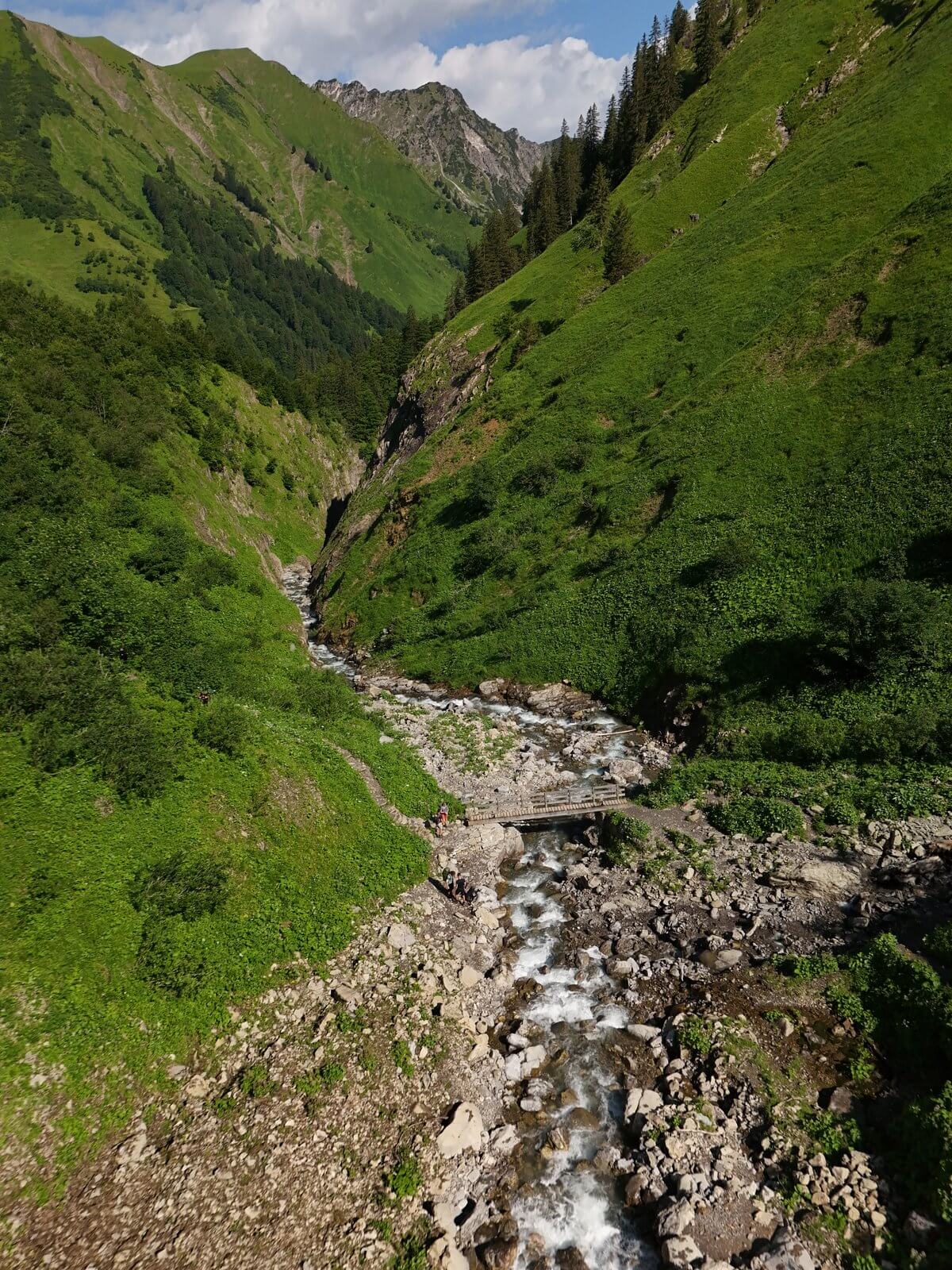
Load More